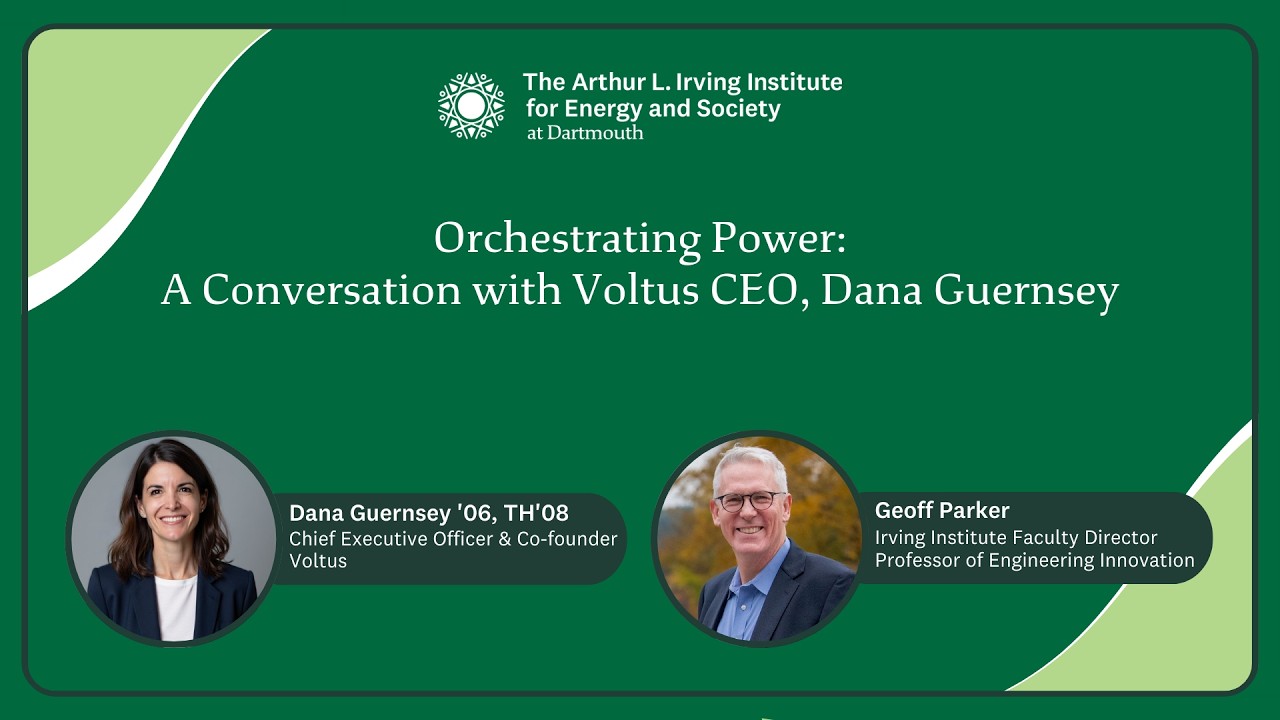
Orchestrating Power: A Conversation with Voltus CEO Dana Guernsey
Keywords
Summary
173 words
Critical Evaluation
Value of the Information & Strength of the Argument
The video provides valuable insights into the practical application of virtual power plants, particularly the BYOC model and the importance of speed to power. Guernsey’s arguments are coherent and supported by specific examples, such as the 103% performance rate and the comparison to traditional peaker plants. However, the discussion is largely from a company perspective, and the claims are not independently verified. The argumentation is persuasive but could benefit from more critical examination of potential drawbacks or challenges.
Scientific Rigor, Source Quality, Title Accuracy
The conversation is based on the expertise of the CEO and is not heavily sourced. No specific studies or reports are cited, though the description mentions the Irving Institute. The title accurately reflects the content, and the discussion is relevant to the field of energy and environment. The lack of external sources limits the scientific rigor, but the practical insights are valuable.
155 words
Title / Content Match
The title accurately reflects the content: a conversation with the CEO of Voltus about virtual power plants.
Quality & Reliability
7/10
The conversation features an industry expert with deep domain knowledge, providing concrete examples and data points (e.g., 103% performance, 300 GWh). However, it is largely promotional and lacks independent verification or critical examination of claims.
Key Moments
Markers derived by PSI from the transcript: the creator did not define chapters.
- Introduction of Dana Guernsey and explanation of virtual power plants.
- Discussion on the grid's D+ rating and the analogy of physics 101 to quantum mechanics.
- Explanation of how VPPs solve the speed to power problem with five-month average capacity build.
- Introduction of the 'bring your own capacity' (BYOC) model and its distinction from BYOG.
- Types of distributed energy resources enrolled, including EVs, storage, and commercial loads.
- Comparison of VPPs to traditional peaker plants in terms of speed, cost, and reliability.
- Discussion on regulatory challenges and market design improvements.
- The tipping point moment for VPPs, with political attention on grid issues.
Cited Sources
- Irving Institute for Energy and Society — The host institution for the interview, mentioned in the introduction.
Concurring Sources
- U.S. Department of Energy - Virtual Power Plants — The DOE discusses the potential of VPPs to enhance grid reliability and resilience.
Dissenting Sources
- Critique of VPPs in academic literature — Some studies question the scalability and reliability of VPPs compared to traditional generation, but no specific source is cited in the video.
Contribution & Novelties
The video offers a unique perspective on the practical implementation of virtual power plants, particularly the BYOC model and the emphasis on speed to power. It provides real-world examples and performance metrics that are not commonly discussed in academic literature. The discussion also highlights the current policy environment and the potential for VPPs to play a critical role in grid modernization.
Pour aller plus loin :
- Virtual power plant - Wikipedia — Provides a general overview of VPPs and their components.
- Demand response - Wikipedia — Explains the concept of demand response, which is a key component of VPPs.
- Distributed energy resources - Wikipedia — Details the types of DERs that can be aggregated into VPPs.
116 words
Radar Profile
The radar profile shows high scores in information quantity and quality, reflecting the depth of the discussion. The technical level is moderate, suitable for a general audience. Reliability is slightly lower due to the promotional nature and lack of external verification.
💬 No comments were provided for analysis.