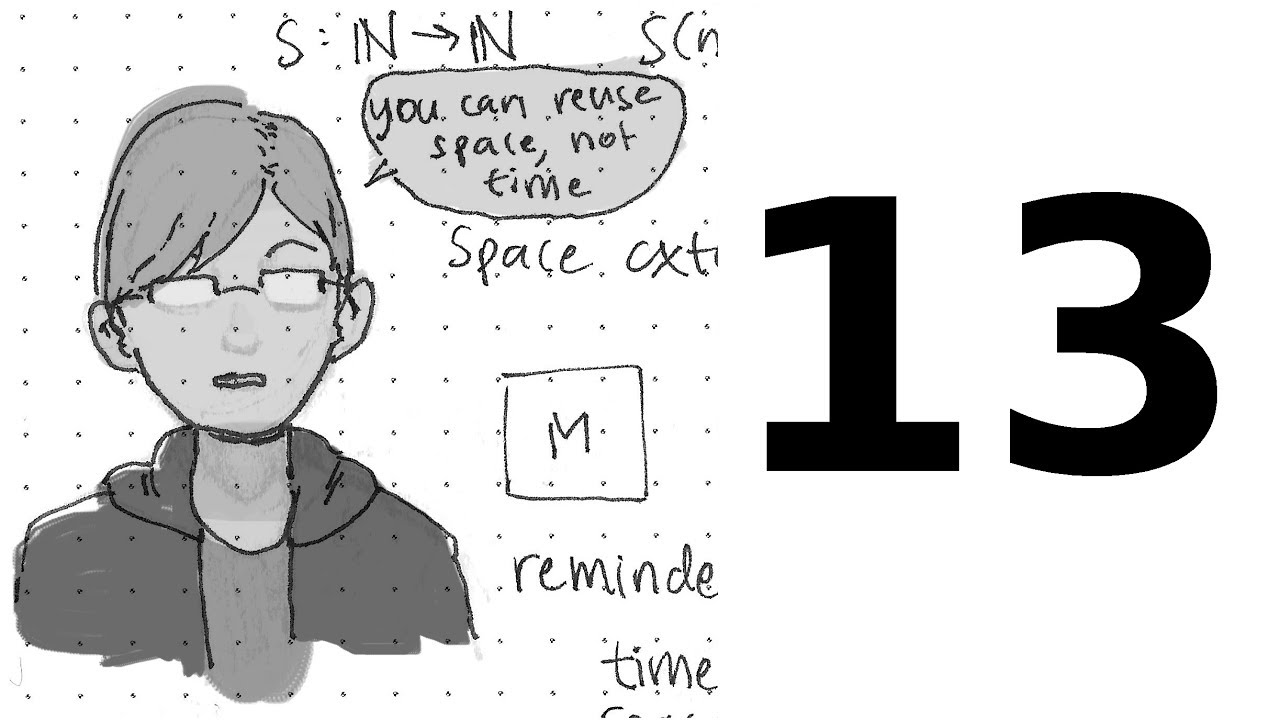
Undergrad Complexity at CMU - Lecture 13: Search-to-Decision, Padding, Dichotomy Theorems
Keywords
Summary
150 words
Critical Evaluation
Value of the Information & Strength of the Argument
The lecture provides valuable insights into fundamental techniques in computational complexity. The search-to-decision reduction is clearly explained with concrete examples (SAT, 3-coloring), illustrating the power of self-reducibility. The padding argument is elegantly presented, showing how to transfer complexity results between different time classes. The discussion of dichotomy theorems is particularly valuable, as it addresses a deep open question in the field. The argumentation is solid, with proofs sketched in a way that is accessible to advanced undergraduates. The lecturer emphasizes the intuition behind each technique, making the material engaging and memorable.
Scientific Rigor, Source Quality, Title Accuracy
The lecture is scientifically rigorous, building on established results such as the Cook-Levin theorem and Ladner’s theorem. The sources cited are the course materials and the lecturer’s own academic page, which are appropriate for a university lecture. The title accurately reflects the content, covering all three main topics. The presentation is well-structured, with clear transitions between topics. The lecturer’s expertise is evident, and the content aligns with standard curriculum in computational complexity.
178 words
Title / Content Match
The title accurately reflects the lecture's content, covering search-to-decision reductions, padding, and dichotomy theorems.
Quality & Reliability
8/10
Lecture by a recognized expert in computational complexity, based on established theoretical results (Cook-Levin theorem, self-reducibility). The content is rigorous and well-structured, though it is a pedagogical exposition rather than new research.
Key Moments
Markers derived by PSI from the transcript: the creator did not define chapters.
- Introduction: overview of remaining topics in the course and motivation for studying complexity measures beyond time.
- Discussion of open questions: fastest algorithm for SAT, average-case complexity, and the possibility of P=NP.
- Search-to-decision reduction for SAT: using a decision oracle to find a satisfying assignment bit by bit.
- Extension to 3-coloring: handling partial colorings and using reductions to the decision problem.
- General theorem: for any NP language with a verifier, search reduces to decision if P=NP.
- Introduction to padding: definition and motivation for creating harder problems.
- Padding argument: showing that if P=NP, then NEXP=EXP.
- Dichotomy theorems: examples of constraint satisfaction problems that are either in P or NP-complete.
- Ladner's theorem: if P≠NP, there are problems in NP that are neither in P nor NP-complete.
- Conclusion and outlook for future lectures.
Cited Sources
- Course Website — Official course page for 15-455, containing lecture notes and assignments.
- Ryan O'Donnell's Homepage — Lecturer's academic page, providing background and publications.
- Panopto — Video platform used to record and host the lecture.
Concurring Sources
- Computational Complexity: A Modern Approach — Standard textbook covering these topics in depth.
- The Complexity Theory Companion — Reference for advanced topics in complexity theory.
Contribution & Novelties
This lecture provides a clear and rigorous exposition of three fundamental techniques in computational complexity: search-to-decision reduction, padding, and dichotomy theorems. It bridges the gap between decision problems and search problems, showing that under P=NP, finding solutions is not harder than deciding existence. The padding argument is elegantly used to prove the collapse of NEXP to EXP under P=NP. The discussion of dichotomy theorems highlights a major open question in the field, with examples from constraint satisfaction. The lecture is particularly valuable for students seeking a deep understanding of these concepts.
Pour aller plus loin :
- Cook-Levin theorem — Foundational result establishing NP-completeness of SAT.
- Self-reducibility — Concept central to search-to-decision reductions.
- Ladner’s theorem — Shows existence of NP-intermediate problems if P≠NP.
- Padding argument — Technique used to transfer complexity results.
- Dichotomy theorem — General concept in computational complexity.
139 words
Radar Profile
The radar profile shows high scores in information quantity, quality, and technical level, indicating a dense and rigorous lecture. The global reliability is also high, reflecting the lecturer's expertise and the solid theoretical foundations. The profile suggests a content that is both informative and technically demanding, suitable for an advanced undergraduate audience.