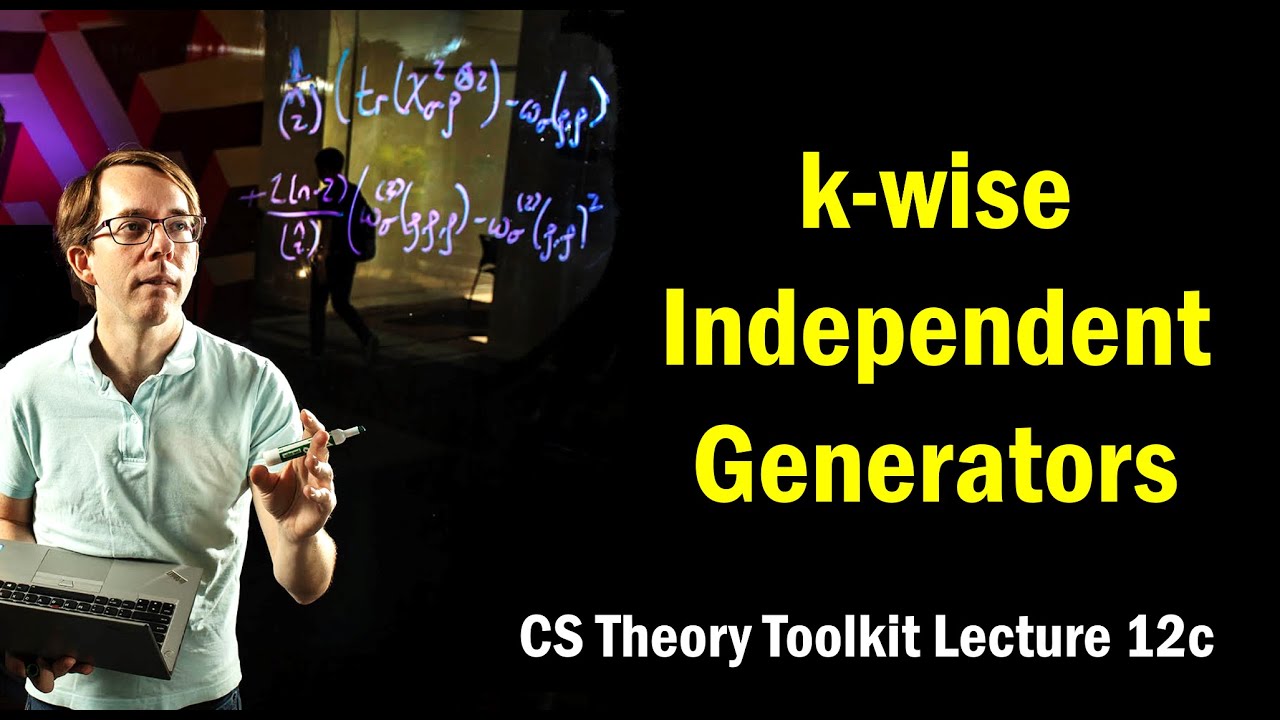
k-wise Independent Generators || @ CMU || Lecture 12c of CS Theory Toolkit
Keywords
Summary
184 words
Critical Evaluation
Value of the Information & Strength of the Argument
The lecture provides a clear and rigorous exposition of k-wise independent generators, a core concept in pseudorandomness. The argumentation is solid: definitions are precise, the theorem is stated with appropriate context, and the proof sketch for the pairwise case is intuitive and correct. The application to Max-Cut effectively illustrates the practical utility of pairwise independence in derandomization. The connection to error-correcting codes is well-motivated and demonstrates a deep understanding of the underlying mathematics. The lecture is valuable for graduate students and researchers in theoretical computer science.
Scientific Rigor, Source Quality, Title Accuracy
The lecture is scientifically rigorous, with careful definitions and proofs. The instructor references standard resources, including van Melkebeek’s lecture notes and Vadhan’s monograph on pseudorandomness, which are reliable and authoritative. The title accurately reflects the content, which focuses on k-wise independent generators and their construction from error-correcting codes. The presentation is well-structured and the arguments are sound.
158 words
Title / Content Match
The title accurately reflects the content, which focuses on k-wise independent generators and their construction from error-correcting codes.
Quality & Reliability
9/10
Lecture from a graduate course at Carnegie Mellon University by a recognized expert in theoretical computer science. The content is mathematically rigorous, with clear definitions, proofs, and references to standard literature. The presentation is well-structured and the arguments are sound.
Key Moments
Markers derived by PSI from the transcript: the creator did not define chapters.
- Introduction to k-wise independence and epsilon bias generators as tools for derandomization.
- Definition of pairwise independence and clarification of the misnomer.
- General definition of k-wise independence and its extension to larger alphabets.
- Theorem on existence of k-wise independent generators with seed length O(k log n), due to Alon, Babai, and Itai.
- Application to Max-Cut: randomized algorithm achieves 1/2-approximation using only pairwise independence.
- Discussion of when pairwise independence suffices in analysis, e.g., Chebyshev's inequality.
- Construction of pairwise independent generator using Hadamard code matrix.
- Proof sketch for pairwise independence using linear independence of columns.
- Generalization: k-wise independence from codes with dual distance > k.
- Use of Reed-Solomon and BCH codes to achieve optimal seed lengths.
Cited Sources
- van Melkebeek's lecture notes for CS880 at UW-Madison — Referenced as a resource for the lecture.
- Vadhan's monograph 'Pseudorandomness' — Referenced as a resource for the lecture.
- Ryan O'Donnell's homepage — Instructor's homepage.
- Course homepage on CMU's Diderot system — Course homepage.
- Panopto — Video platform used for filming.
- Rebecca Kiger Photography — Thumbnail photo credit.
Concurring Sources
- van Melkebeek's lecture notes for CS880 at UW-Madison — Likely covers similar material on pseudorandomness and k-wise independence.
- Vadhan's monograph 'Pseudorandomness' — A comprehensive reference on pseudorandomness, including k-wise independence.
Contribution & Novelties
The lecture provides a clear and rigorous introduction to k-wise independent generators, emphasizing their construction from error-correcting codes. It highlights the practical application in derandomizing algorithms like Max-Cut, and explains the underlying algebraic principles. The connection between linear codes and k-wise independence is a key insight, and the lecture effectively demonstrates how to achieve optimal seed lengths using BCH codes.
Pour aller plus loin :
- Pseudorandomness — Overview of pseudorandomness and related concepts.
- Hadamard code — The code used in the pairwise independent construction.
- Reed-Solomon error correction — A family of codes used to construct k-wise independent generators.
- BCH code — A class of cyclic error-correcting codes that yield optimal seed lengths.
- Derandomization — The broader context of removing randomness from algorithms.
122 words
Radar Profile
The radar profile shows high scores across all dimensions, with particularly strong performance in technical level and reliability, reflecting the advanced and rigorous nature of the lecture. The slightly lower score in information quantity is due to the focused scope of the lecture, which is appropriate for a single session.