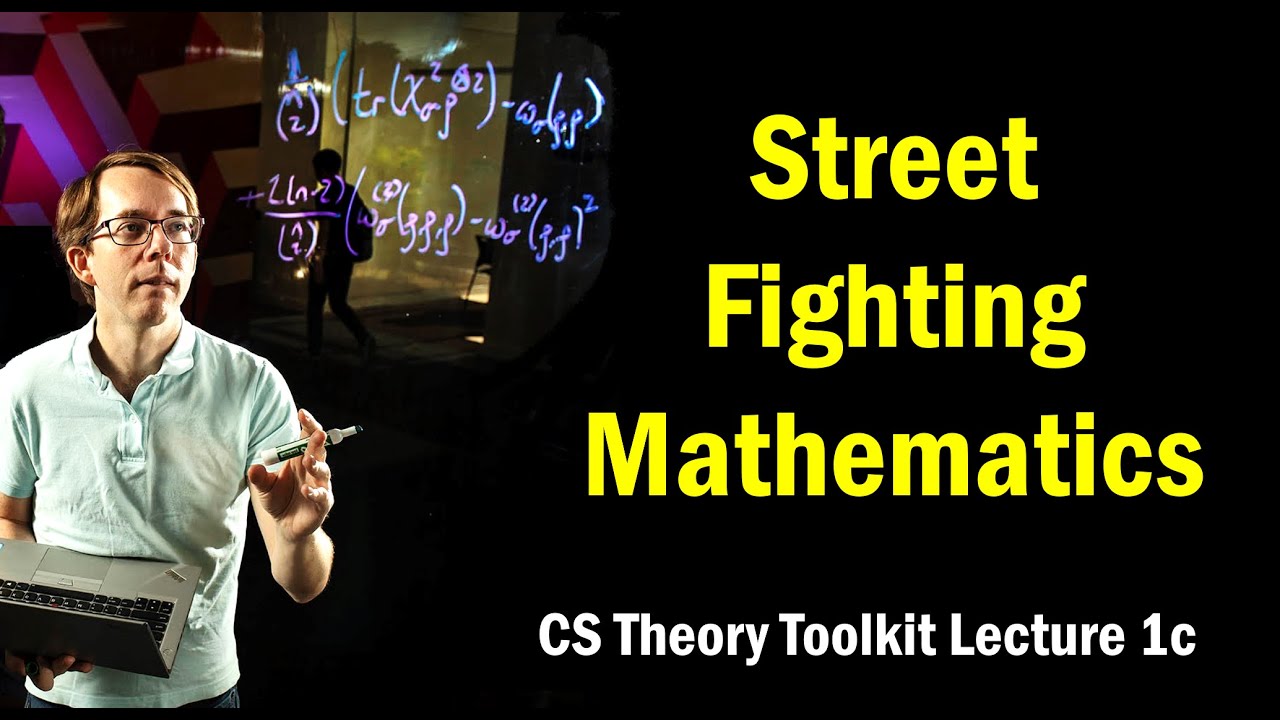
Street Fighting Mathematics || @ CMU || Lecture 1c of TCS Toolkit
Keywords
Summary
152 words
Critical Evaluation
Value of the Information & Strength of the Argument
The lecture provides valuable practical advice for researchers, emphasizing the importance of using computational tools and online resources to accelerate problem solving. The argumentation is persuasive, as O’Donnell demonstrates the effectiveness of these methods through a concrete example, showing how a seemingly difficult problem can be tackled with a combination of experimentation and pattern recognition. He also addresses potential objections, such as the concern that these methods are not rigorous, by explaining that they are meant for initial exploration and can be followed up with formal proofs.
96 words
Title / Content Match
The title accurately reflects the content: a lecture on 'street fighting mathematics' techniques for solving research problems.
Quality & Reliability
8/10
Lecture by a renowned TCS professor at CMU, with practical advice and a worked example. The content is well-structured and based on personal experience, but it is not a formal scientific study.
Key Moments
Markers derived by PSI from the transcript: the creator did not define chapters.
- Introduction to 'Street Fighting Mathematics' and the attitude for research.
- Use of OEIS to identify sequences.
- Use of Wikipedia for math concepts.
- Anecdote about John Feldman and the inverse symbolic calculator.
- Example of Ryan Williams' theorem and using the inverse symbolic calculator.
- Use of MathOverflow for research-level questions.
- Recommendation to use Mathematica or Maple for symbolic computation.
- Start of the worked example: bounding the derivative of a polynomial.
- Setting up the linear program and using Maple to solve it.
- Results for degrees 1 to 6 and pattern recognition.
- Conjecture and identification with Chebyshev polynomials.
- Finding the reference in Rivlin's book and concluding remarks.
Cited Sources
- The Nature of Computation — Recommended as a good overview book for TCS researchers.
- Mathematics and Computation — Recommended as a good overview book for TCS researchers.
- Ryan O'Donnell's homepage — Instructor's homepage.
- Course homepage on Diderot — Course materials and information.
- Panopto — Video recording platform.
- Rebecca Kiger Photography — Thumbnail photo credit.
Concurring Sources
- The Nature of Computation — Recommended as a good overview book for TCS researchers.
- Mathematics and Computation — Recommended as a good overview book for TCS researchers.
Contribution & Novelties
The lecture offers a unique perspective on mathematical research methodology, emphasizing the use of computational tools and online resources to accelerate problem solving. It provides a concrete example that illustrates the entire process, from initial experimentation to final proof. This approach is not commonly taught in formal education and is valuable for aspiring researchers.
Pour aller plus loin :
- Online Encyclopedia of Integer Sequences (OEIS) — Essential tool for identifying sequences.
- MathOverflow — Q&A site for research-level mathematics.
- Chebyshev polynomials — The extremal polynomials identified in the example.
- Theodor Rivlin, Chebyshev Polynomials — Reference for the theorem used.
98 words
Radar Profile
The radar profile shows high scores in quality of information and reliability, with moderate scores in quantity and technical level. This indicates a lecture that is well-structured and trustworthy, but not extremely dense in content or highly technical.