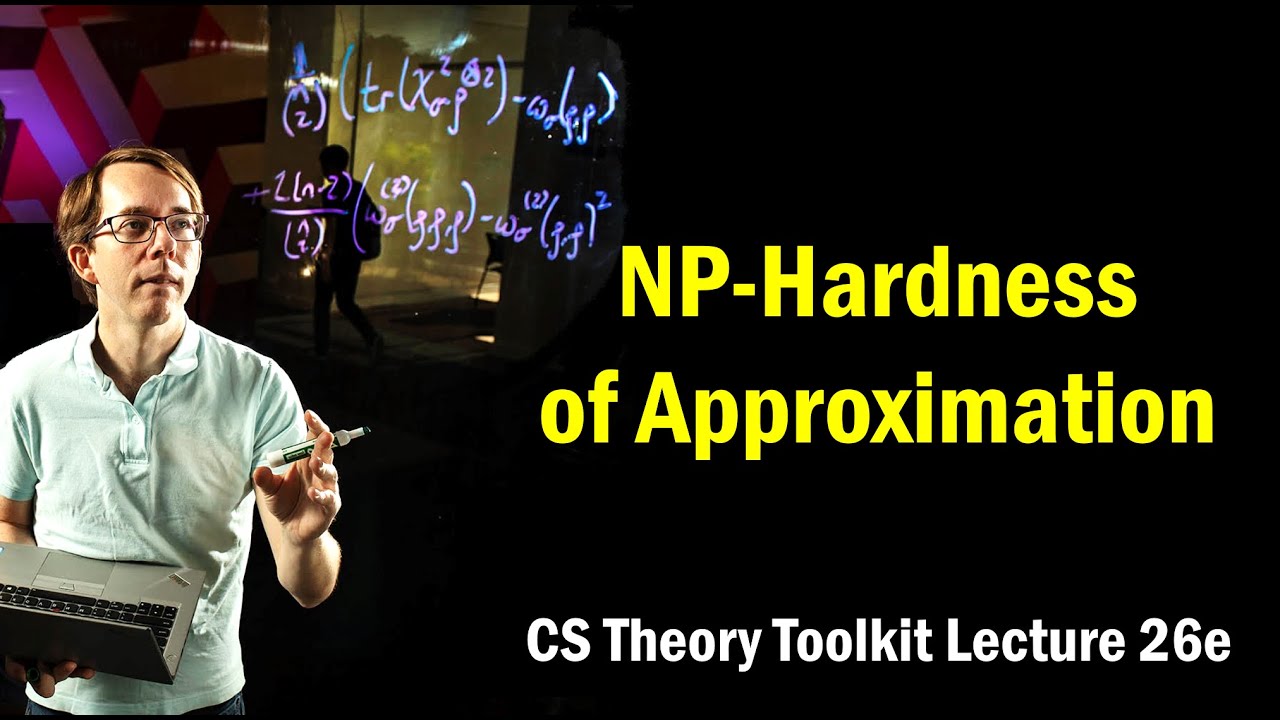
NP-Hardness of Approximation || @ CMU || Lecture 26e of CS Theory Toolkit
Keywords
Summary
164 words
Critical Evaluation
Value of the Information & Strength of the Argument
The lecture provides a high-level overview of key results in hardness of approximation, emphasizing the central role of Label Cover and the Unique Games Conjecture. The argumentation is clear and logical, building from the definition of Label Cover to its hardness, then contrasting with Unique Games. The instructor effectively explains the significance of these results and their implications for algorithm design. He also presents open questions and recent developments, giving a balanced view of the field.
Scientific Rigor, Source Quality, Title Accuracy
The lecture is scientifically rigorous, referencing well-established theorems and results. The instructor cites specific papers (Raz 1994, Raz-Moshkovitz 2010, Khot 2002, etc.) and provides context for each. The title accurately reflects the content. The description includes links to the instructor’s homepage and course materials, which are relevant for further study.
141 words
Title / Content Match
The title accurately reflects the content, which focuses on NP-hardness of approximation, specifically Label Cover and Unique Games.
Quality & Reliability
9/10
Lecture by a renowned professor at Carnegie Mellon, based on established theorems (Raz, Raz-Moshkovitz, Khot) and presented with mathematical rigor. The content is up-to-date and includes recent developments (2-to-2 games).
Key Moments
Markers derived by PSI from the transcript: the creator did not define chapters.
- Introduction to NP-hardness of approximation and the role of Label Cover
- Definition of Label Cover and its representation as a bipartite graph
- Raz's parallel repetition theorem and its implications for Label Cover hardness
- Application to Max 3SAT and Max Independent Set hardness
- Introduction to Unique Games and the Unique Games Conjecture
- Consequences of UGC for Max Cut and other problems
- Recent progress on 2-to-2 games and the status of UGC
- Philosophical discussion on the practical hardness of Unique Games
Cited Sources
- Ryan O'Donnell's homepage — Instructor's academic page, providing credentials and further resources.
- Course homepage on Diderot — Course materials and lecture notes for CS Theory Toolkit.
- Rebecca Kiger Photography — Photographer credited for the thumbnail image.
Concurring Sources
- Raz's parallel repetition theorem — The theorem is central to the hardness of Label Cover as discussed.
- Unique Games Conjecture — The conjecture is the main topic of the latter part of the lecture.
Contribution & Novelties
This lecture provides a concise yet comprehensive overview of the state of the art in NP-hardness of approximation, focusing on Label Cover and the Unique Games Conjecture. It highlights the central role of these problems and their implications for algorithm design. The instructor also discusses recent developments, such as the 2-to-2 games result, and offers a balanced perspective on the plausibility of UGC.
Pour aller plus loin :
- Label Cover problem — Wikipedia article providing background and formal definition.
- Parallel repetition theorem — Wikipedia article on the theorem by Raz.
- Unique Games Conjecture — Wikipedia article with details and implications.
- PCP theorem — Wikipedia article on the foundational theorem.
- Max Cut — Wikipedia article on the problem and its approximation.
120 words
Radar Profile
The radar profile shows high scores across all dimensions, indicating a well-balanced and rigorous lecture. The high scores for quantity and quality of information reflect the depth and accuracy of the content, while the high technical level is appropriate for a graduate course. The overall reliability is excellent, given the instructor's expertise and the established nature of the results discussed.