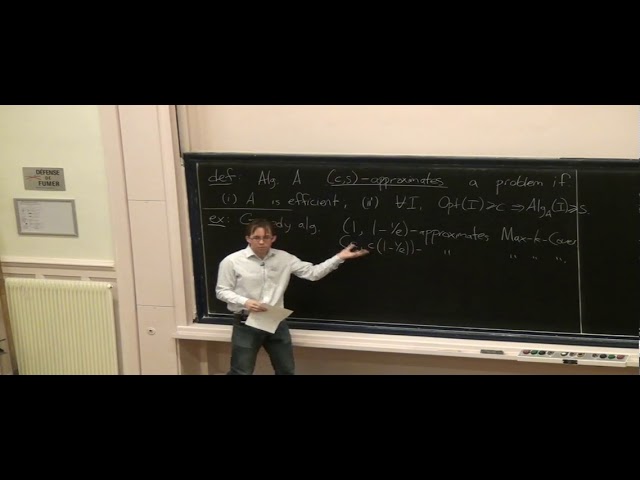
Ryan O'Donnell tutorial on Hardess of Approximation - Part 1
Keywords
Summary
156 words
Critical Evaluation
Value of the Information & Strength of the Argument
The lecture provides a solid foundation for understanding hardness of approximation, clearly explaining the definitions and the significance of approximation ratios. The argumentation is logical and well-structured, moving from algorithmic results to hardness results and the role of reductions. The speaker effectively motivates the study of inapproximability by highlighting the gap between known algorithms and hardness bounds. However, the lecture is primarily definitional and lacks detailed proofs, which is appropriate for an introductory tutorial but limits the depth of argumentation.
Scientific Rigor, Source Quality, Title Accuracy
The lecture is scientifically rigorous, presenting well-established results with appropriate citations to original papers (e.g., Goemans-Williamson for Max Cut, Håstad for Max 3Lin). The title accurately reflects the content, as it is indeed a tutorial on hardness of approximation. The speaker is a leading researcher in the field, adding credibility. No external sources are provided in the description, but the lecture itself references key works.
160 words
Title / Content Match
The title accurately reflects the content: a tutorial on hardness of approximation, focusing on definitions and examples.
Quality & Reliability
8/10
The lecture is given by a recognized expert in computational complexity, presents established results with clear definitions, and avoids unsupported claims. However, it is a tutorial with limited depth and no formal proofs in this part.
Key Moments
Markers derived by PSI from the transcript: the creator did not define chapters.
- Introduction to optimization problems and the concept of approximation.
- Definition of Max Cut, Max 3Lin, Max Independent Set, and Max K-Cover.
- Introduction of C, s-approximation notation and the definition of approximation algorithms.
- Examples of approximation algorithms: greedy for Max K-Cover, trivial for Max 3Lin, SDP for Max Independent Set and Max Cut.
- Statement of hardness results assuming P ≠ NP, including Håstad's result for Max 3Lin.
- Discussion of the Unique Games Conjecture and its implications for stronger inapproximability results.
- Explanation of the reduction framework for proving NP-hardness of approximation, using 3-colorability as an example.
- Outline of how to construct a reduction for Max K-Cover to prove inapproximability.
Cited Sources
- Goemans-Williamson algorithm for Max Cut — Mentioned as an SDP-based algorithm achieving a 0.878 approximation.
- Håstad's result on Max 3Lin — Cited for showing inapproximability of Max 3Lin within 1/2+ε.
- Khot's Unique Games Conjecture — Mentioned as a stronger assumption leading to tight inapproximability results.
Concurring Sources
- Goemans-Williamson algorithm — The lecture's description of the algorithm matches known results.
- Håstad's inapproximability results — The lecture's claims align with published results.
Contribution & Novelties
This tutorial provides a clear and accessible introduction to the field of hardness of approximation, synthesizing key definitions and results. It is valuable for students and researchers new to the area. The lecture does not present new research but serves as a pedagogical overview.
Pour aller plus loin :
- Unique Games Conjecture — Central conjecture in hardness of approximation.
- P versus NP problem — Fundamental assumption underlying all NP-hardness results.
- Semidefinite programming — Technique used in approximation algorithms for Max Cut and other problems.
84 words
Radar Profile
The radar profile shows high scores in quality and reliability, with moderate scores in quantity and technical level, indicating a well-structured but not overly dense lecture. The balance suggests a solid introductory tutorial.