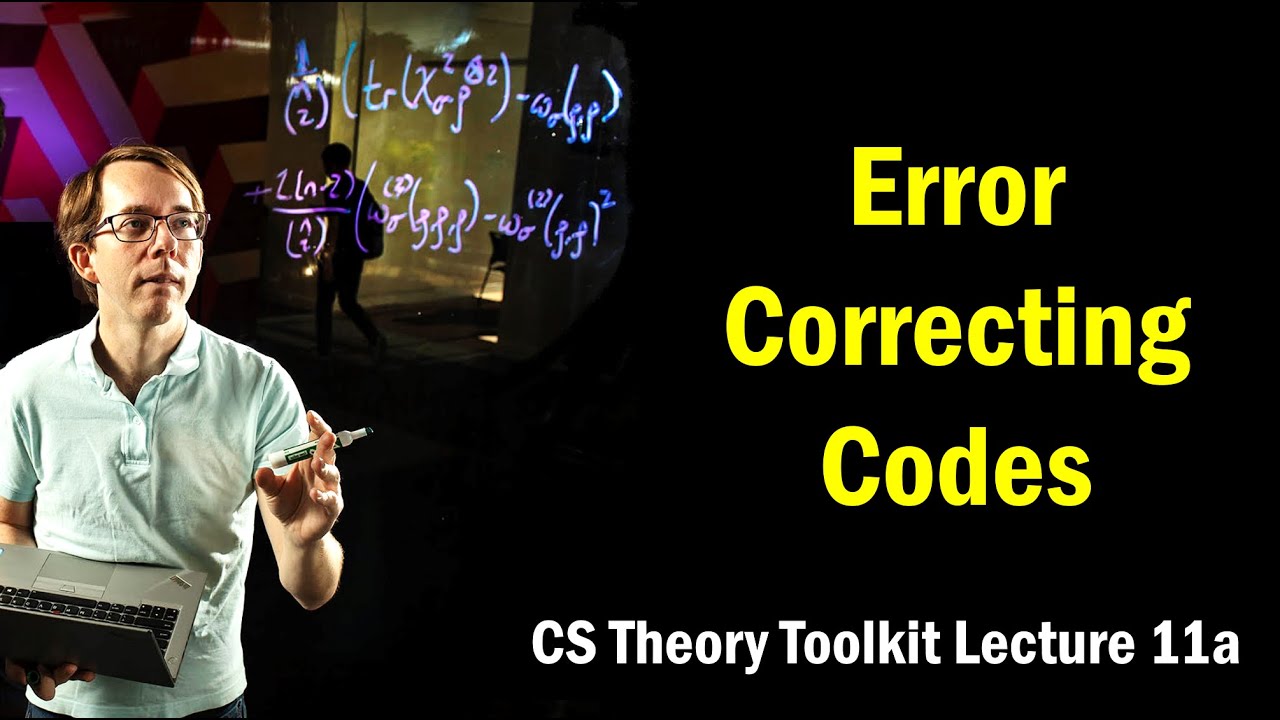
Error Correcting Codes || @ CMU || Lecture 11a of CS Theory Toolkit
Keywords
Summary
179 words
Critical Evaluation
Value of the Information & Strength of the Argument
The lecture provides a clear and rigorous introduction to error correcting codes, emphasizing the worst-case Hamming model. The argumentation is logical and well-structured, building from definitions to the crucial condition for unique decoding. The value lies in its pedagogical clarity and the solid foundation it lays for understanding more advanced topics in coding theory. The speaker effectively uses visual aids (though not shown in transcript) to illustrate concepts like Hamming balls. The discussion of random codes as a potential construction method is insightful, though it only touches on the trade-offs without delving into details.
Scientific Rigor, Source Quality, Title Accuracy
The scientific rigor is high, as the content is standard and well-established in coding theory. The speaker is a professor at CMU, and the lecture is part of a graduate course, indicating expertise. However, no specific sources are cited within the talk itself, and the description only lists general textbooks without URLs. The title accurately reflects the content, being a lecture on error correcting codes within a CS theory course. The description provides links to the instructor’s page and course materials, but these are not direct sources for the content.
199 words
Title / Content Match
The title accurately reflects the content: a lecture on error correcting codes within a CS theory course.
Quality & Reliability
8/10
Lecture by a recognized CMU professor, part of a graduate course, with clear definitions and logical progression. The content is standard and well-established in coding theory, though no specific sources are cited within the talk.
Key Moments
Markers derived by PSI from the transcript: the creator did not define chapters.
- Introduction to error correcting codes and their importance in CS theory.
- Definition of an error correcting code: injective map from messages to codewords.
- Explanation of parameters: rate, block length, and message length.
- Introduction of Hamming distance and minimum distance of a code.
- Discussion of Hamming balls and the condition for unique decoding.
- Derivation of the error correction capability: t <= (d-1)/2.
- Mention of random codes as a combinatorial construction method.
- Discussion of algorithmic challenges with random codes.
- Conclusion and outlook for future lectures.
Cited Sources
- Ryan O'Donnell's homepage — Instructor's academic page, providing credibility.
- Course homepage on Diderot — Course materials and resources for the CS Theory Toolkit course.
- Panopto — Video platform used for recording the lecture.
- Rebecca Kiger Photography — Photographer credited for the thumbnail image.
Concurring Sources
- Error detection and correction - Wikipedia — General overview of error correction concepts, consistent with the lecture.
- Coding theory - Wikipedia — Broader context of coding theory, aligning with the lecture's scope.
Contribution & Novelties
This lecture provides a concise and accessible introduction to error correcting codes, focusing on the worst-case Hamming model. It effectively bridges the gap between abstract definitions and the geometric intuition of Hamming balls. The lecture’s contribution lies in its pedagogical clarity, making it a valuable resource for students new to coding theory. It also sets the stage for more advanced topics such as efficient encoding/decoding algorithms and specific code families.
Pour aller plus loin :
- Hamming distance — Fundamental metric in coding theory.
- Error correction and detection — Overview of error correction methods.
- Linear code — Important class of codes with algebraic structure.
- Reed–Solomon error correction — Widely used code based on polynomials.
113 words
Radar Profile
The radar profile shows high scores in quality and reliability, with moderate scores in quantity and technical depth. This indicates a lecture that is well-presented and accurate, but with limited breadth and depth, suitable for an introductory audience.
💬 No comments were provided for analysis.