Spring 2015 Lecture 18 Probability 2
Keywords
Summary
140 words
Critical Evaluation
Value of the Information & Strength of the Argument
The lecture provides a solid foundation in probability theory, with clear definitions and intuitive explanations. The instructor uses multiple examples and analogies to programming, making abstract concepts accessible. The argumentation is rigorous, with proofs for key results like linearity of expectation. The value lies in its pedagogical clarity and the emphasis on practical problem-solving techniques.
Scientific Rigor, Source Quality, Title Accuracy
The scientific rigor is high, as the content is standard probability theory taught at university level. The instructor does not cite external sources, but the material is well-established. The title accurately describes the content, as it is a lecture on probability. No comments were provided, so no analysis of public reception is possible.
123 words
Title / Content Match
The title accurately reflects the content: a lecture on probability, part of a series.
Quality & Reliability
8/10
Lecture by a university professor (Ryan O'Donnell, CMU) covering standard probability theory. The content is mathematically rigorous, definitions and proofs are clear. No external sources cited, but the material is well-established.
Key Moments
Markers derived by PSI from the transcript: the creator did not define chapters.
- Introduction and recap of previous lecture on probability basics.
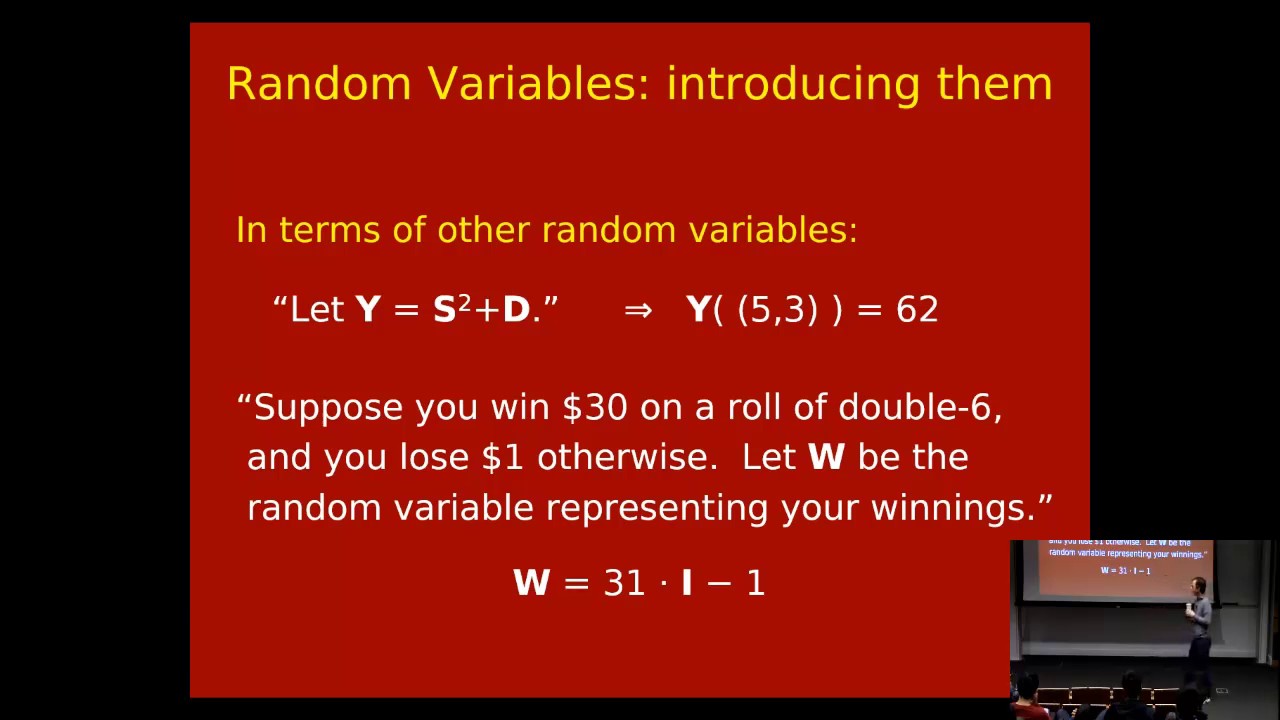
- Definition of random variables as variables in randomized code.
- Example with rolling two dice, defining random variables S and I.
- Random variables as functions from sample space to real numbers.
- Introduction of indicator random variables.
- Definition of independence for random variables.
- Definition of expectation (expected value) and its intuitive meaning.
- Example: expectation of a single die roll.
- Example: expectation of winnings in a dice game.
- Linearity of expectation: statement and proof.
- Application: expectation of sum of two dice using linearity.
- Expectation of indicator random variable equals probability of event.
- Combining linearity of expectation and indicator variables as a method.
- Introduction of the problem: expected number of students getting their own midterm back.
Contribution & Novelties
This lecture provides a clear and rigorous introduction to random variables and expectation, emphasizing the power of linearity of expectation and indicator variables. The pedagogical approach, using programming analogies, is effective for computer science students. The lecture is part of a course on probability for computer science, so its novelty lies in its tailored presentation for that audience.
Pour aller plus loin :
- Linearity of expectation — Wikipedia article on expected value, including linearity property.
- Indicator function — Wikipedia article on indicator functions, relevant to indicator random variables.
- Random variable — Wikipedia article on random variables, providing formal definitions and properties.
- Probability theory — Wikipedia article on probability theory, for broader context.
112 words
Radar Profile
The radar profile shows high scores in information quantity, quality, and reliability, with a slightly lower technical level, indicating a lecture that is comprehensive and trustworthy but accessible to a broad audience.