Spring 2015 Lecture 17 Probability 1 default
Keywords
Summary
150 words
Critical Evaluation
Value of the Information & Strength of the Argument
The lecture provides a solid foundation in probability theory, uniquely tailored for computer science students. The value lies in its clear pedagogical approach: translating probability problems into code and using probability trees to visualize and compute probabilities. The argumentation is logical and step-by-step, building from simple examples to more complex ones. The historical context adds interest and motivation. The instructor’s explanations are precise, and he anticipates common misconceptions, such as the incorrect addition of probabilities for union events. The use of concrete examples (de Méré’s problems) effectively illustrates the concepts. The argumentation is convincing and well-structured, making the material accessible while maintaining mathematical rigor.
Scientific Rigor, Source Quality, Title Accuracy
The lecture demonstrates high scientific rigor. The mathematical definitions and rules are standard and correctly presented. The historical account of probability’s origins is accurate, though no specific sources are cited. The title accurately reflects the content: a lecture on probability basics. The lecture is part of a known course series by Ryan O’Donnell, a reputable computer science professor, which adds to its credibility. However, the lack of explicit citations or references to external sources is a minor weakness, as viewers cannot verify the historical details or further reading. The content itself is reliable and aligns with established probability theory.
218 words
Title / Content Match
The title accurately reflects the content: a lecture on probability basics, part of a series.
Quality & Reliability
8/10
Lecture by a known academic (Ryan O'Donnell, CMU professor) covering foundational probability theory with a computational perspective. The content is mathematically rigorous, historically accurate, and pedagogically sound. No external sources cited, but the material is standard and well-established.
Key Moments
Markers derived by PSI from the transcript: the creator did not define chapters.
- Introduction to probability lectures and historical origins with Chevalier de Méré.
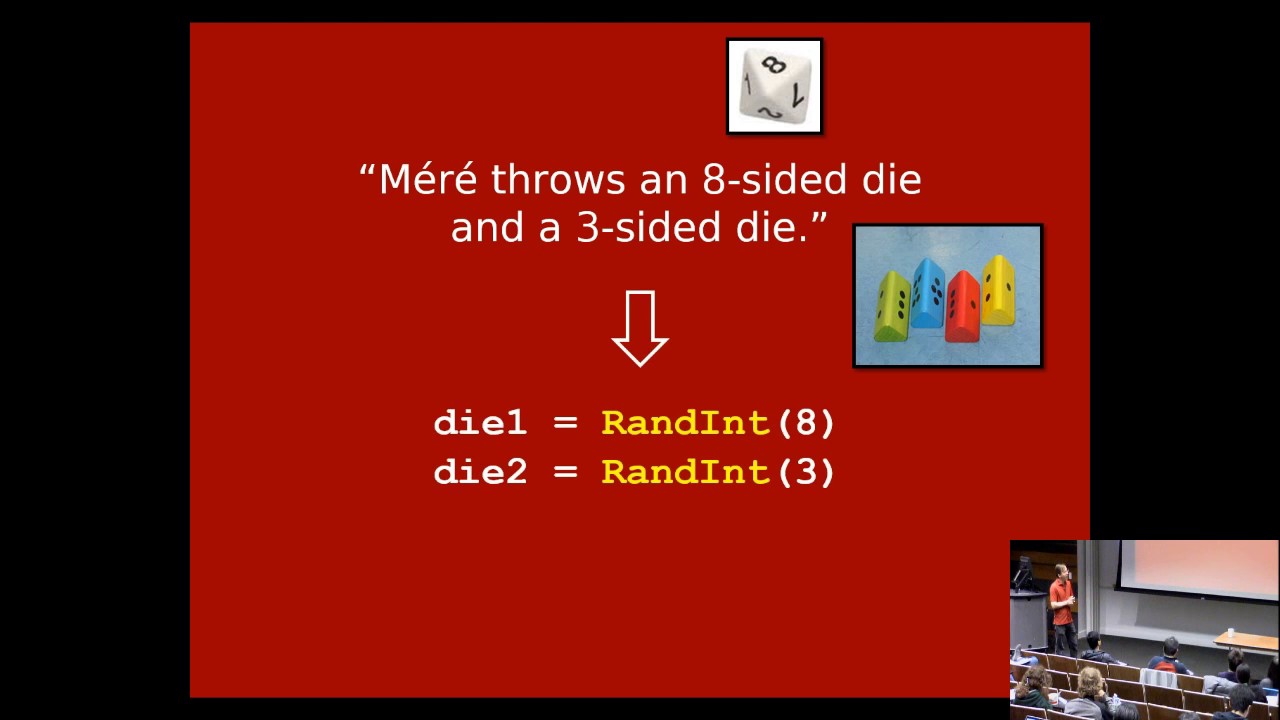
- Translation of probability problems into code with random number generators.
- Introduction of probability trees and definitions of outcomes, sample space, and events.
- Example: computing probability of die roll being 3 or higher using probability tree.
- Solving the problem of points: fair division of stakes when game is interrupted.
- Basic facts about event probabilities: complement, union, and union bound.
- Solving de Méré's first gambling problem: probability of getting at least one 1 in four rolls.
- Solving de Méré's second gambling problem: probability of getting double ones in 24 rolls.
- Discussion of the problem of points and its solution using probability.
- Conclusion and transition to next topics.
Contribution & Novelties
This lecture offers a distinctive computational perspective on probability, framing it as the analysis of randomized code. This approach is particularly valuable for computer science students, as it bridges the gap between abstract probability theory and practical algorithm analysis. The use of probability trees as a visualization tool is a pedagogical innovation that simplifies complex problems. The historical narrative adds depth and motivation.
Pour aller plus loin :
- Probability theory — Foundational concepts and history.
- Randomized algorithm — Direct application of probability in computer science.
- Bernoulli distribution — The Bernoulli random variable introduced in the lecture.
- Problem of points — Historical problem discussed in the lecture.
106 words
Radar Profile
The radar profile shows high scores in information quantity, quality, and technical level, with a slightly lower but still strong reliability score. This indicates a dense, well-presented lecture with solid content, though the lack of cited sources slightly reduces the reliability score.