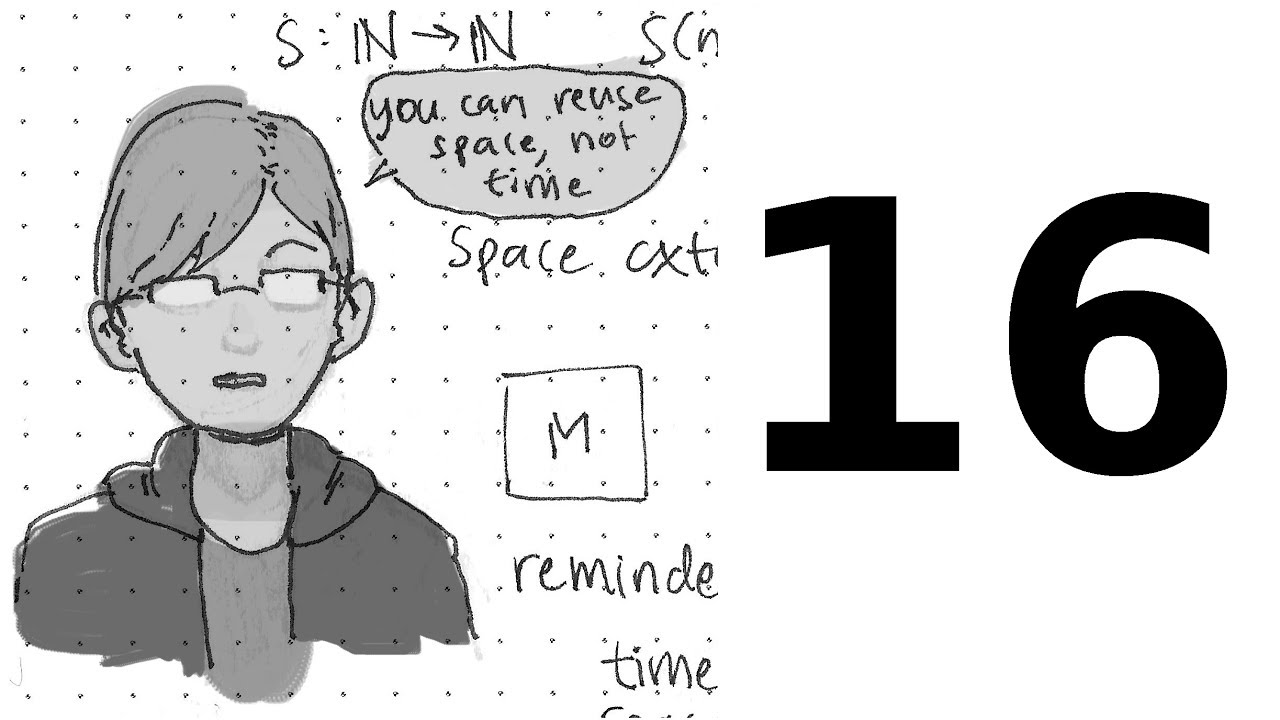
Undergrad Complexity at CMU - Lecture 16: Space Complexity
Keywords
Summary
157 words
Critical Evaluation
Value of the Information & Strength of the Argument
The lecture provides a solid foundation in space complexity, clearly explaining definitions and motivating the study of logarithmic space. The argumentation is rigorous, with careful attention to the Turing machine model and the distinction between time and space. The examples are well-chosen to illustrate key concepts, and the instructor’s explanations are thorough, making the material accessible while maintaining technical depth. The value lies in the clear pedagogical approach and the emphasis on the practical implications of space usage in algorithms.
Scientific Rigor, Source Quality, Title Accuracy
The lecture is scientifically rigorous, based on standard textbook material (Sipser’s ‘Introduction to the Theory of Computation’). The instructor is a recognized expert in the field, and the content is presented with precision. The title accurately reflects the content, and the lecture is well-structured. The sources cited are the course website and the instructor’s personal page, which are appropriate for a university lecture. The lecture does not rely on external sources but rather on established knowledge in computational complexity.
174 words
Title / Content Match
The title accurately reflects the content: a university lecture on space complexity, part of a series.
Quality & Reliability
9/10
Lecture by a recognized expert in computational complexity, based on standard textbook (Sipser), rigorous definitions and proofs, and clear pedagogical structure.
Key Moments
Markers derived by PSI from the transcript: the creator did not define chapters.
- Introduction to space complexity and its importance.
- Definition of space complexity for Turing machines.
- Introduction of read-only input tape and work tapes.
- Discussion on simulating multi-tape machines with one work tape.
- Definition of the complexity class L (logarithmic space).
- Example: deciding 0^m1^m in log space.
- Example: deciding palindromes in log space.
- Technique for input lookup using counters.
- Mental model for log-space algorithms.
Cited Sources
- Course website — Course materials and syllabus.
- Ryan O'Donnell's homepage — Instructor's academic page.
- Panopto — Video recording platform.
Concurring Sources
- Sipser's Introduction to the Theory of Computation — Standard textbook covering space complexity.
Contribution & Novelties
This lecture provides a clear and rigorous introduction to space complexity, emphasizing the distinction between time and space and the importance of logarithmic space. It offers a mental model for designing log-space algorithms, which is valuable for students. The lecture is part of a well-structured course, and the instructor’s expertise ensures accuracy and depth.
Pour aller plus loin :
- Space complexity (Wikipedia) — Overview of space complexity and related classes.
- L (complexity) (Wikipedia) — Details on the class L and its properties.
- Turing machine (Wikipedia) — Foundational model for computation.
- Sipser’s textbook — Standard reference for computational complexity.
98 words
Radar Profile
The radar profile shows high scores across all dimensions, indicating a well-balanced and comprehensive lecture. The high technical level and information quality are consistent with a university course, and the strong reliability reflects the instructor's expertise.
💬 No comments were provided for analysis.