Spring 2013 Lecture 19 Quantum Computation
Keywords
Summary
180 words
Critical Evaluation
Value of the Information & Strength of the Argument
The lecture provides a solid foundation for understanding quantum computation by first establishing classical reversible and probabilistic computation. The argumentation is clear and logical, building from simple Boolean circuits to reversible gates and then to probabilistic circuits, which naturally leads to the quantum model. The instructor uses concrete examples and step-by-step calculations, making the material accessible. The value lies in the pedagogical approach, which demystifies quantum computation by showing its roots in classical concepts. However, the lecture does not delve into actual quantum algorithms or phenomena, so its value is primarily as an introductory primer.
Scientific Rigor, Source Quality, Title Accuracy
The lecture is scientifically rigorous, presenting established concepts accurately. No external sources are cited, but the content aligns with standard textbooks on quantum computation and reversible logic. The title accurately reflects the content, though the first half is classical. The lecture is well-structured and the explanations are precise. However, the lack of citations may be a minor weakness for those seeking further references.
173 words
Title / Content Match
Title accurately reflects the lecture content on quantum computation, though the first half focuses on classical reversible and probabilistic circuits as prerequisites.
Quality & Reliability
8/10
Lecture by a recognized academic (Ryan O'Donnell, CMU) covering established topics (reversible computation, probabilistic circuits) with clear explanations. No citations provided, but content aligns with standard textbook material.
Key Moments
Markers derived by PSI from the transcript: the creator did not define chapters.
- Introduction and warning about physics knowledge.
- Review of Boolean circuits and universality of NAND.
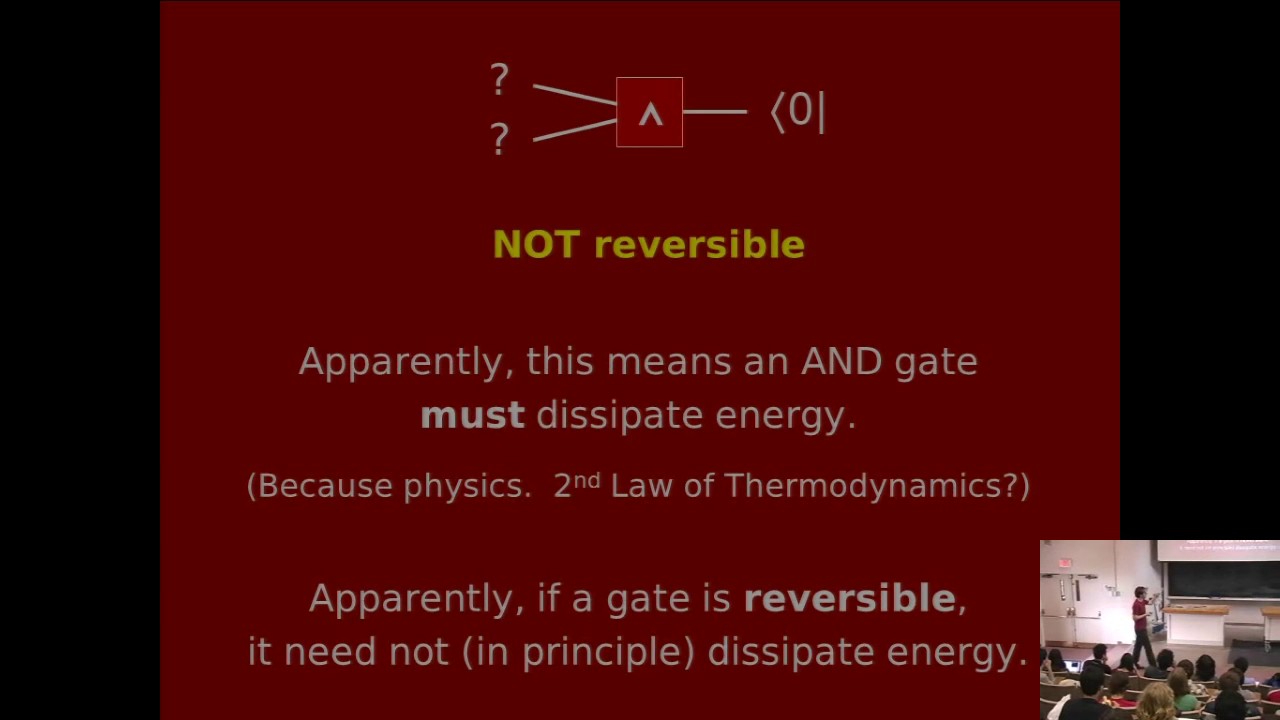
- Introduction to reversible computation and Landauer's principle.
- Demonstration of Toffoli gate as universal for reversible computation.
- Transition to probabilistic circuits and representation as vectors.
- Example of CNOT gate with probabilistic inputs.
- Analysis of a probabilistic circuit with correlated bits.
- Expansion of transition matrices to joint state space.
- Conclusion and transition to quantum computation.
Contribution & Novelties
The lecture provides a clear pedagogical bridge from classical reversible and probabilistic computation to quantum computation, emphasizing that quantum mechanics can be understood without deep physics. It highlights the importance of reversible gates for energy efficiency and the role of probability vectors in analyzing circuits. The approach of expanding transition matrices to capture correlations is a useful technique for understanding quantum superposition.
Pour aller plus loin :
- Quantum computation — Overview of quantum computing concepts.
- Reversible computing — Theoretical foundations and Landauer’s principle.
- Toffoli gate — Universal reversible gate.
- Quantum superposition — Key quantum phenomenon.
95 words
Radar Profile
The radar profile shows high scores in information quantity, quality, and technical level, with a slightly lower score in global reliability due to lack of citations. This indicates a well-structured and informative lecture that is technically sound but may benefit from additional references.