Spring 2013 Lecture 07: Time Complexity
Keywords
Summary
187 words
Critical Evaluation
Value of the Information & Strength of the Argument
The lecture provides high-value foundational knowledge in theoretical computer science. It clearly explains the definitions of problems, instances, algorithms, and running time, using relatable examples and a step-by-step approach. The argumentation is solid: the instructor justifies the need for infinite instances, explains the choice of worst-case analysis, and demonstrates the counting of steps with concrete algorithms. The presentation is logical and builds upon previous lectures, making it an excellent resource for students.
Scientific Rigor, Source Quality, Title Accuracy
The lecture is scientifically rigorous, presenting concepts accurately and citing the historical contribution of Hartmanis and Stearns. The title accurately reflects the content, focusing on time complexity. The instructor uses pseudocode and formal definitions, maintaining a high level of precision. No external sources are cited in the video, but the content is based on established computer science theory. The lecture is part of a well-known course, adding to its credibility.
157 words
Title / Content Match
The title accurately reflects the content: a lecture on time complexity, covering definitions, input size, and running time analysis.
Quality & Reliability
9/10
Lecture by a renowned computer science professor (Ryan O'Donnell) from Carnegie Mellon University, part of a formal course. The content is rigorous, well-structured, and based on established theoretical computer science concepts. The presentation is clear and accurate, with no apparent errors or misleading information.
Key Moments
Markers derived by PSI from the transcript: the creator did not define chapters.
- Introduction with palindrome poem example
- Definition of problems and instances
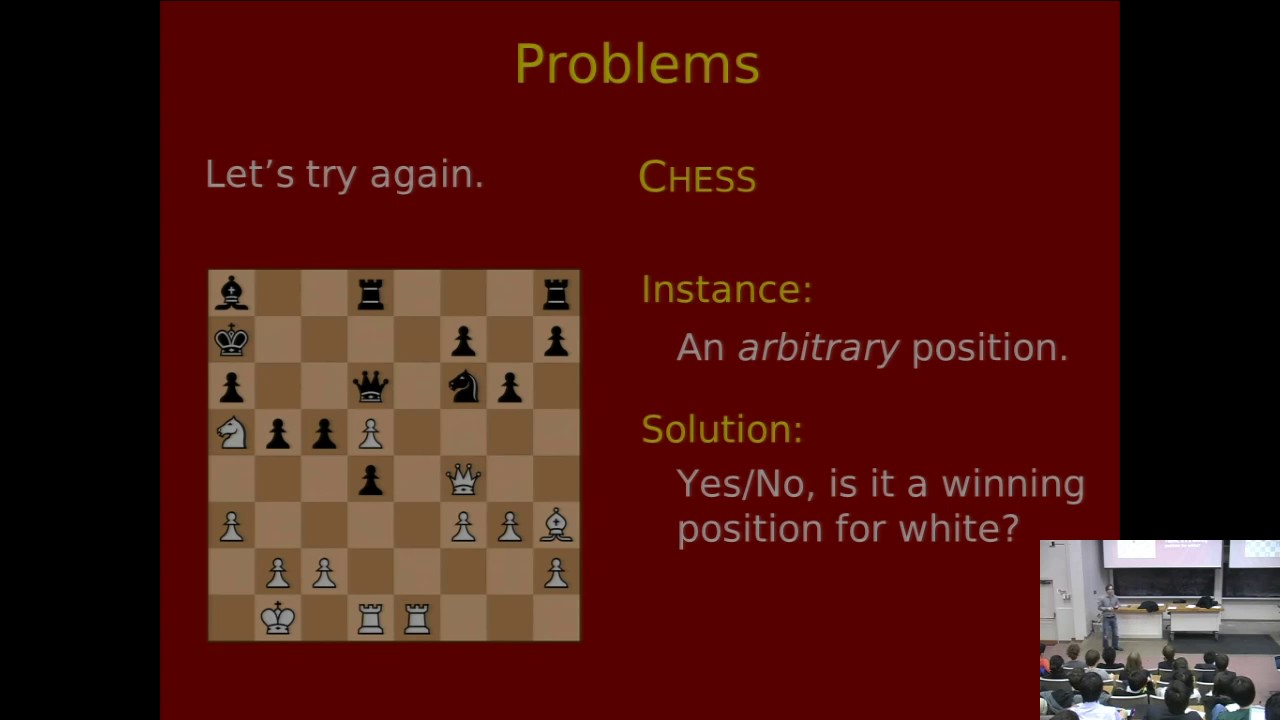
- Discussion on infinite instances and generalized chess
- Introduction to algorithms and solving problems
- Concept of input size and binary representation
- Examples of input size for integers, strings, and graphs
- Running time as a function of input size
- Worst-case analysis and its importance
- Example: two-finger palindrome test step counting
- Closest pair problem and brute-force algorithm
Contribution & Novelties
This lecture provides a clear and accessible introduction to time complexity, emphasizing the importance of worst-case analysis and input size. It is particularly effective in using concrete examples to illustrate abstract concepts. The lecture is part of a broader course, but this segment stands alone as a primer on computational complexity.
Pour aller plus loin :
- Time complexity — Wikipedia article providing an overview of time complexity and related notations.
- Big O notation — Wikipedia article explaining Big O notation, essential for analyzing algorithm efficiency.
- Computational complexity theory — Wikipedia article on the field that studies the resources required to solve computational problems.
- Hartmanis–Stearns conjecture — Wikipedia article on the conjecture related to the founders of computational complexity theory.
119 words
Radar Profile
The radar profile shows high scores in information quality and quantity, with slightly lower but still strong scores in technical level and reliability. This indicates a lecture that is both informative and rigorous, suitable for an academic audience.