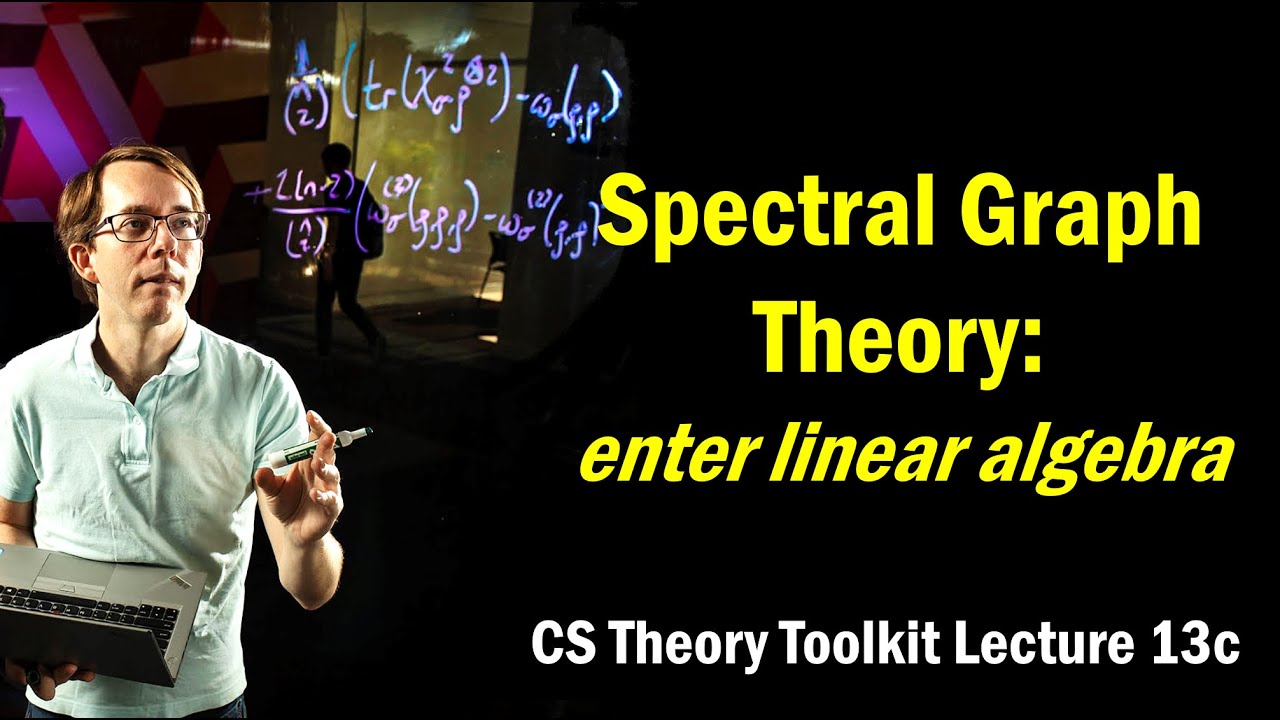
Spectral Graph Theory: Enter Linear Algebra || @ CMU || Lecture 13c of CS Theory Toolkit
Keywords
Summary
179 words
Critical Evaluation
Value of the Information & Strength of the Argument
The lecture provides a clear and rigorous introduction to the use of linear algebra in spectral graph theory. The instructor carefully motivates the need for a non-standard inner product by considering irregular graphs, and he demonstrates the validity of this inner product by checking the axioms. The argumentation is solid, with step-by-step derivations and intuitive explanations, such as interpreting the quadratic form as local variance. The value lies in building a foundation for understanding expander graphs and random walk convergence, which are central topics in theoretical computer science.
Scientific Rigor, Source Quality, Title Accuracy
The lecture is scientifically rigorous, with precise definitions and proofs. The instructor references the book ‘Spectral and Algebraic Graph Theory’ by Spielman as a resource, which is a reputable source. The title accurately reflects the content, as the lecture indeed marks the entry of linear algebra into the study of spectral graph theory. The presentation is well-structured and appropriate for a graduate-level audience.
166 words
Title / Content Match
The title accurately reflects the content: the lecture introduces linear algebra concepts (inner products, variance) in the context of spectral graph theory.
Quality & Reliability
8/10
Lecture by a recognized expert in theoretical computer science, part of a graduate course at CMU. The content is mathematically rigorous, with clear definitions and proofs. The presentation is well-structured and pedagogically sound.
Key Moments
Markers derived by PSI from the transcript: the creator did not define chapters.
- Introduction and recap of random walk mixing and quadratic form.
- Definition of mean of a function with respect to stationary distribution.
- Definition of variance and alternative formula using independent copies.
- Comparison of variance (global) and quadratic form (local variance).
- Introduction of the non-standard inner product weighted by stationary distribution.
- Verification that the inner product satisfies the axioms.
- Discussion of notation for squared norm and its connection to volume for indicator functions.
Cited Sources
- Ryan O'Donnell's homepage — Instructor's academic page.
- Course homepage on Diderot — Course materials and resources.
- Rebecca Kiger Photography — Photographer of thumbnail.
Concurring Sources
- Spectral and Algebraic Graph Theory — Book by Spielman, recommended as a resource.
Contribution & Novelties
This lecture provides a clear pedagogical bridge between probability theory and linear algebra in the context of spectral graph theory. It introduces a non-standard inner product that is essential for handling irregular graphs, and it connects the quadratic form to the concept of variance, offering intuitive insights. The lecture is part of a broader course, so its novelty lies in its clarity and accessibility for graduate students.
Pour aller plus loin :
- Spectral graph theory — Overview of the field.
- Expander graphs — Applications of spectral properties.
- Random walk — Basic concept.
- Inner product space — Mathematical background.
98 words
Radar Profile
The radar profile shows high scores in quality, technical level, and reliability, with a slightly lower score in quantity due to the focused scope of the lecture. This indicates a dense, rigorous presentation that may be challenging for beginners but valuable for advanced students.