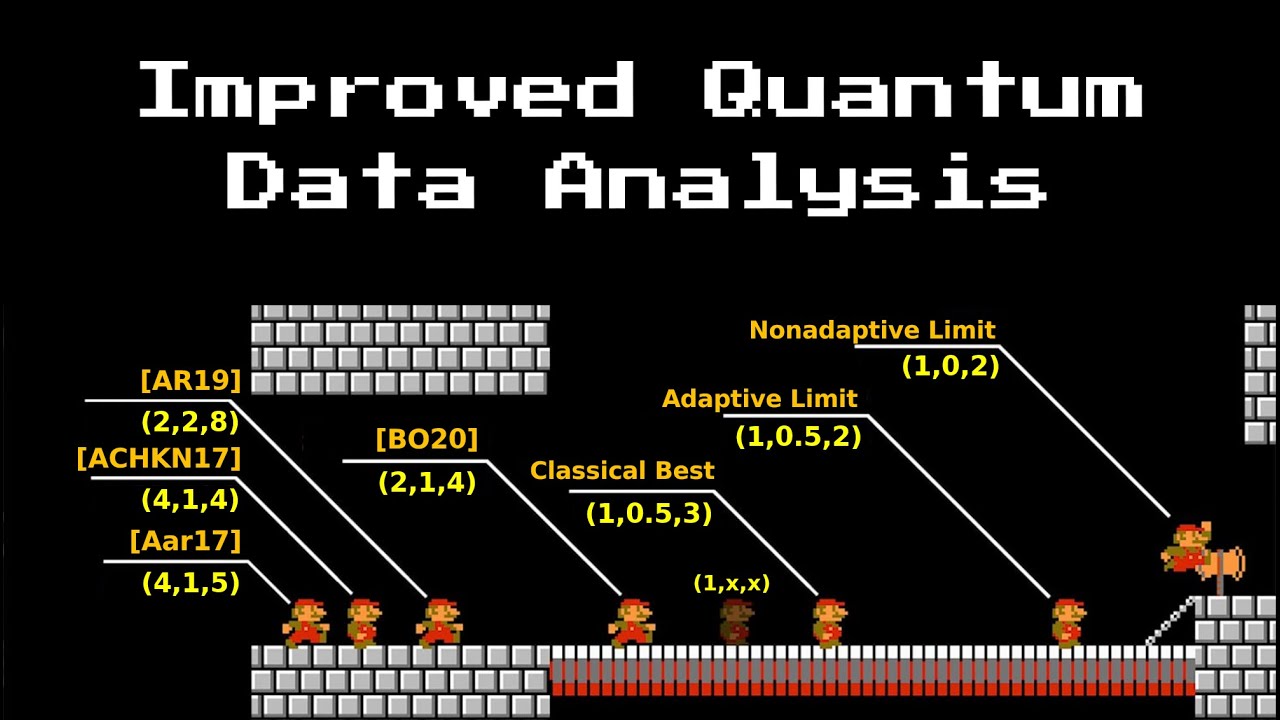
Improved Quantum Data Analysis (Shadow Tomography)
Keywords
Summary
182 words
Critical Evaluation
Value of the Information & Strength of the Argument
The talk provides a clear and rigorous explanation of the problem and the solution. The speaker motivates the problem well, starting from classical adaptive data analysis and drawing analogies to the quantum setting. The argumentation is solid, with a logical progression from known results to the new contribution. The speaker carefully explains the reduction steps and the intuition behind them, making the technical content accessible to a knowledgeable audience. The value of the information is high, as it presents a significant improvement in sample complexity for an important problem in quantum learning theory.
Scientific Rigor, Source Quality, Title Accuracy
The talk is based on a specific paper (arXiv:2011.10908) and references prior work appropriately. The speaker cites the original papers on adaptive data analysis and shadow tomography, and acknowledges the contributions of other researchers. The title accurately reflects the content. The talk is rigorous in its technical claims, though as a presentation, it omits some proofs and details. The speaker also mentions connections to differential privacy, which is a relevant and well-established field.
181 words
Title / Content Match
The title accurately reflects the content: the talk presents improved algorithms for quantum shadow tomography, a form of quantum data analysis.
Quality & Reliability
8/10
The talk presents original research results from a peer-reviewed paper (arXiv:2011.10908), with clear technical explanations and references to prior work. The speaker is a recognized researcher in theoretical computer science. However, the presentation is a talk, not a formal publication, and some details are simplified.
Key Moments
Markers derived by PSI from the transcript: the creator did not define chapters.
- Introduction: analogy between video game second quests and quantum versions of classical problems.
- Classical data analysis: estimating probability of an event from samples.
- Adaptive data analysis: the problem of p-hacking and the need for fresh samples.
- Classical solution via differential privacy: adding noise to estimates.
- Quantum shadow tomography: problem definition and warm-up.
- Adaptive shadow tomography: the main problem studied.
- Overview of known results and the new result.
- Reduction to quantum threshold search via mistake-bounded learning.
- Reduction to stable threshold decision and the final algorithm.
- Discussion of contributions and connections to prior work.
Cited Sources
- Improved Quantum Data Analysis (Shadow Tomography) — The paper presenting the main result of the talk.
- Costin Bădescu's website — Co-author of the paper.
Concurring Sources
- Aaronson's paper on shadow tomography — Introduced the shadow tomography problem.
- Aaronson and Rothblum's paper — Made connections to differential privacy and adaptive data analysis.
External References
Contribution & Novelties
The talk presents a new algorithm for adaptive quantum shadow tomography with improved sample complexity, achieving O(log^2(m) * log(d) / epsilon^4) copies, which matches the best known bounds for all parameters simultaneously. The contribution lies in a clean separation and optimization of three reduction steps, clarifying and improving upon previous work. The talk also highlights the connection between quantum shadow tomography and classical adaptive data analysis, and the role of differential privacy.
Pour aller plus loin :
- Quantum shadow tomography — Provides background on quantum state tomography and related concepts.
- Adaptive data analysis — Overview of the classical problem and its solutions.
- Differential privacy — The privacy framework used in the classical solution.
113 words
Radar Profile
The radar profile shows high scores in quantity of information, technical level, and global reliability, indicating a dense and rigorous technical talk. The quality of information is also high, but slightly lower due to the presentation format. The overall profile is consistent with a specialized research talk.
💬 Sur les 0 commentaires analysés, aucune tendance n'est disponible.