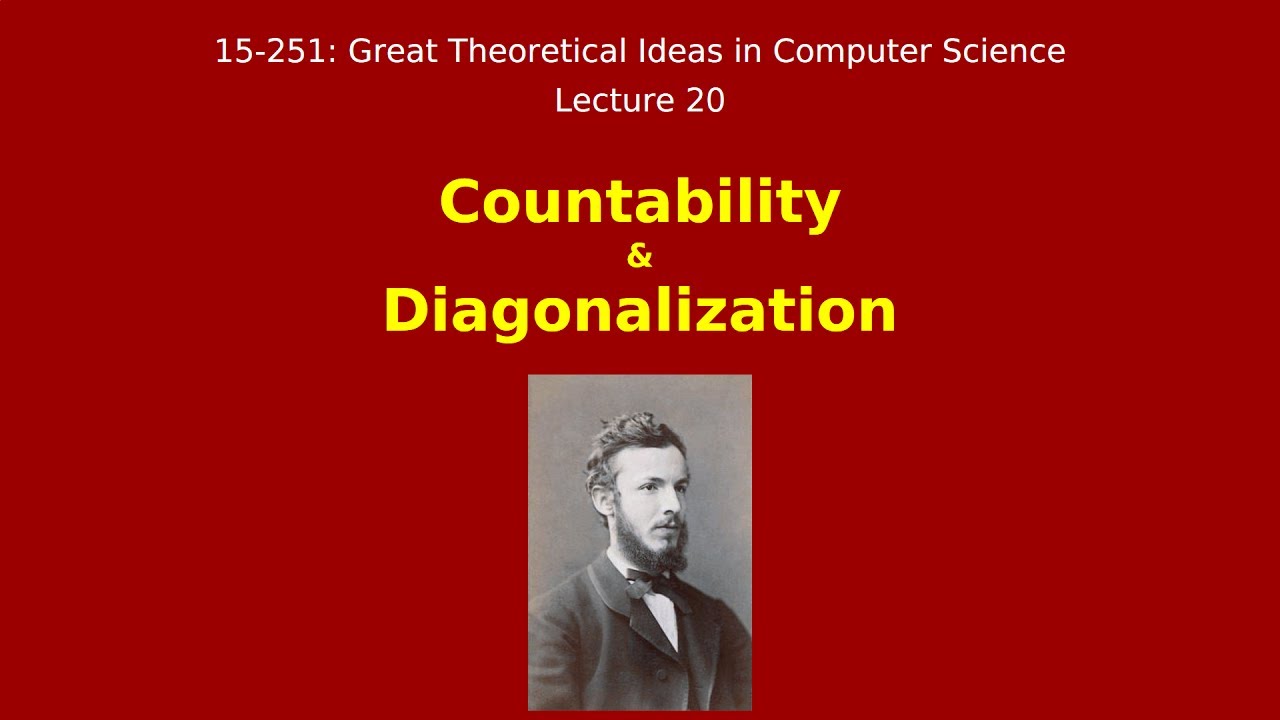
Great Ideas in Theoretical Computer Science: Countability and Diagonalization (Spring 2013)
Keywords
Summary
152 words
Critical Evaluation
Value of the Information & Strength of the Argument
The lecture provides a clear and rigorous introduction to fundamental concepts in set theory and computability. The argumentation is solid, with each step carefully explained and justified. The use of historical context and examples enhances understanding. The diagonalization proof is presented in a compelling and accessible manner, highlighting its power and significance.
Scientific Rigor, Source Quality, Title Accuracy
The lecture is scientifically rigorous, with precise definitions and proofs. The sources cited are the course website and the professor’s personal page, which are appropriate for the context. The title accurately reflects the content. The lecture is well-structured and the presentation is clear.
110 words
Title / Content Match
The title accurately describes the content: a lecture on countability and diagonalization in theoretical computer science.
Quality & Reliability
9/10
Lecture by a CMU professor, part of a well-known course, mathematically rigorous, clear definitions and proofs, historical context accurate.
Key Moments
Markers derived by PSI from the transcript: the creator did not define chapters.
- Introduction to the lecture topic and historical context with Galileo.
- Definition of cardinality and bijection.
- Examples of countably infinite sets: evens, integers, primes.
- Proof that the rationals are countable.
- Introduction to diagonalization and proof that the reals are uncountable.
- Discussion of implications for computability and the halting problem.
- Conclusion and summary of key ideas.
Cited Sources
- CMU 15-251 Course Website — Course materials and information.
- Ryan O'Donnell's Homepage — Professor's personal page.
- Panopto — Video recording platform used for the lecture.
Concurring Sources
- Cantor's theorem — The theorem that the power set of a set has larger cardinality, proven via diagonalization.
Contribution & Novelties
The lecture provides a clear and engaging introduction to countability and diagonalization, making these abstract concepts accessible. It connects historical ideas (Galileo) to modern theoretical computer science. The presentation of the diagonalization argument is particularly effective.
Pour aller plus loin :
- Cantor’s diagonal argument — The core proof technique introduced in the lecture.
- Countable set — Formal definition and properties.
- Halting problem — A key undecidable problem, often proved via diagonalization.
71 words
Radar Profile
The radar profile shows high scores in information quantity, quality, and technical level, with a slightly lower but still high score in reliability. This indicates a dense, rigorous, and well-presented lecture.