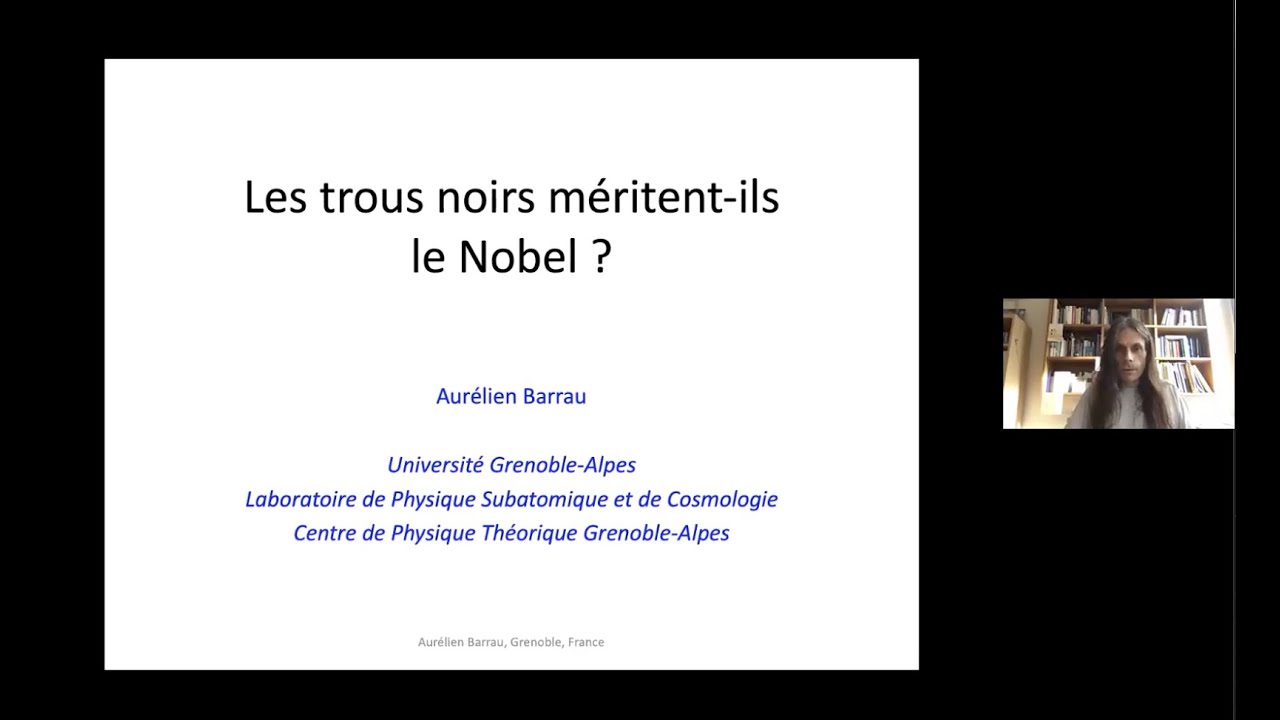
Les trous noirs méritent-ils le prix Nobel ? (Pour physiciens non spécialistes)
Keywords
Summary
157 words
Critical Evaluation
The lecture is a masterful exposition of black hole physics, delivered by an expert with deep knowledge of the subject. Barrau’s pedagogical approach is effective: he builds the theory of general relativity from first principles, making it accessible to physicists from other fields. The content is scientifically rigorous, with accurate explanations of the equivalence principle, the metric tensor, and the Einstein equations. He correctly highlights the significance of Penrose’s theorem, which was a key contribution to the 2020 Nobel Prize in Physics. The discussion of singularities is nuanced, distinguishing between space-like and time-like singularities and explaining the conditions under which they are inevitable. Barrau also provides a critical perspective on the Nobel Prize itself, questioning its role in science and society. This adds a philosophical dimension that is thought-provoking, though it may be seen as somewhat tangential to the scientific content. The lecture is well-structured, with clear transitions between topics. However, it is not a peer-reviewed presentation, and some claims are presented without detailed citations. The speaker acknowledges a slip about the Sun’s diameter and a misattribution of the Klein-Gordon equation, which are minor errors. Overall, the lecture is highly informative and intellectually stimulating, making it a valuable resource for physicists and science enthusiasts.
204 words
Title / Content Match
The title is a provocative question that frames the lecture; the content directly addresses whether black holes deserve a Nobel Prize, while also providing a comprehensive overview of black hole physics.
Quality & Reliability
8/10
The speaker is a renowned physicist (Aurélien Barrau) with deep expertise in general relativity and black holes. The content is technically accurate, well-structured, and includes references to key theorems and recent Nobel Prize work. However, it is an opinion-based lecture rather than a peer-reviewed presentation, and some illustrative experiments are not directly attributed.
Key Moments
Markers derived by PSI from the transcript: the creator did not define chapters.
- Introduction: provocative question about whether black holes deserve the Nobel Prize.
- Explanation of the equivalence principle and its implications for general relativity.
- Derivation of the metric tensor and introduction to the Einstein field equations.
- Discussion of the two types of singularities and Penrose's theorem.
- Hawking's extension of singularity theorems to cosmology.
- Reflection on the Nobel Prize and its impact on science.
Cited Sources
- Penrose, R. (1965). Gravitational collapse and space-time singularities. — Referenced as the key theoretical work on singularities in black holes.
- Hawking, S. (1966). The occurrence of singularities in cosmology. — Mentioned as an extension of Penrose's theorem to the cosmological context.
Concurring Sources
- Nobel Prize in Physics 2020 — Official Nobel Prize page confirming the award to Penrose, Ghez, and Genzel.
Contribution & Novelties
The lecture provides a clear and accessible explanation of black hole physics, emphasizing the theoretical foundations and recent Nobel Prize work. It offers a critical perspective on the Nobel Prize system, encouraging reflection on the nature of scientific recognition.
Pour aller plus loin :
- General relativity — Overview of the theory.
- Penrose singularity theorem — Detailed explanation of the theorem.
- Black hole — General information on black holes.
68 words
Radar Profile
The radar profile shows high scores in quantity and quality of information, reflecting the depth and accuracy of the content. The technical level is also high, indicating that the lecture is suitable for an audience with some physics background. The overall reliability is strong, though the opinion-based nature slightly reduces the score.
💬 Sur les 0 commentaires analysés, aucune tendance n'est disponible.