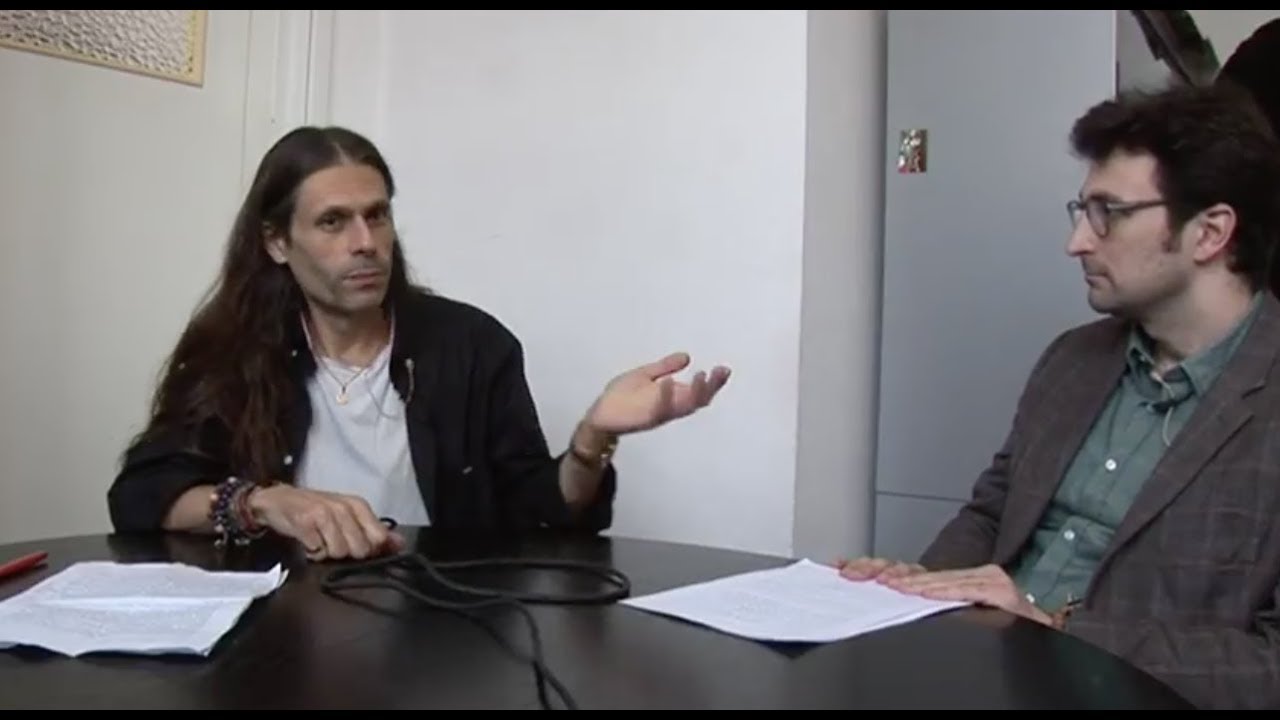
Aurélien Barrau et Cyril Crignon autour des intersections art / science.
Keywords
Summary
144 words
Critical Evaluation
The video presents a thoughtful and nuanced discussion on the relationship between art and science, led by two intellectuals with deep expertise in their respective fields. Aurélien Barrau, a prominent astrophysicist and philosopher, brings a unique perspective as someone who has actively collaborated with artists, notably with filmmaker Claire Denis on the science fiction film ‘High Life’. This practical experience grounds his theoretical reflections, making the conversation both abstract and concrete.
The argumentation is solid: Barrau rejects the simplistic view of art as mere illustration of scientific ideas, and equally rejects the notion that science holds a monopoly on truth. He advocates for a mutual enrichment, where art can provide constraints that challenge scientific frameworks, and science can offer new materials and perspectives for artistic creation. This is a sophisticated position that avoids both scientism and anti-scientific relativism.
The discussion draws on philosophical references such as Nelson Goodman’s constructivism, which posits that different symbolic systems create different ‘worlds’. Barrau uses this to argue that art and science are not in competition but are complementary ways of engaging with reality. He also references the Sokal affair, a significant event in the ‘science wars’, to caution against both the misuse of scientific concepts in the humanities and the dismissal of entire fields as ‘imposture’.
The quality of the sources is high, as Barrau cites his own collaborative projects and well-known philosophical works. However, the conversation is largely based on personal experience and philosophical argument rather than empirical evidence, which is appropriate for a debate on this topic.
The title accurately reflects the content, and the discussion is well-structured, with Crignon guiding the conversation and Barrau providing detailed responses. The video is intellectually stimulating and offers valuable insights for anyone interested in the intersection of art and science.
One minor weakness is that the conversation could have delved deeper into specific examples of how art has influenced science, but overall, it is a rich and engaging dialogue.
324 words
Title / Content Match
The title accurately reflects the content: a conversation between Aurélien Barrau and Cyril Crignon on the intersections between art and science.
Quality & Reliability
8/10
The discussion is led by a renowned astrophysicist and philosopher, Aurélien Barrau, with a philosopher, Cyril Crignon. The content is intellectually rigorous, drawing on philosophical concepts (Goodman, Derrida, Sokal) and personal experience in art-science collaborations. The conversation is well-structured and avoids sensationalism, though it remains a dialogue of opinions rather than a peer-reviewed analysis.
Key Moments
Markers derived by PSI from the transcript: the creator did not define chapters.
- Barrau discusses the role of science as a material for art and the importance of constraints.
- Barrau recounts his collaboration with Claire Denis on the film 'High Life'.
- Discussion on the non-hierarchical relationship between art and science.
- Barrau critiques the sacralization of science and references the Sokal affair.
- Exploration of Nelson Goodman's constructivism and the idea of multiple worlds.
- Barrau emphasizes the importance of mutual respect and the creative potential of interdisciplinary dialogue.
Cited Sources
- High Life (film) — Barrau mentions his collaboration with Claire Denis on this film.
- Nelson Goodman - Ways of Worldmaking — Barrau references Goodman's constructivist philosophy.
- Sokal affair — Barrau discusses the Sokal affair in the context of science wars.
Concurring Sources
- Nelson Goodman - Languages of Art — Goodman's work on symbol systems aligns with Barrau's discussion.
Dissenting Sources
- Sokal affair - criticism — Some critics argue that Sokal's hoax was justified in exposing misuse of scientific concepts, while Barrau suggests it led to an overcorrection.
Contribution & Novelties
The video offers a unique perspective on the art-science intersection, combining Barrau’s personal experience as a scientist involved in artistic projects with a philosophical framework. It challenges common assumptions about the hierarchy between disciplines and proposes a model of mutual enrichment.
Pour aller plus loin :
- Nelson Goodman - Ways of Worldmaking — A key philosophical text on constructivism and symbolic systems.
- Sokal affair — An important event in the science wars, relevant to the discussion of scientific authority.
- Claire Denis - High Life — The film Barrau collaborated on, illustrating a concrete art-science collaboration.
95 words
Radar Profile
The radar profile shows high scores in quality of information and reliability, reflecting the expertise of the speakers and the depth of the discussion. The quantity of information is moderate, as the conversation is focused on a specific topic, and the technical level is high due to the philosophical references.
💬 Sur les 0 commentaires analysés, aucune tendance n'est disponible.