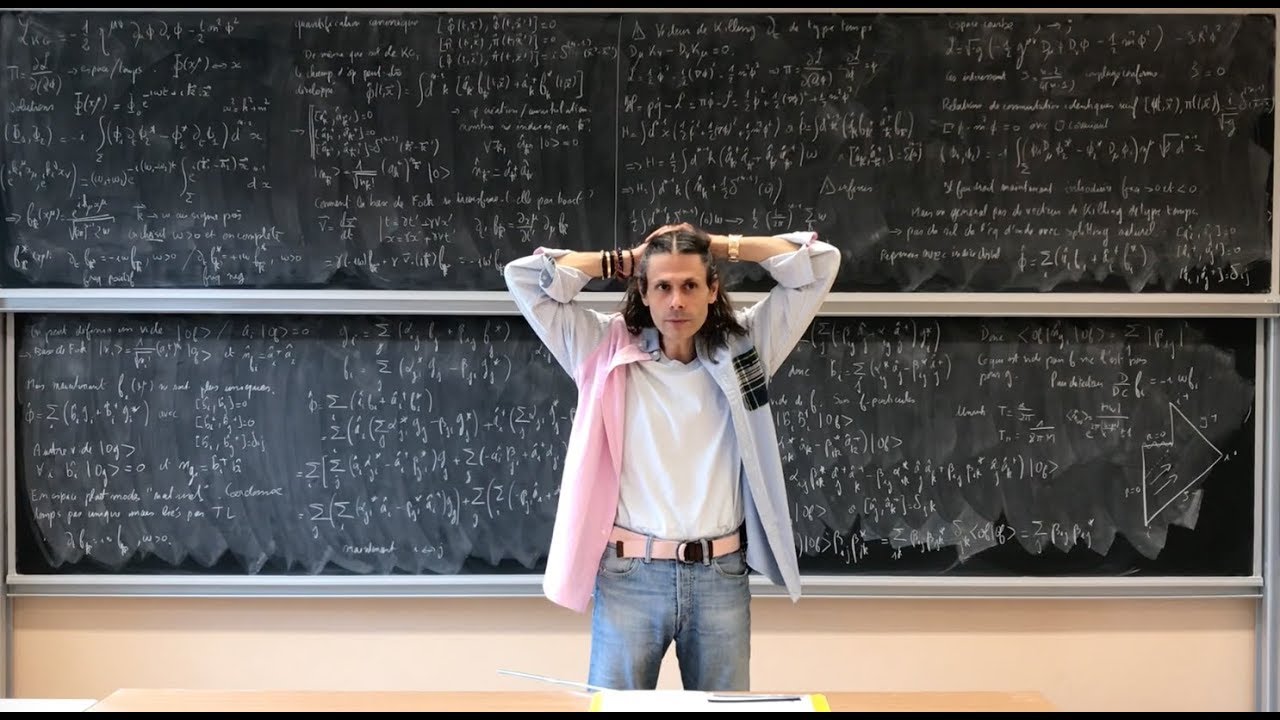
L'existence des particules est-elle relative ? Cours de Master, Aurélien Barrau
Keywords
Summary
194 words
Critical Evaluation
The lecture is an excellent exposition of a subtle and often misunderstood topic in quantum field theory. Aurélien Barrau demonstrates deep pedagogical skill by carefully building the mathematical framework from the Klein-Gordon equation to the canonical quantization, ensuring that the audience understands the role of each step. The central message—that the concept of a particle is observer-dependent—is conveyed with clarity and mathematical precision. The argumentation is rigorous: he shows that the definition of positive and negative frequency modes depends on the choice of time coordinate, and in curved spacetime this choice is not unique, leading to different particle number operators and hence different particle content. He does not shy away from technical details, but he also provides intuitive explanations, such as the analogy with the harmonic oscillator. The sources cited are standard textbooks and papers in the field, and the lecture is consistent with established scientific knowledge. The title is appropriate, as the content indeed addresses the relativity of particle existence. The only minor criticism is that the lecture is quite dense and may be challenging for those without prior knowledge of quantum field theory, but this is expected for a master’s level course. Overall, this is a high-quality educational resource that provides valuable insights into a fundamental aspect of modern physics.
212 words
Title / Content Match
The title accurately reflects the content: the lecture explores the relativity of the concept of particles, a central theme in quantum field theory in curved spacetime.
Quality & Reliability
9/10
The lecture is given by a recognized physicist (Aurélien Barrau, professor at Université Grenoble Alpes and researcher at LPSC), and the content is mathematically rigorous, following standard derivations in quantum field theory in curved spacetime. The presentation is clear and well-structured, with explicit equations and careful explanations. The video is a formal academic lecture, not a popularization, and the scientific content is accurate and up-to-date.
Key Moments
Markers derived by PSI from the transcript: the creator did not define chapters.
- Introduction: the concept of particles is relative, not absolute.
- Review of the Klein-Gordon field: Lagrangian density and equation of motion.
- Hamiltonian formalism and the distinction between field and wavefunction.
- Expansion of the field in plane waves and definition of positive/negative frequency modes.
- Canonical quantization: promotion of fields to operators and commutation relations.
- Definition of creation/annihilation operators and the vacuum state.
- Ambiguity of particle definition in curved spacetime: no preferred time coordinate.
- Introduction to the Unruh effect: accelerated observers see thermal particles.
- Particle creation in expanding universes and cosmological implications.
- Conclusion: particles are not fundamental but emergent from quantum fields.
Cited Sources
- Quantum Fields in Curved Space — Standard reference for quantum field theory in curved spacetime, likely used for the lecture.
- The Unruh effect — Wikipedia article explaining the Unruh effect, mentioned in the lecture.
Concurring Sources
- Quantum Fields in Curved Space — Standard textbook that supports the lecture's content.
Contribution & Novelties
The lecture provides a clear and rigorous introduction to the concept of particles in quantum field theory in curved spacetime, emphasizing the observer-dependence of particle existence. It is particularly valuable for its pedagogical approach, breaking down complex ideas into understandable steps. The discussion of the Unruh effect and particle creation in cosmology highlights the profound implications for our understanding of the universe.
Pour aller plus loin :
- Quantum field theory in curved spacetime - Wikipedia — Overview of the topic.
- Unruh effect - Wikipedia — Detailed explanation of the effect.
- Hawking radiation - Wikipedia — Related phenomenon of particle creation near black holes.
103 words
Radar Profile
The radar profile shows high scores across all dimensions, indicating a well-balanced and comprehensive lecture. The strong performance in technical depth and information quality reflects the rigorous mathematical treatment and the depth of the subject matter.
💬 Sur les 0 commentaires analysés, aucune tendance n'a pu être dégagée.