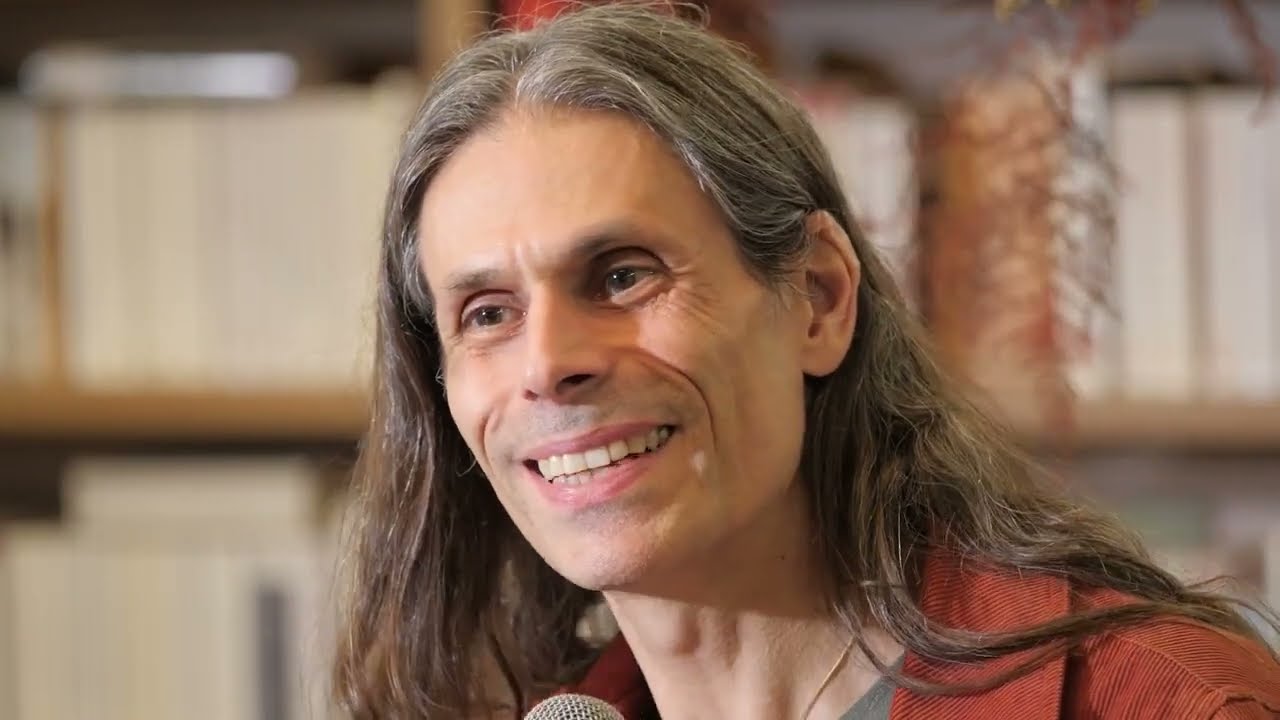
La science face à la catastrophe écologique - Intervention @ Millepages autour de "L'Hypothèse K."
Keywords
Summary
133 words
Critical Evaluation
Aurélien Barrau delivers a passionate and intellectually stimulating critique of modern science and its role in ecological crisis. His argument is rooted in a philosophical tradition that values poetry and ethics alongside rationality. He effectively highlights the dangers of scientific hegemony and the reduction of progress to technological advancement. The talk is well-structured, moving from a critique of science’s autonomy to a call for a more poetic and ethical engagement with the world. Barrau’s use of examples, such as the space conquest, is vivid and provocative, though it may alienate some viewers. His references to Lucretius and Jean-Luc Nancy ground his argument in a rich intellectual heritage. However, the talk is primarily opinion-based, lacking empirical evidence or concrete policy proposals. The adéquation between title and content is strong, as the talk directly addresses the ecological catastrophe and the role of science. Overall, the talk is valuable for its philosophical depth and its challenge to dominant narratives, but it may not satisfy those seeking practical solutions. The public comments (not provided) would likely reflect a mix of admiration and criticism, but without data, we cannot speculate.
185 words
Title / Content Match
The title accurately reflects the content: a talk about science in the face of ecological catastrophe, centered on the book 'L'Hypothèse K.'
Quality & Reliability
8/10
The speaker is a recognized astrophysicist and philosopher, providing a well-articulated critique of technoscience. The content is opinion-based but grounded in philosophical and scientific references. The presentation is coherent and thoughtful, though it lacks empirical data and is inherently subjective.
Key Moments
Markers derived by PSI from the transcript: the creator did not define chapters.
- Introduction by the host, setting the stage for the discussion on science and philosophy.
- Barrau discusses the link between science and poetry, referencing Lucretius' 'De rerum natura'.
- Critique of the political instrumentalization of science, mentioning the French president's plan to make science more competitive.
- Barrau argues that science should not be the sole definer of reality, but one among many ways of knowing.
- Strong critique of space conquest as a symbol of technoscientific hubris and necrophilia.
- Discussion on the need to redefine progress beyond technical advancement, referencing Jacques Ellul and Bernard Charbonneau.
- Call for a 'cosmopoetics' and a re-enchantment of the world through a fusion of science, philosophy, and poetry.
Cited Sources
- L'Hypothèse K. — Barrau's book discussed in the talk.
- De rerum natura — Lucretius' poem referenced as an example of science and poetry intertwined.
Concurring Sources
- L'Hypothèse K. — The book aligns with the talk's arguments.
Dissenting Sources
- Space exploration advocates — Barrau's critique of space conquest may be contested by those who see it as beneficial for science and inspiration.
Contribution & Novelties
Barrau offers a unique perspective by bridging science, philosophy, and poetry, arguing for a ‘cosmopoetics’ that reconnects knowledge with ethical and aesthetic values. He challenges the dominant technoscientific paradigm and calls for a redefinition of progress.
Pour aller plus loin :
- L’Hypothèse K. — The book expands on the talk’s themes.
- De rerum natura — Lucretius’ poem as a foundational text for science and poetry.
- Jacques Ellul — Philosopher who critiqued technique and progress.
- Bernard Charbonneau — Thinker on ecology and technology.
- Jean-Luc Nancy — Philosopher whose work on sense and world resonates with Barrau’s ideas.
96 words
Radar Profile
The radar profile shows high scores in quality of information and fiabilité, reflecting the speaker's expertise and coherent argumentation. The lower score in niveau technique indicates that the talk is accessible to a general audience, while quantite_information is moderate due to the focus on philosophical reflection rather than factual data.