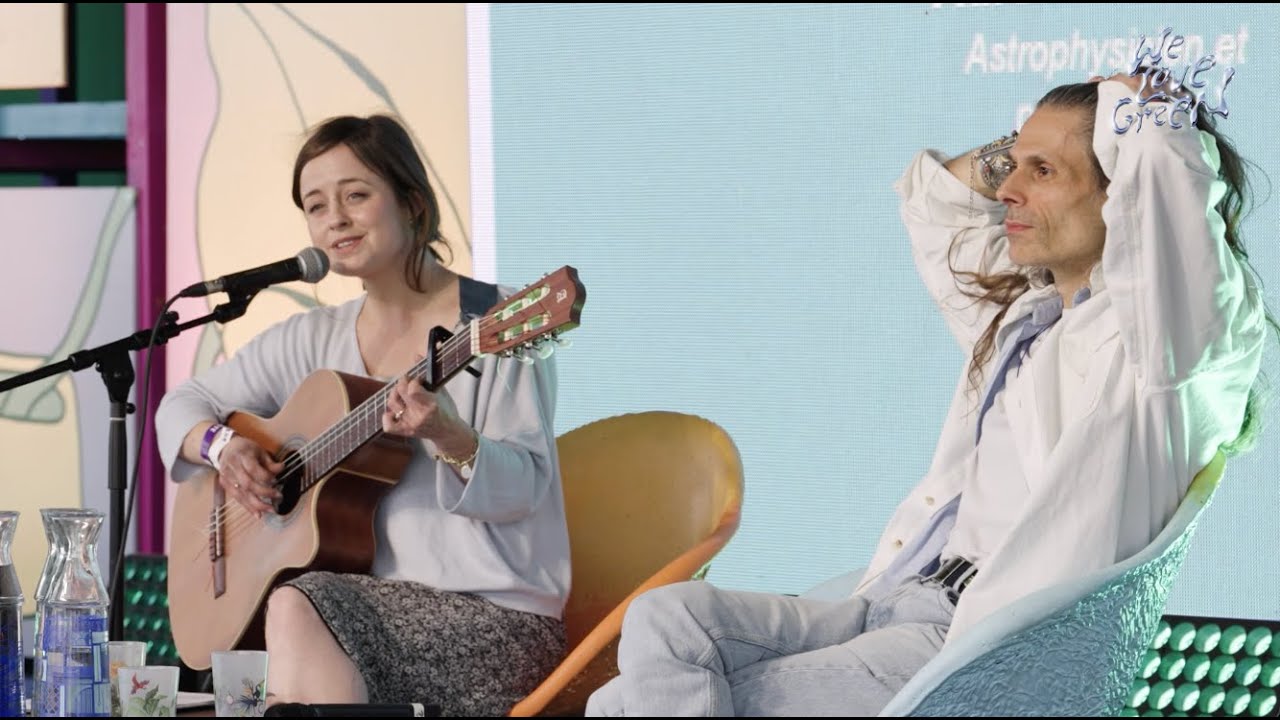
"Où aller ?" : Aurélien Barrau et Leïla Huissoud @ We Love Green 2024.
Keywords
Summary
187 words
Critical Evaluation
Aurélien Barrau’s talk is a powerful and eloquent call to rethink our relationship with the world, moving beyond technical fixes to address the underlying philosophical and ethical dimensions of the ecological crisis. His argumentation is compelling, weaving together scientific facts with philosophical insights. He correctly points out that the climate crisis is only one symptom of a deeper malaise, and that focusing solely on it can perpetuate the illusion that we can solve our problems with technological innovation. His critique of ‘growth’ and ‘artificialization’ is well-founded, and he effectively challenges the notion that sustainability alone is a sufficient goal. The inclusion of Leïla Huissoud’s song adds an emotional depth that complements the intellectual content. However, the talk is more of an opinion piece than a rigorous scientific analysis. While Barrau references scientific concepts like exponential growth and planetary boundaries, he does not provide specific citations or data, which limits its scientific rigor. The argumentation is sometimes rhetorical and relies on emotional appeals, which may not convince those seeking a more evidence-based approach. Additionally, his call for ‘betrayal’ is provocative but lacks concrete political or social strategies for implementation. Overall, the talk is valuable for its philosophical depth and its ability to provoke thought, but it should be complemented with more detailed scientific and practical resources for a comprehensive understanding.
219 words
Title / Content Match
The title 'Où aller ?' (Where to go?) accurately reflects the central question of the talk, which explores the direction humanity should take in the face of ecological collapse.
Quality & Reliability
7/10
The speaker is a well-known astrophysicist and philosopher, but the talk is primarily an opinion piece with strong rhetorical elements. It references scientific concepts (exponential growth, planetary boundaries, sixth extinction) but does not provide detailed citations. The argumentation is coherent and grounded in established scientific consensus, but the presentation is more philosophical than strictly scientific.
Key Moments
Markers derived by PSI from the transcript: the creator did not define chapters.
- Introduction: Barrau sets the stage, acknowledging the audience and introducing the theme of the talk.
- Barrau begins the 'constat' (assessment), discussing exponential functions and resource depletion.
- He introduces the concept of 'pic oil' and the crossing of planetary boundaries.
- Barrau argues that the problem is not just sustainability but desirability, questioning whether our world makes us happy.
- He criticizes the focus on climate change as a technical problem and calls for a deeper ethical and philosophical approach.
- Leïla Huissoud performs her song, adding an emotional interlude.
- Barrau resumes, discussing what not to do and introducing the idea of 'betrayal' as a line of flight.
- He elaborates on the concept of betrayal, drawing on Deleuze, and calls for a radical shift in perspective.
- Barrau concludes with a call to change the goal of the game, emphasizing ethics and aesthetics over technical solutions.
Cited Sources
- The Limits to Growth — Barrau references the 1972 MIT report and its author Denis Meadows.
- Planetary Boundaries — Barrau mentions that half of the planetary boundaries have been exceeded.
Concurring Sources
- IPCC Reports — The IPCC reports provide scientific evidence on climate change, which aligns with Barrau's acknowledgment of the crisis.
- IPBES Global Assessment Report on Biodiversity and Ecosystem Services — This report documents the unprecedented loss of biodiversity, supporting Barrau's statements about the sixth extinction.
Dissenting Sources
- Techno-optimist perspectives — Some argue that technological innovation can solve environmental problems without fundamental societal change, which contrasts with Barrau's call for radical transformation.
Contribution & Novelties
The talk offers a philosophical perspective on the ecological crisis, arguing that the core issue is not sustainability but the desirability of our current world. It challenges the dominant technocratic approach and calls for a radical reorientation of values.
Pour aller plus loin :
- Gilles Deleuze and Félix Guattari, ‘A Thousand Plateaus’ — Explores the concept of ’line of flight’ and becoming-minor, which Barrau references.
- The concept of ‘degrowth’ — An economic and social movement that advocates for reducing consumption and production, aligning with Barrau’s critique of growth.
- The ‘Sixth Extinction’ by Elizabeth Kolbert — A journalistic account of the ongoing mass extinction, providing scientific context for Barrau’s claims.
109 words
Radar Profile
The radar profile shows high scores in 'qualite_information' and 'fiabilite_globale', reflecting the speaker's credibility and the scientific grounding of his arguments. However, 'niveau_technique' is moderate, as the talk is more philosophical than technical. 'quantite_information' is also high, indicating a dense and substantive presentation.
💬 Sur les 0 commentaires analysés, aucune tendance n'est disponible.