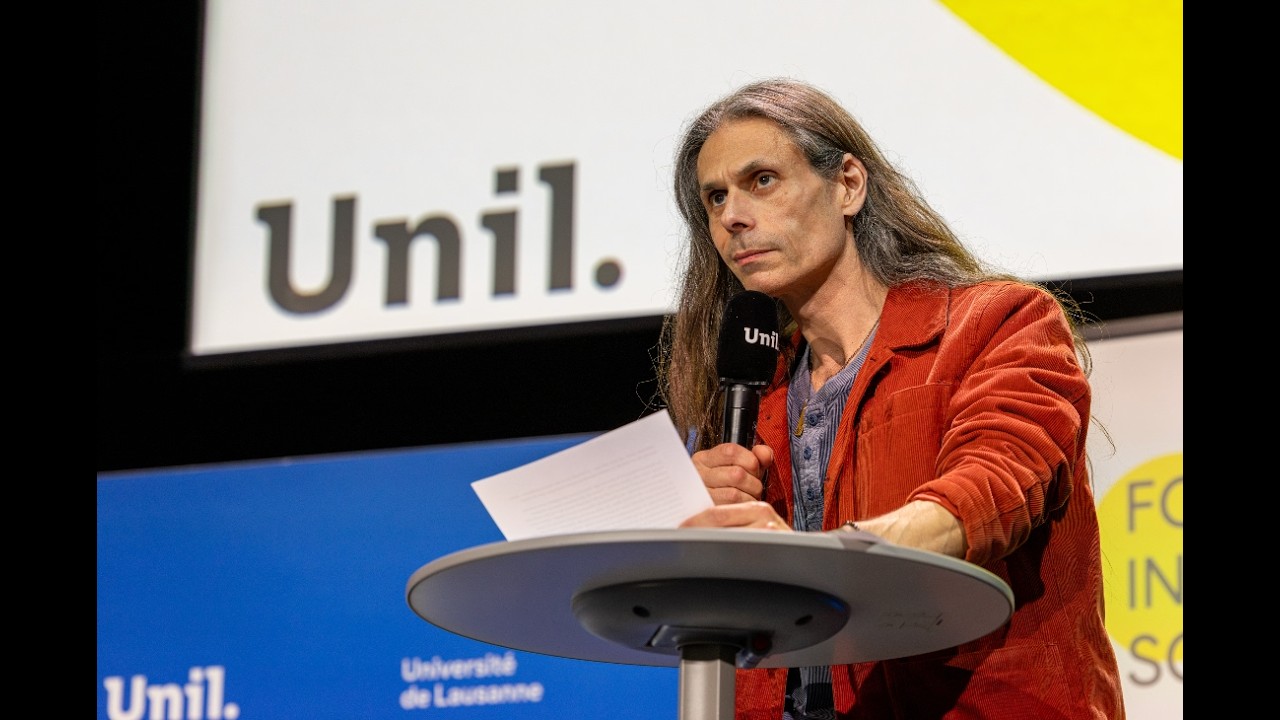
Où en sommes-nous ?
Keywords
Summary
122 words
Critical Evaluation
Aurélien Barrau’s talk is a powerful and eloquent critique of contemporary Western civilization, blending ecological urgency with geopolitical analysis. As an astrophysicist, Barrau brings a scientific perspective, but this speech is primarily philosophical and ethical. The argumentation is coherent and emotionally charged, but it lacks empirical data and relies heavily on personal convictions. The references to Grothendieck and Darwich are relevant and add depth, but they are not systematically sourced. The talk does not engage with counterarguments, which weakens its scientific rigor. However, its strength lies in its moral clarity and its call to action. The title accurately reflects the content, and the speech is well-structured. Overall, it is a thought-provoking and valuable contribution to public discourse, though it should be understood as an opinion piece rather than a scientific analysis.
131 words
Title / Content Match
The title 'Où en sommes-nous ?' accurately reflects the content, which is a broad assessment of the current state of the world, focusing on ecological and geopolitical crises.
Quality & Reliability
7/10
The video is a personal and philosophical reflection by a renowned astrophysicist, but it does not present scientific data or peer-reviewed sources. The argumentation is coherent and references historical figures (Grothendieck, Darwich) and concepts, but it is primarily an opinion piece. The speaker's credibility is high, but the content is not empirically verifiable.
Key Moments
Markers derived by PSI from the transcript: the creator did not define chapters.
- Introduction: Barrau thanks the audience and sets the stage, stating that the world is not doing well.
- Discussion of ecological collapse and the return of war as a symptom of Western civilization.
- Critique of Trump as a symbol of Western values, not the origin of the problem.
- Call to think deeply and reject technological solutions; critique of AI and digital technology.
- Introduction of the concept of poetic vs. prosaic, and the need to choose the poetic.
- Example of Alexander Grothendieck, who left mathematics to become an activist.
- Call to follow Grothendieck's example and to question what deserves to live.
- Conclusion: Barrau ends with a quote from Mahmoud Darwich and thanks the audience.
Cited Sources
- Alexander Grothendieck — Mentioned as an example of a scientist who left his career to become an activist.
- Mahmoud Darwich — Quoted at the end of the talk.
Concurring Sources
- IPCC Reports — Scientific consensus on climate change supports the urgency of ecological collapse.
Dissenting Sources
- Techno-optimism — Some argue that technology can solve environmental problems, contrary to Barrau's critique.
Contribution & Novelties
The talk offers a unique perspective by linking ecological collapse with geopolitical violence and critiquing technological solutionism. It emphasizes the need for a poetic, life-affirming approach over prosaic exploitation.
Pour aller plus loin :
- Alexander Grothendieck — His life and work as a mathematician and activist.
- Mahmoud Darwich — Palestinian poet whose work inspires the talk’s conclusion.
- Écocide — Concept of large-scale environmental destruction, relevant to Barrau’s critique.
68 words
Radar Profile
The radar profile shows high scores in quality of information and fiabilité, but lower in quantity and technical level, reflecting the philosophical nature of the talk.