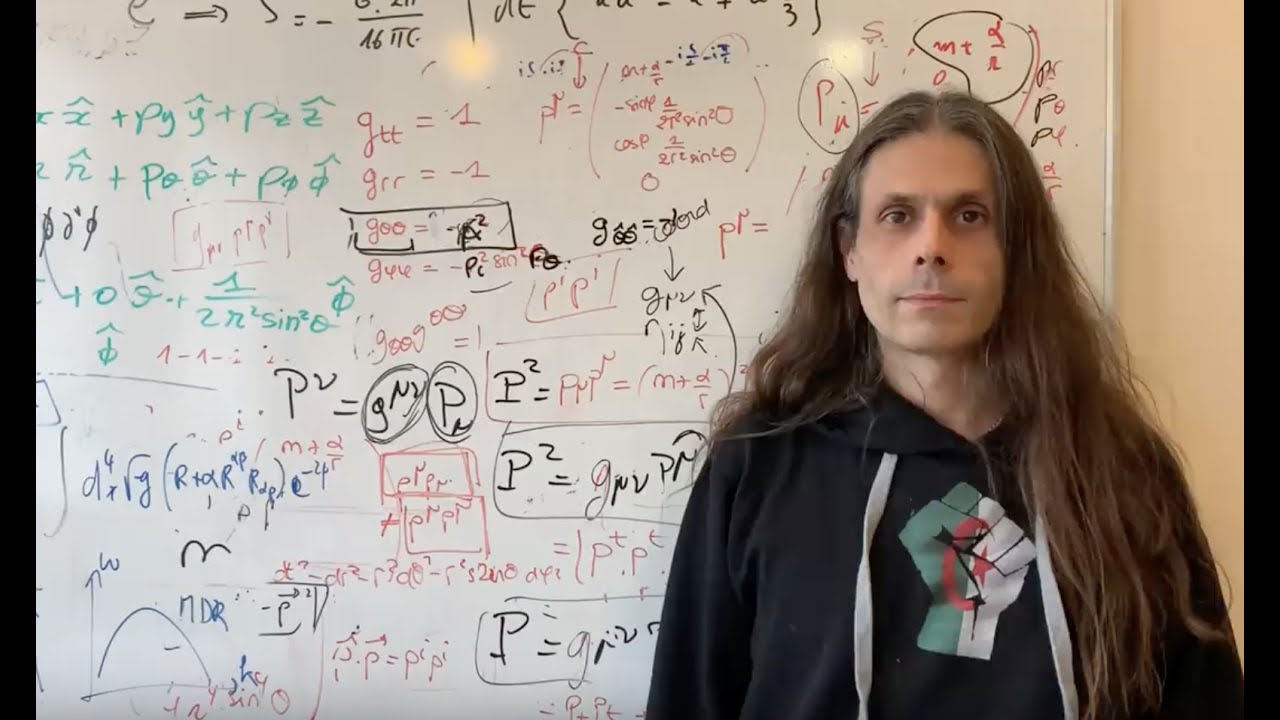
Matière noire : bases et nouvelle idée
Keywords
Summary
152 words
Critical Evaluation
The video provides a clear and scientifically accurate introduction to dark matter, suitable for an informed audience. Barrau correctly summarizes the key evidence: galaxy rotation curves, gravitational lensing, and cosmic microwave background fluctuations, emphasizing the robustness of the dark matter hypothesis. He also appropriately notes the alternative of modified gravity, but explains why it is disfavored by observations. The discussion of the failure of supersymmetric WIMPs is timely and reflects the current state of particle physics. The main strength of the video is the presentation of his own research, which is published in a reputable journal (Physical Review D). The model of Planck relics is speculative, but Barrau is transparent about its uncertainties and the low probability of it being correct. He also outlines potential observational tests, such as gravitational waves and high-energy gamma rays, which is crucial for scientific credibility. However, the video lacks depth in explaining the theoretical motivations for Planck relics and the details of the formation mechanism. Additionally, while the video is well-structured, the rapid pace and technical jargon may be challenging for a general audience. The title accurately reflects the content, and the video does not contain any misleading claims. Overall, the video is a valuable contribution to science communication, offering both foundational knowledge and a glimpse into cutting-edge research.
215 words
Title / Content Match
The title accurately reflects the content: the video covers the basics of dark matter and then introduces a new idea (Planck relics from black holes).
Quality & Reliability
8/10
The video is presented by a recognized physicist (Aurélien Barrau) and discusses established evidence for dark matter (galaxy rotation curves, CMB fluctuations) as well as a speculative model published in Physical Review D. The scientific content is accurate, but the speculative nature of the proposed model and the lack of detailed references in the video reduce the score slightly.
Key Moments
Markers derived by PSI from the transcript: the creator did not define chapters.
- Introduction to dark matter as a fundamental enigma
- Historical evidence: Zwicky and Vera Rubin's rotation curves
- CMB fluctuations as strong evidence for dark matter
- Discussion of modified gravity alternatives and their disfavor
- Failure of supersymmetric WIMPs and introduction of axions
- Proposal of Planck relics from primordial black holes
- Formation mechanism via trans-Planckian collisions and potential detection
Cited Sources
- Physical Review D article on Planck relics — The paper presenting the model of dark matter as Planck relics from primordial black holes, discussed in the video.
Concurring Sources
- Physical Review D article — The paper itself, which the video is based on, supports the claims made.
Contribution & Novelties
The video presents a novel idea for dark matter: Planck relics, which are remnants of evaporating black holes. This is an original contribution that combines existing concepts (primordial black holes, Hawking radiation) in a new way. The model is published in a peer-reviewed journal, indicating scientific validity. The video also provides a clear synthesis of the dark matter problem, making it accessible to a broader audience.
Pour aller plus loin :
- Dark matter on Wikipedia — Overview of dark matter evidence and candidates.
- Primordial black holes on Wikipedia — Background on primordial black holes and their formation.
- Hawking radiation on Wikipedia — Explanation of black hole evaporation, central to the Planck relic idea.
113 words
Radar Profile
The radar profile shows high scores in quality of information and reliability, reflecting the scientific rigor and the publication in a peer-reviewed journal. The quantity of information is moderate, as the video is concise. The technical level is high, indicating that the content is aimed at an audience with some background in physics.