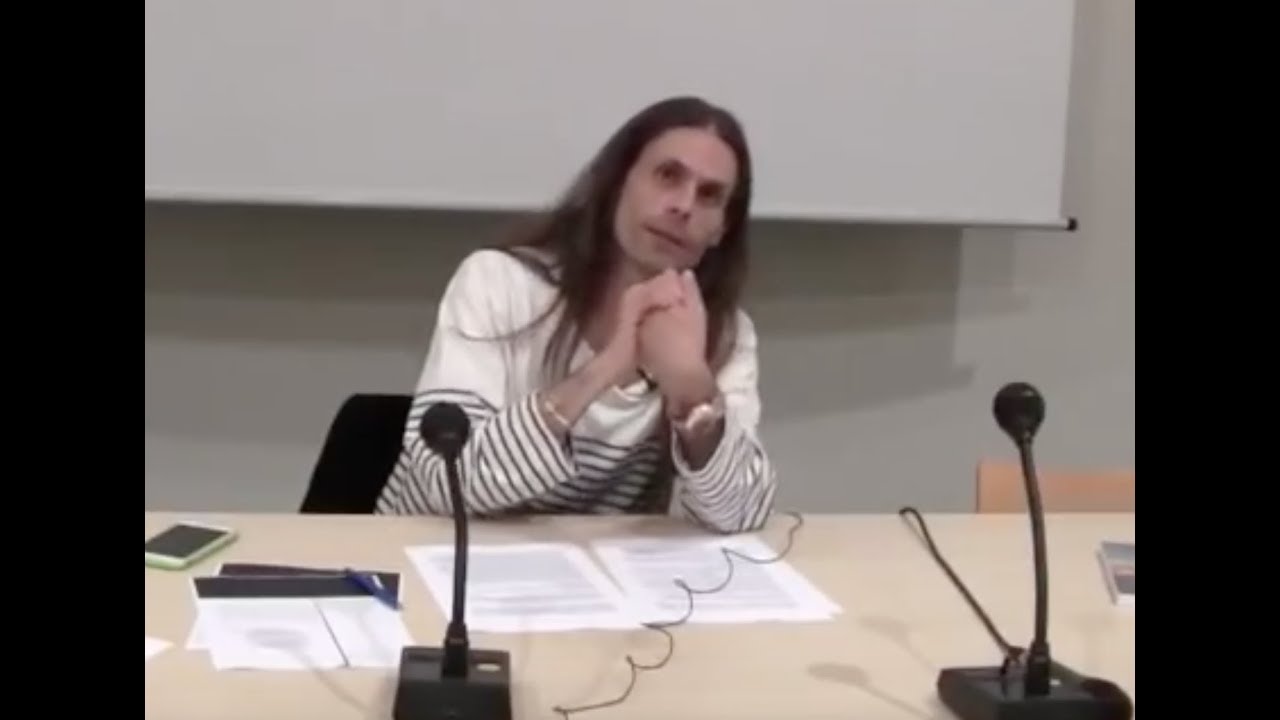
Aurélien Barrau : La cosmologie, création ou invention ?
Keywords
Summary
169 words
Critical Evaluation
The talk presents a nuanced and intellectually stimulating perspective on the philosophy of cosmology. Barrau, as a practicing physicist and philosopher, brings a unique dual perspective. He effectively uses examples from observational astronomy to illustrate how our perception of the sky depends on the scale and method of observation, setting the stage for the central question. The summary of modern cosmology is accurate and accessible, though it assumes some prior knowledge. The philosophical discussion is well-informed, referencing key historical figures and contemporary thinkers. However, the argumentation is sometimes more suggestive than rigorous, and Barrau’s personal views are presented without extensive justification. For instance, his critique of Penrose’s mathematical Platonism is brief and could be seen as oversimplified. The talk does not provide a definitive answer to the question posed, but rather opens up a space for reflection. The lack of formal citations is a limitation, but the speaker’s authority and the coherence of the argument lend credibility. The title is appropriate, and the content is engaging for an audience with some background in science and philosophy. Overall, the talk offers valuable insights into the nature of scientific knowledge, though it may not satisfy those seeking a more rigorous philosophical analysis.
200 words
Title / Content Match
The title accurately reflects the central question of the talk, which explores whether cosmology is a discovery or a construction.
Quality & Reliability
8/10
The speaker is a renowned astrophysicist and philosopher, and the content is well-structured, drawing on established scientific theories (quantum field theory, general relativity) and philosophical debates. However, it is an informal talk without formal citations, and some philosophical interpretations are personal.
Key Moments
Markers derived by PSI from the transcript: the creator did not define chapters.
- Introduction and welcome of Aurélien Barrau
- Observation of the sky: regularity vs irregularity
- Summary of the Big Bang model and inflation
- Quantum field theory and the origin of interactions
- General relativity and the universality of gravity
- The philosophical debate: discovery vs invention
- Plato and Aristotle on mathematics
- Contemporary positions: Penrose and Changeux
- Critique of the dichotomy and conclusion
Contribution & Novelties
The talk offers a personal and interdisciplinary perspective on the epistemology of cosmology, bridging physics and philosophy. It challenges the simplistic dichotomy between discovery and invention, suggesting that scientific knowledge is a complex interplay of both. The speaker’s dual expertise adds depth to the discussion.
Pour aller plus loin :
- Plato’s Theory of Forms — Relevant to the philosophical background.
- Roger Penrose — His views on mathematical Platonism are discussed.
- Jean-Pierre Changeux — His neuroconstructivist perspective is mentioned.
- Quantum Field Theory — Underpins the particle physics discussion.
- General Relativity — Central to the cosmological model.
95 words
Radar Profile
The radar profile shows high scores in information quantity, quality, and reliability, with a slightly lower technical level, indicating a talk that is informative and credible but accessible to a broader audience.