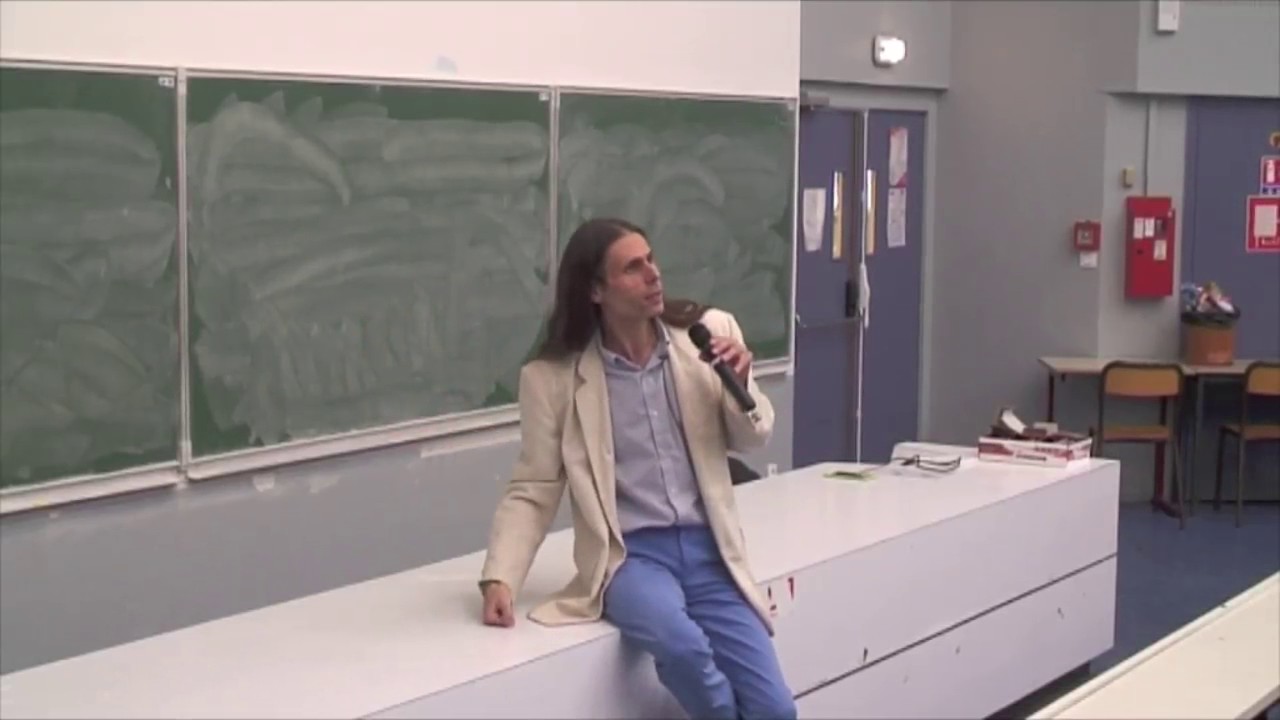
L’Univers (Partie 11/11). Cours « tout public » Aurélien Barrau. Un multivers ?
Keywords
Summary
157 words
Critical Evaluation
The lecture provides a comprehensive and accessible overview of the multiverse concept, situating it within both historical and contemporary scientific contexts. Barrau demonstrates a strong command of the subject, clearly explaining complex ideas such as eternal inflation and the anthropic principle. He is careful to distinguish between established physics and speculative extensions, which is crucial for maintaining scientific rigor. The historical survey is valuable, showing that the idea of multiple universes is not new but has evolved over centuries. However, the lecture is primarily a popularization, and some arguments are simplified. For instance, the discussion of the anthropic principle does not delve into the criticisms it faces. Additionally, Barrau’s philosophical musings, while interesting, may not be fully rigorous from a philosophical standpoint. The sources cited are not explicitly mentioned in the video, but the content aligns with mainstream cosmological literature. The title accurately reflects the content, and the lecture is well-structured. Overall, it is a thought-provoking and informative presentation, but it should be complemented with more technical resources for a deeper understanding.
172 words
Title / Content Match
The title accurately reflects the content, which is the final part of a cosmology course focusing on the multiverse concept.
Quality & Reliability
8/10
The lecture is given by a recognized astrophysicist, presents a balanced view of multiverse hypotheses, and clearly distinguishes established science from speculative extensions. The content is consistent with current cosmological knowledge, though it includes some philosophical interpretations.
Key Moments
Markers derived by PSI from the transcript: the creator did not define chapters.
- Introduction and recap of unsolved problems in cosmology
- Historical overview of multiverse idea from ancient Greeks to modern philosophy
- Discussion of modern multiverse proposals in physics, including eternal inflation
- Philosophical implications and the nature of scientific explanation
- Conclusion and reflections on the future of cosmology
Contribution & Novelties
This lecture provides a unique synthesis of historical and contemporary perspectives on the multiverse, making it accessible to a general audience while maintaining scientific accuracy. It highlights the philosophical underpinnings of scientific inquiry, which is often overlooked in popular science.
Pour aller plus loin :
- Multiverse (Wikipedia) — Overview of the concept and its scientific status.
- Eternal inflation (Wikipedia) — A key mechanism for generating multiple universes.
- Anthropic principle (Wikipedia) — Often invoked in multiverse discussions.
76 words
Radar Profile
The radar profile shows high scores in quantity and quality of information, indicating a rich and reliable content. The technical level is moderate, making it accessible to a broad audience. The global reliability is high, reflecting the expertise of the speaker.