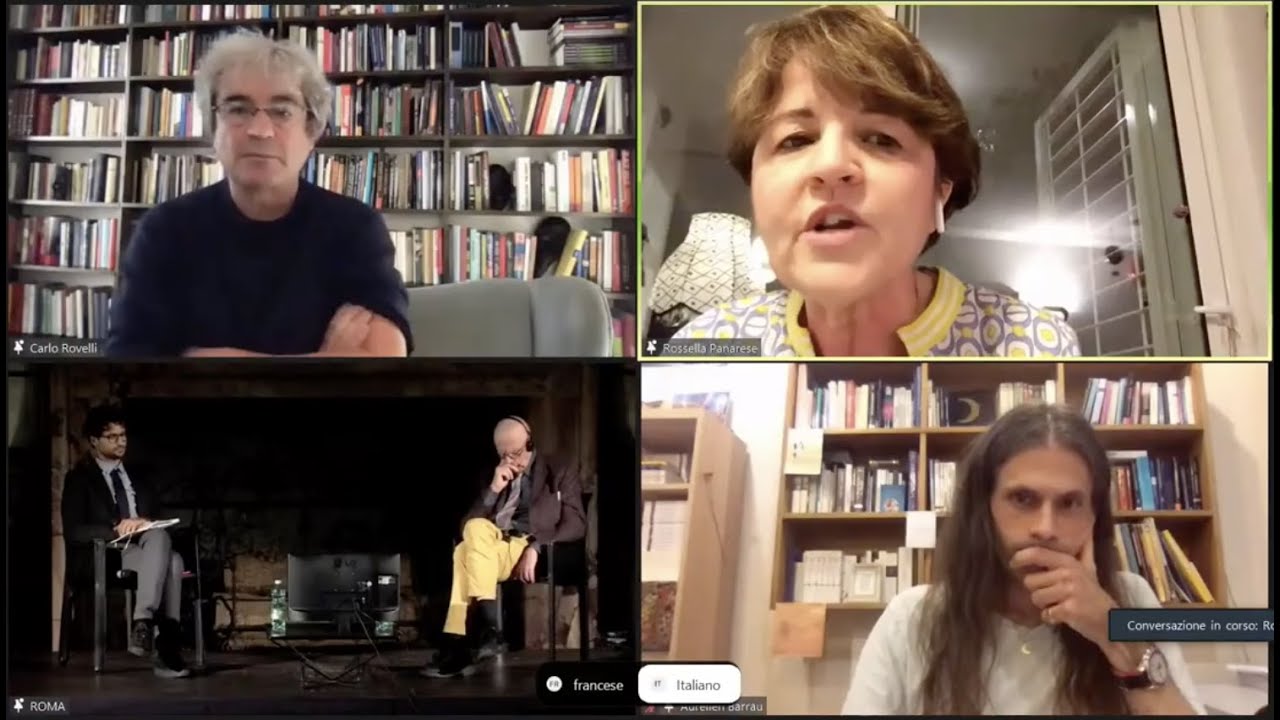
Barrau, Latour, Rovelli : FRAGMENTATION ET INTERDEPENDANCES
Keywords
Summary
180 words
Critical Evaluation
The video presents a high-level intellectual discussion among three distinguished thinkers, each bringing their unique perspective to the themes of fragmentation and interdependence. Bruno Latour’s exposition of Gaia is particularly insightful, clarifying that Gaia is not a mystical entity but a critical zone—a thin layer of the Earth modified by life over billions of years. This concept grounds environmental ethics in a concrete, local reality, making the call to action more tangible. Aurélien Barrau’s passionate advocacy for treating climate change as an emergency is compelling, though his arguments sometimes rely on rhetorical appeal rather than detailed scientific data. Carlo Rovelli’s contributions, while more abstract, provide a scientific foundation for interdependence, drawing on relational quantum mechanics and the philosophy of science. The discussion is well-structured, with each speaker building on the others’ ideas, creating a coherent narrative. However, the video lacks concrete data or citations, which limits its scientific rigor. The arguments are largely philosophical and ethical, which is appropriate for the format but may not satisfy viewers seeking empirical evidence. The moderation is effective, guiding the conversation without dominating it. The adéquation between title and content is strong, as the dialogue explicitly addresses fragmentation and interdependence from multiple angles. Overall, the video offers valuable insights into contemporary ecological and societal challenges, but its impact is diminished by the absence of specific references and the occasional vagueness of the proposals. The public comments, if any, are not provided, so no analysis of audience reception is possible.
245 words
Title / Content Match
The title accurately reflects the central theme of the discussion: fragmentation and interdependence, as explored by the three speakers.
Quality & Reliability
8/10
The discussion features three renowned intellectuals (a philosopher, an astrophysicist, and a physicist) with high credibility. The content is a philosophical and scientific reflection on fragmentation and interdependence, grounded in their respective works. No specific data or studies are cited in detail, but the arguments are coherent and well-articulated. The video is a recorded dialogue, not a peer-reviewed source, but the participants' expertise lends reliability.
Key Moments
Markers derived by PSI from the transcript: the creator did not define chapters.
- Introduction of the theme and speakers by the moderator.
- Bruno Latour explains the concept of Gaia and the critical zone.
- Aurélien Barrau discusses the urgency of climate action.
- Carlo Rovelli reflects on the relational nature of reality.
- Discussion on the role of science in addressing global crises.
- Debate on the failure of traditional categories and the need for new frameworks.
- Exploration of individual and collective responsibility.
- Concluding remarks on hope and the possibility of change.
Cited Sources
- Le défi de Gaia (Bruno Latour) — Mentioned by the moderator as Latour's recent work.
- Le plus grand défi de l'histoire de l'humanité (Aurélien Barrau) — Mentioned as Barrau's book on climate change.
- The Order of Time (Carlo Rovelli) — Referenced indirectly as Rovelli's popular science work.
Concurring Sources
- IPCC Special Report on Global Warming of 1.5°C — Supports the urgency of climate action emphasized by Barrau.
Dissenting Sources
- Critiques of the Gaia hypothesis — Some scientists argue that Gaia is not a testable hypothesis, which contrasts with Latour's use of it as a conceptual tool.
Contribution & Novelties
The video offers a unique interdisciplinary dialogue that bridges philosophy, physics, and ecology, providing a holistic perspective on fragmentation and interdependence. It introduces the concept of Gaia as a critical zone, which reframes environmental ethics. The discussion also touches on the relational nature of reality, drawing from Rovelli’s work.
Pour aller plus loin :
- Gaia hypothesis — Background on the scientific hypothesis that inspired Latour’s concept.
- Anthropocene — The geological epoch discussed in the context of human impact.
- Relational quantum mechanics — Rovelli’s theory that underscores interdependence at the quantum level.
91 words
Radar Profile
The radar profile shows high scores in quality and reliability, reflecting the expertise of the speakers, but lower scores in quantity and technical level, as the discussion is more philosophical than data-driven.