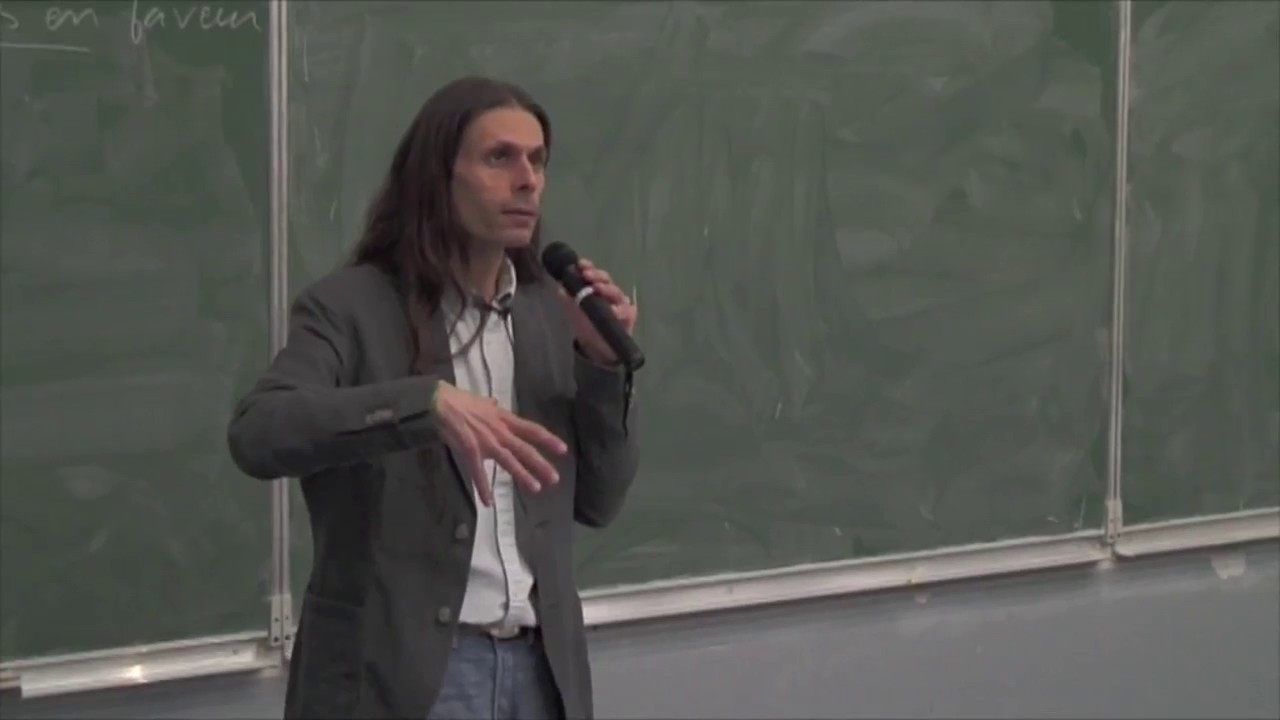
L’Univers (Partie 5/11). Cours « tout public » Aurélien Barrau. Big Bang: observations.
Keywords
Summary
178 words
Critical Evaluation
Aurélien Barrau delivers a masterful lecture that combines scientific rigor with philosophical depth. The opening segment on gravitational waves is particularly valuable: he systematically dismantles popular misconceptions, demonstrating a keen awareness of how science is often misrepresented in the media. His distinction between direct and indirect detection is epistemologically crucial, and he rightly emphasizes that the LIGO detection is not the first evidence for gravitational waves, but rather a new and powerful confirmation. He also correctly points out that the detection does not prove general relativity, as no theory can be proven, and that it does not directly detect gravitons, as gravitational waves are classical phenomena. His emphasis on the provisional nature of scientific theories is a refreshing antidote to the overconfidence often found in popular science communication.
The lecture then shifts to the Big Bang model, and Barrau does an excellent job of conveying the profound strangeness of the idea that space and time themselves have a history. He challenges the audience to think beyond their intuitive notions, using philosophical references such as Kant and Cézanne to illustrate the difficulty of perceiving the world without preconceptions. This interdisciplinary approach enriches the lecture and makes it accessible to a broad audience.
The scientific content is accurate and up-to-date, and Barrau is careful to distinguish between established facts and theoretical interpretations. He acknowledges the limitations of current knowledge and encourages critical thinking. The lecture is well-structured, with clear transitions between topics, and the delivery is engaging and passionate.
One minor criticism is that the lecture is quite long, and some sections may be dense for a general audience. However, Barrau’s ability to explain complex concepts in an accessible manner mitigates this. Overall, this is an excellent educational resource that provides a rigorous and thoughtful introduction to cosmology.
296 words
Title / Content Match
The title accurately reflects the content: it is the fifth part of a series on the universe, focusing on observational evidence for the Big Bang, delivered as a public lecture.
Quality & Reliability
9/10
The lecture is given by a renowned astrophysicist, Aurélien Barrau, who provides a rigorous and nuanced explanation of the Big Bang model and the recent gravitational wave detection. He emphasizes the distinction between direct and indirect detection, corrects common misconceptions, and stresses the provisional nature of scientific theories. The content is well-structured and scientifically accurate, with appropriate caveats.
Key Moments
Markers derived by PSI from the transcript: the creator did not define chapters.
- Introduction and discussion of gravitational wave detection, correcting misconceptions.
- Explanation that gravitational waves were already indirectly detected via binary pulsars.
- Clarification that the LIGO detection is not a detection of gravitons.
- Discussion on the impossibility of proving scientific theories.
- Transition to the main topic: observational evidence for the Big Bang.
- Introduction to the problem of distances in the universe.
- Discussion on the expansion of space and the age of the universe.
- Explanation of the cosmic microwave background as evidence for the Big Bang.
- Discussion on the abundance of light elements as evidence for the Big Bang.
- Summary and conclusion of the lecture.
Cited Sources
- LIGO Scientific Collaboration — Mentioned as the experiment that detected gravitational waves.
- BICEP2 — Mentioned in the context of the false claim of primordial gravitational waves.
Concurring Sources
- LIGO Scientific Collaboration — The official LIGO website provides details on the detection of gravitational waves, consistent with the lecture.
- NASA's Universe of Learning — Educational resources on cosmology that align with the lecture's content.
Dissenting Sources
- Popular media articles claiming first detection of gravitational waves — Some media outlets incorrectly reported that this was the first detection, whereas the lecture correctly notes indirect detections were made decades ago.
Contribution & Novelties
The lecture provides a clear and rigorous explanation of the Big Bang model and its observational evidence, while also correcting common misconceptions about gravitational waves. It emphasizes the philosophical implications of the model, such as the idea that space and time have a history.
Pour aller plus loin :
- Cosmic microwave background — The thermal radiation left over from the Big Bang, a key piece of evidence.
- Big Bang nucleosynthesis — The production of light elements in the early universe, another pillar of evidence.
- Hubble’s law — The observation that galaxies are receding, indicating cosmic expansion.
96 words
Radar Profile
The radar profile shows high scores in quantity and quality of information, reflecting the lecture's comprehensive and accurate content. The technical level is moderate, making it accessible to a general audience while still providing depth. The overall reliability is high, consistent with the lecturer's expertise.
💬 Sur les 0 commentaires analysés, aucune tendance n'est disponible.