Planning a Clean Cooking Intervention: Delivery and Financing Models
Keywords
Summary
187 words
Critical Evaluation
Value of the Information & Strength of the Argument
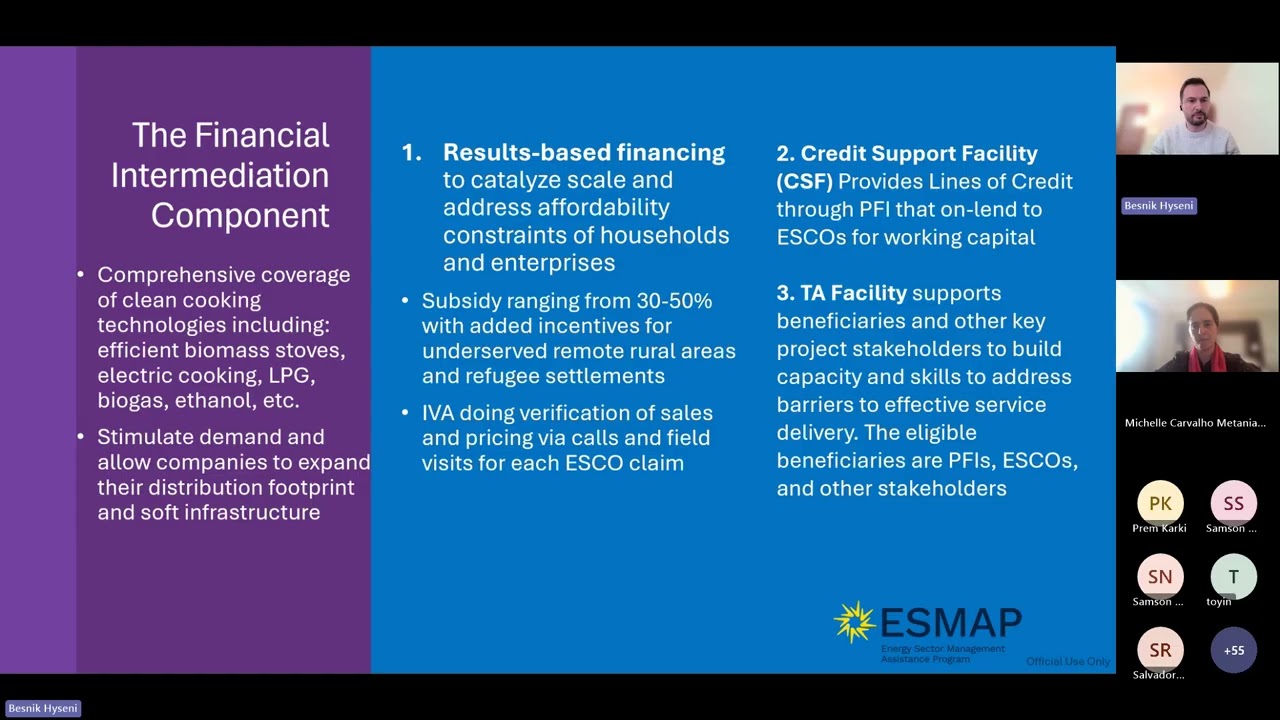
The webinar provides valuable insights into the design and implementation of clean cooking interventions, with concrete examples and data from three countries. The argumentation is grounded in practical experience, with speakers detailing specific mechanisms such as RBF, credit lines, and technical assistance. The value lies in the actionable lessons learned, such as the importance of consumer financing, the need for robust verification systems, and the benefits of bundling clean cooking with other energy products. However, the argumentation is largely descriptive and lacks critical analysis of potential drawbacks or alternative approaches. The speakers are practitioners, which adds credibility but also potential bias towards their own projects.
Scientific Rigor, Source Quality, Title Accuracy
The webinar is presented by ESMAP, a World Bank program, and features government representatives and project managers, lending institutional credibility. The content is based on real project data and experiences, but no external sources are cited. The title accurately reflects the content, which focuses on delivery and financing models. The presentation is well-structured and coherent, with clear explanations of complex mechanisms. However, the lack of independent verification and the reliance on self-reported data limit the scientific rigor. The webinar does not address potential criticisms or limitations of the presented models.
210 words
Title / Content Match
The title accurately reflects the content, which focuses on delivery and financing models for clean cooking interventions.
Quality & Reliability
7/10
The webinar features practitioners from Uganda, Ghana, and Bangladesh sharing firsthand implementation experience. While not peer-reviewed, the content is grounded in actual project data and lessons learned, with references to World Bank and Green Climate Fund projects. The presentation is coherent and specific, but lacks external verification and independent sources.
Key Moments
Markers derived by PSI from the transcript: the creator did not define chapters.
- Introduction to the webinar and Uganda case study.
- Uganda pilot project: distribution challenge fund and consumer trials.
- Uganda EASP: financing facility with RBF, credit support, and TA.
- Use of Prospect DMRV platform for monitoring and verification.
- Uganda results: LPG adoption and regional sales distribution.
- Challenges: testing labs, standards, and credit access.
- Ghana and Bangladesh case studies.
- Lessons learned and concluding remarks.
Cited Sources
- ESMAP — Organizer of the webinar and source of the presentation.
- World Bank — Mentioned as supporting the Uganda project and Bangladesh program.
- Green Climate Fund — Co-financing the Bangladesh program.
Concurring Sources
- Clean Cooking Alliance — Supports the importance of clean cooking interventions and financing models.
- World Bank — Provides funding and technical assistance for clean cooking projects.
Contribution & Novelties
The webinar provides a detailed, practitioner-level overview of clean cooking delivery and financing models, with specific examples from Uganda, Ghana, and Bangladesh. It highlights innovative mechanisms such as results-based financing, digital monitoring and verification, and the bundling of clean cooking with other energy products. The presentation offers practical lessons learned, including the importance of consumer financing, the need for robust verification systems, and the value of continuity of support. This is particularly useful for policymakers and practitioners designing similar interventions.
Pour aller plus loin :
- Clean Cooking Alliance — Global organization promoting clean cooking solutions.
- Results-Based Financing for Clean Cooking — ESMAP resource on RBF mechanisms.
- World Bank Clean Cooking — Overview of World Bank initiatives in clean cooking.
119 words
Radar Profile
The radar profile shows high scores in quantity of information and fiabilité, reflecting the detailed and credible content. The moderate score in niveau technique indicates that while the content is accessible, it still requires some familiarity with development finance and energy access concepts.
💬 No comments were provided for analysis.