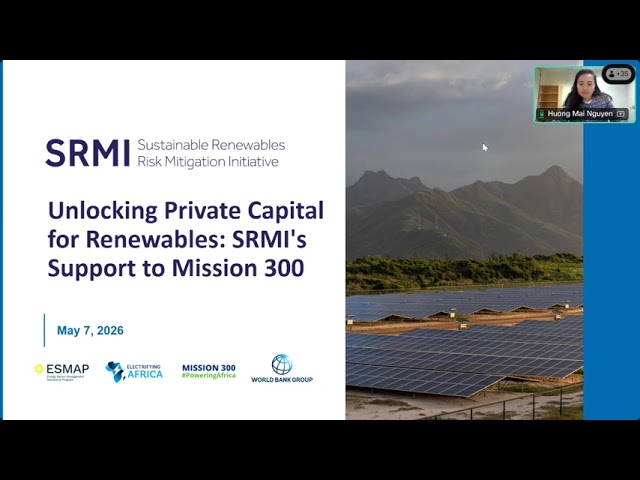
Unlocking Private Capital for Renewables: SRMI's Support to Mission 300
Keywords
Summary
175 words
Critical Evaluation
Value of the Information & Strength of the Argument
The video provides valuable insights into the practical implementation of renewable energy projects in Africa, with concrete examples and data. The argumentation is solid, based on real project experiences and lessons learned. The presenters effectively demonstrate how SRMI’s standardized approach addresses key barriers such as off-taker creditworthiness, foreign exchange risk, and grid integration. However, the presentation is largely promotional, highlighting successes without delving into failures or challenges in depth. The case studies are compelling but may overstate the effectiveness of the instruments without independent evaluation.
Scientific Rigor, Source Quality, Title Accuracy
The scientific rigor is moderate. The information is based on institutional knowledge and project reports, but no external sources are cited. The title accurately reflects the content, focusing on SRMI’s support to Mission 300. The video is a webinar recording, so it lacks the peer-review process of academic publications. The quality of sources is acceptable for an institutional presentation, but the lack of independent verification limits its scientific reliability.
169 words
Title / Content Match
The title accurately reflects the content, which focuses on SRMI's role in mobilizing private capital for renewables in the context of Mission 300.
Quality & Reliability
7/10
The video features presentations by World Bank and ESMAP staff, providing detailed case studies and specific data (e.g., 40 tenders, 20 GW pipeline, $1.35 billion mobilized). The information is based on institutional experience and project implementation, but it is promotional in nature and lacks independent verification or critical analysis.
Key Moments
Markers derived by PSI from the transcript: the creator did not define chapters.
- Introduction by Frederick Verdol and opening remarks by Fanny Misselringus, highlighting SRMI's achievements.
- Juan presents SRMI's standardized approach, including upstream planning and downstream investment support.
- Sabine discusses the first pillar: expanding energy infrastructure at competitive cost, with Guinea-Bissau example.
- Sabine covers the second pillar: fostering private participation, with Ethiopia's foreign exchange liquidity facility.
- Sabine explains the third pillar: regional power integration, with Gambia's solar and storage project.
- Juan presents the fourth pillar: strengthening utility capacity and creditworthiness, with Liberia example.
- Juan discusses the fifth pillar: embracing distributed renewable energy, with DRC's demand risk guarantee.
- Q&A session begins; Matar from Gambia asks about the foreign exchange facility structure and access to guarantees.
- Discussion on the challenges of obtaining letters of credit for small projects and the need for innovative risk mitigation.
- Further Q&A and concluding remarks.
Cited Sources
- ESMAP - Energy Sector Management Assistance Program — The video is produced by ESMAP, and the initiative SRMI is part of ESMAP's programs.
- Mission 300 — The video discusses SRMI's support to Mission 300 countries, and this is the official program page.
Concurring Sources
- ESMAP - SRMI — The video describes SRMI's activities, and this is the official program page.
- World Bank - Mission 300 — The video discusses Mission 300, and this is the official program page.
Contribution & Novelties
The video provides an in-depth look at SRMI’s approach to mobilizing private capital for renewable energy in Africa, with specific case studies and innovative risk mitigation instruments. It highlights the importance of combining upstream planning with downstream transaction support and the use of climate finance to de-risk projects. The session offers practical lessons for policymakers and development practitioners.
Pour aller plus loin :
- Sustainable Renewables Risk Mitigation Initiative (SRMI) — Official SRMI page with more details on the initiative.
- World Bank Group - Private Participation in Infrastructure — Data and reports on private investment in infrastructure.
- IRENA - Renewable Energy Auctions — Analysis of auction mechanisms for renewable energy.
109 words
Radar Profile
The radar profile shows high scores in quantity of information and reliability, reflecting the detailed case studies and institutional backing. The technical level is moderate, suitable for a professional audience. The overall quality is strong, but the promotional nature slightly reduces the critical assessment.
💬 Sur les 0 commentaires analysés, aucune tendance n'est disponible.