From Barriers to Breakthroughs: Lessons on Policy and Regulation for Pumped Storage Hydropower
Keywords
Summary
211 words
Critical Evaluation
Value of the Information & Strength of the Argument
The webinar provides valuable insights into the policy and regulatory landscape for pumped storage hydropower, drawing on the experiences of international organizations and utilities. The argumentation is solid, grounded in real-world examples and practical recommendations. The speakers effectively argue that PSH is crucial for integrating variable renewables and that policy support is essential to overcome barriers. The discussion on revenue mechanisms, such as capacity markets and revenue stabilization, is particularly informative. However, the presentation is largely qualitative and lacks quantitative analysis or case study data to strengthen the arguments.
Scientific Rigor, Source Quality, Title Accuracy
The webinar demonstrates scientific rigor through the involvement of reputable institutions like the World Bank and IHA. The sources cited include the IHA Hydropower Outlook and a policy toolkit, which are credible. The title accurately reflects the content, focusing on policy and regulation. The discussion is well-structured and covers key aspects of PSH development. However, the lack of specific citations for data and the reliance on expert opinion rather than peer-reviewed studies slightly reduces the overall rigor.
181 words
Title / Content Match
The title accurately reflects the content, which focuses on policy and regulatory barriers and solutions for pumped storage hydropower.
Quality & Reliability
7/10
The webinar features experts from the World Bank, IHA, Hydro Tasmania, and Sarawak Energy, providing practical insights and policy recommendations. The content is grounded in institutional experience and references a policy toolkit, but lacks peer-reviewed citations and detailed data. The discussion is largely qualitative and relies on expert opinion.
Key Moments
Markers derived by PSI from the transcript: the creator did not define chapters.
- Introduction by Demetrius, emphasizing the importance of storage in clean energy systems.
- Bente presents World Bank support for enabling environments and common barriers.
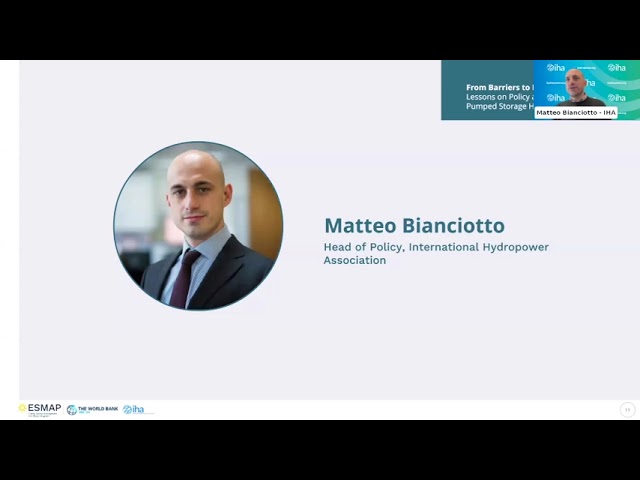
- Matteo from IHA presents the policy toolkit and key areas for action.
- Discussion on revenue visibility mechanisms and capacity markets.
- Panel discussion begins with Tony from Sarawak Energy on Malaysia's energy policies.
- Colin from Hydro Tasmania discusses the Cethana Pumped Hydro project and ARENA support.
- Q&A session with audience questions on regulatory frameworks and market design.
- Closing remarks by Jessica Kery, summarizing key takeaways.
Cited Sources
- IHA Hydropower Outlook — Referenced by Matteo for data on global PSH pipeline.
- IHA Policy Toolkit for Pumped Storage Hydropower — Presented by Matteo as a set of good practices.
Concurring Sources
- IHA Hydropower Outlook — Provides data on global PSH pipeline, supporting the webinar's claims.
- World Bank Energy Storage — Aligns with the World Bank's approach to supporting energy storage projects.
Contribution & Novelties
The webinar provides a comprehensive overview of policy and regulatory barriers to pumped storage hydropower and offers practical recommendations from leading institutions. It highlights the importance of proactive planning, efficient permitting, and revenue mechanisms tailored to PSH’s long payback periods. The inclusion of case studies from Australia and Malaysia adds valuable real-world perspectives.
Pour aller plus loin :
- Pumped-storage hydroelectricity — Overview of the technology and its role in energy storage.
- International Hydropower Association — Organization providing resources and policy guidance on hydropower.
- World Bank Energy Storage — Insights on energy storage and policy support from the World Bank.
99 words
Radar Profile
The radar profile shows high scores in quantity of information and technical level, reflecting the webinar's comprehensive coverage and expert insights. Quality and reliability are slightly lower due to the reliance on expert opinion rather than peer-reviewed data. Overall, the profile indicates a solid, informative session with minor limitations in empirical evidence.
💬 No comments were provided for analysis.