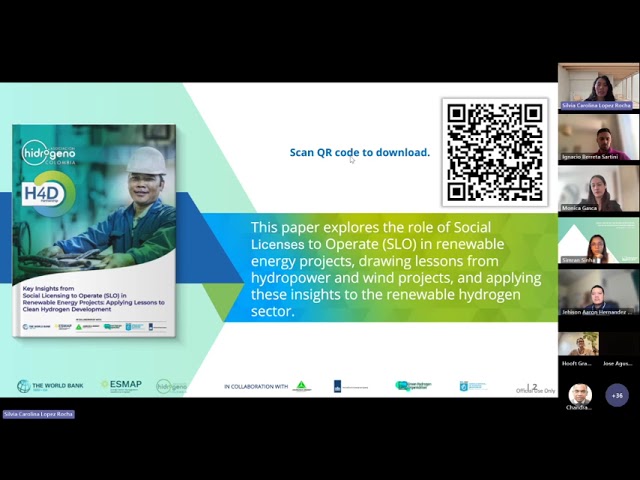
REPORT LAUNCH | Key Insights from Social Licensing to Operate (SLO) in Renewable Energy Projects
Keywords
Summary
173 words
Critical Evaluation
Value of the Information & Strength of the Argument
The webinar provides valuable insights into the concept of social license to operate, particularly in the context of renewable energy and hydrogen projects. The argumentation is solid, drawing on real-world case studies and expert opinions. The speakers effectively argue that SLO is crucial for project success, highlighting that without community acceptance, projects face delays, cancellations, and financial risks. The presentation of the actionable checklist offers practical guidance, and the case studies illustrate both challenges and successful strategies. The panel discussion adds depth by addressing remaining challenges and the need for context-specific approaches. However, the argumentation relies heavily on anecdotal evidence and institutional experience rather than systematic data analysis, which limits its scientific rigor.
Scientific Rigor, Source Quality, Title Accuracy
The webinar demonstrates a reasonable level of scientific rigor, with sources primarily from institutional reports and case studies. The report itself is a joint effort by the World Bank and partners, lending credibility. The case studies are well-known examples, but the presentation does not provide detailed citations or references to specific studies. The title accurately reflects the content, and the discussion stays on topic. The webinar does not include any advertising or sponsored content. The panelists are experts from reputable organizations, adding to the credibility. However, the lack of explicit source citations in the presentation and the reliance on expert opinion rather than peer-reviewed literature slightly reduce the overall rigor.
238 words
Title / Content Match
The title accurately reflects the content: a report launch focusing on insights from social licensing in renewable energy projects, with a specific emphasis on hydrogen.
Quality & Reliability
7/10
The webinar is a report launch by the World Bank's ESMAP, featuring experts from international organizations. It provides practical insights and case studies, but the content is largely based on expert opinion and institutional knowledge rather than peer-reviewed research. The discussion is well-structured and credible, but lacks detailed methodological transparency.
Key Moments
Markers derived by PSI from the transcript: the creator did not define chapters.
- Introduction by Monica Gasca, setting the context for the webinar on social license to operate in renewable energy projects.
- Opening remarks by Chandra Shekhar Goindalu, emphasizing the importance of social license for project viability and development.
- Karolina Lopez begins the main presentation, introducing the report and its objectives.
- Definition of social license to operate and its key components: responsible corporate behavior, transparency, and tangible local benefits.
- Presentation of the actionable checklist for developers, including stakeholder mapping, capacity building, and environmental assessments.
- Case study 1: Itaipu Dam (Brazil/Paraguay) - challenges and solutions in obtaining social license.
- Case study 2: Kipeto Wind Project (Kenya) - land lease and benefit-sharing mechanisms with the Maasai community.
- Case study 3: Kaligandaki Hydro (Nepal) - early consultation and transparency as key factors.
- Panel discussion begins with introductions of panelists from various organizations.
- Panelists discuss the importance of the report and remaining challenges in social licensing.
Cited Sources
- Social Licensing to Operate in Renewable Energy Projects (Report) — The report being launched, which is the central focus of the webinar.
- Hydrogen for Development (H4D) Partnership — Mentioned as a key initiative supporting the report and the 10 GW Lighthouse initiative.
Concurring Sources
- Social License to Operate in the Mining Industry — Academic literature on social license to operate, supporting the concept's relevance.
Dissenting Sources
- Critique of Social License to Operate — Some scholars argue that the concept is vague and lacks clear measurement, which may be a limitation.
Contribution & Novelties
The webinar provides a practical framework for understanding and obtaining social license to operate in renewable energy and hydrogen projects, drawing on case studies from hydropower and wind. It emphasizes the importance of early engagement, transparency, and tangible local benefits. The actionable checklist offers concrete steps for developers. The discussion highlights the need for context-specific approaches and the role of partnerships like H4D.
Pour aller plus loin :
- Social License to Operate (Wikipedia) — Provides a general overview of the concept.
- IFC Performance Standards on Environmental and Social Sustainability — Relevant for understanding international standards on community engagement.
- The 10 GW Lighthouse Initiative — Directly related to the initiative mentioned in the webinar.
113 words
Radar Profile
The radar profile shows high scores in quantity of information and technical level, reflecting the detailed presentation and expert panel. Quality and reliability are moderate, indicating the reliance on expert opinion and case studies rather than peer-reviewed research. The overall profile suggests a valuable but not highly rigorous resource.
💬 Sur les 0 commentaires analysés, aucune tendance n'est disponible.