Electrifying Africa: Delivering on Mission 300 Faster Together
Keywords
Summary
188 words
Critical Evaluation
Value of the Information & Strength of the Argument
The video provides valuable information on the practical challenges of maintaining off-grid solar systems in public facilities, a topic often overlooked in electrification discussions. The argumentation is solid, based on real project experience and data from Burundi. The speakers present a coherent strategy that integrates technical design, financing mechanisms, and institutional arrangements. They acknowledge limitations and lessons learned, such as the need for early digital connectivity planning. The value is enhanced by the inclusion of specific examples, such as the use of performance-based financing and remote monitoring, which are innovative approaches in the context of FCV countries.
Scientific Rigor, Source Quality, Title Accuracy
The scientific rigor is high, as the content is based on a World Bank project with concrete data and implementation details. The sources cited are primarily internal project documents and the speakers’ expertise, which are credible but not externally verifiable. The title accurately reflects the content, focusing on electrification and the Mission 300 initiative. The session is part of a learning series, indicating a structured and informative approach. No external sources are referenced, but the information is consistent with known practices in the energy sector.
197 words
Title / Content Match
The title accurately reflects the content, which focuses on electrification in Africa and the Mission 300 initiative, with a specific case study on Burundi.
Quality & Reliability
8/10
The video features World Bank and ESMAP experts presenting a real project (SOLEIL) with concrete data and implementation details. The information is based on practical experience and institutional knowledge, but it is not peer-reviewed and lacks external verification.
Key Moments
Markers derived by PSI from the transcript: the creator did not define chapters.
- Introduction by Juliet Ben, setting the context for the session on maintenance and sustainability in electrification.
- Opening remarks by Babakari, emphasizing the importance of reliable service delivery and the need for institutional solutions.
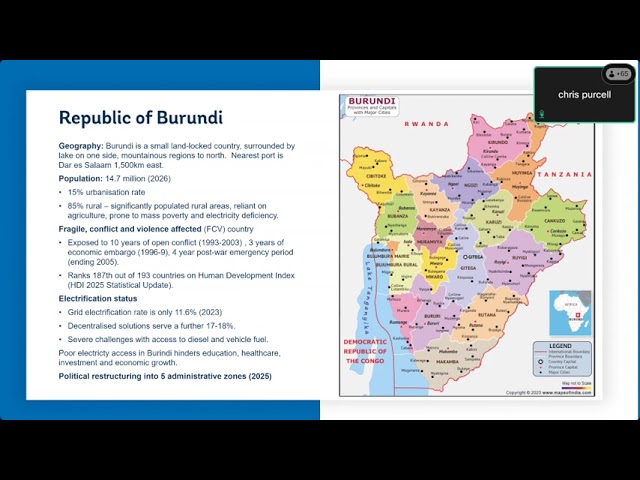
- Chris Pel presents the context of Burundi, including low electrification rates and the challenges of a fragile state.
- Chris Pel discusses the project's approach to remote monitoring and the importance of digital connectivity.
- Stephanie Sum explains the maintenance approach, including the use of performance-based financing and cross-sectoral collaboration.
- Jean Paul Wo shares lessons on embedding maintenance into the health PBF mechanism.
- Say Gulam discusses the PBF incentives and early lessons from the health sector.
- Mkta Ben Karajio Mahamadu talks about cross-sector collaboration and the role of digital technologies.
Cited Sources
- ESMAP — Mentioned as the program supporting the learning series and the SOLEIL project.
- World Bank — The World Bank Group is the implementing agency for the SOLEIL project.
Concurring Sources
- World Bank - Energizing Africa — The video aligns with the World Bank's broader electrification goals in Africa.
Contribution & Novelties
The video provides an original contribution by detailing the SOLEIL project’s innovative approach to maintenance in a fragile context. It highlights the integration of technical design, financing incentives, and institutional arrangements to ensure long-term sustainability. The use of performance-based financing for maintenance and the emphasis on remote monitoring are notable innovations. The session also underscores the importance of cross-sectoral collaboration between energy, health, and education sectors.
Pour aller plus loin :
- Performance-Based Financing — Provides background on the PBF mechanism used in health systems.
- Mission 300 — The World Bank’s initiative to provide electricity to 300 million people in Africa by 2030.
- Off-grid solar — Overview of off-grid solar systems and their maintenance challenges.
114 words
Radar Profile
The radar profile shows high scores in quantity and quality of information, indicating a content-rich and reliable presentation. The technical level is also high, reflecting the expert audience. The overall reliability is strong, but the lack of external sources slightly reduces the score.
💬 Sur les 0 commentaires analysés, aucune tendance n'a pu être dégagée.