Arzikin Haske au Niger : financer les résultats dans la cuisson propre et le solaire hors réseau
Keywords
Summary
171 words
Critical Evaluation
Value of the Information & Strength of the Argument
The webinar provides valuable insights into the practical implementation of a Results-Based Financing mechanism in a fragile context. The speakers, who are directly involved in the project, offer concrete data on the fund’s structure, progress, and challenges. The argumentation is coherent, emphasizing the need for flexibility and adaptation. However, the presentation is largely descriptive and lacks critical analysis of potential drawbacks or alternative approaches. The value lies in the detailed case study, which can inform similar initiatives.
Scientific Rigor, Source Quality, Title Accuracy
The webinar is presented by World Bank and ESMAP staff, who are credible sources given their direct involvement. However, no external sources are cited, and the content is based on their own experience and project documents. The title accurately reflects the content, focusing on the Arzikin Haske fund. The presentation is rigorous in terms of internal consistency, but the lack of independent verification limits its overall scientific rigor.
160 words
Title / Content Match
The title accurately reflects the content, which focuses on the Arzikin Haske fund for clean cooking and off-grid solar in Niger.
Quality & Reliability
7/10
The webinar features experienced World Bank and ESMAP staff discussing a real project (Arzikin Haske) with concrete data and lessons learned. However, it is largely a presentation of their own work, with limited independent verification or critical external perspective.
Key Moments
Markers derived by PSI from the transcript: the creator did not define chapters.
- Introduction and overview of the webinar agenda.
- Overview of Niger's energy sector: access rate, disparities, and challenges.
- Presentation of the Energy Compact and its objectives.
- Introduction to the Multi-Phase Programmatic Approach (MPA) and ASK1 project components.
- Discussion on the solar sector and lessons from the NESAP project.
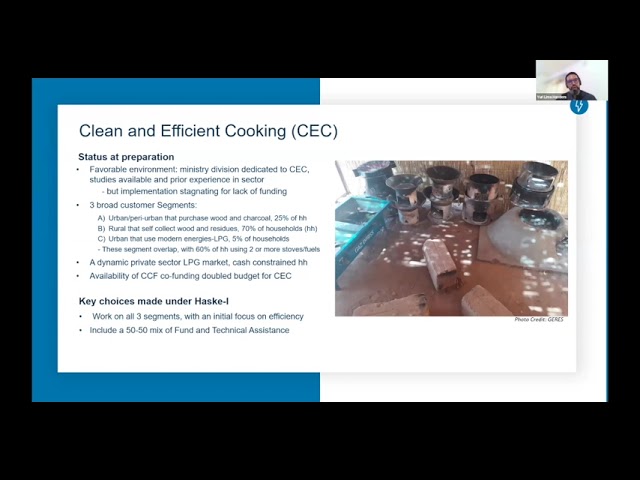
- Clean cooking sector analysis and segmentation.
- Implementation timeline and challenges, including administrative delays.
- Fund structure: two pillars, four windows, and governance.
- Current status: 21 companies supported, 135,000 kits, upcoming calls.
- Lessons learned and adaptation strategies.
Contribution & Novelties
The webinar provides a detailed case study of a pioneering RBF fund combining clean cooking and off-grid solar in a fragile state, offering practical insights into design, implementation, and adaptation. It highlights the importance of flexibility, stakeholder engagement, and realistic timelines.
Pour aller plus loin :
- Results-Based Financing (RBF) - World Bank — Overview of RBF mechanisms and applications.
- Clean Cooking Alliance — Resources and initiatives for clean cooking.
- Off-grid solar market trends - GOGLA — Data and reports on off-grid solar.
- Energy Compact for Niger - SEforALL — Information on national energy compacts.
94 words
Radar Profile
The radar profile shows balanced scores across all dimensions, with slightly lower technical depth and information quantity, reflecting the webinar's focus on practical implementation rather than deep technical analysis.