Benefits of Nuclear Energy for Remote Industrial Applications
Keywords
Summary
142 words
Critical Evaluation
Value of the Information & Strength of the Argument
The presentation provides valuable insights from the speaker’s operational experience in remote mining power systems, offering practical perspectives on the challenges and solutions. The argumentation is structured, moving from general grid characteristics to specific case studies and cost comparisons. The speaker effectively highlights the limitations of renewables, such as the need for oversizing and storage, and the economic infeasibility of high renewable penetration. He also addresses common objections to nuclear, such as construction time and safety, with reasoned counterarguments. However, the argumentation is somewhat one-sided, as the speaker is clearly advocating for nuclear and does not deeply explore potential drawbacks or alternative solutions. The cost estimates are high-level and may not be universally applicable, but they serve to illustrate the speaker’s points.
Scientific Rigor, Source Quality, Title Accuracy
The presentation lacks formal citations, relying instead on the speaker’s professional experience and general knowledge. The speaker mentions specific examples, such as the Akademik Lomonosov and the Spanish blackout, but does not provide detailed sources. The title accurately reflects the content, which is focused on the benefits of nuclear for remote industrial applications. The speaker’s expertise adds credibility, but the lack of verifiable sources limits the scientific rigor. The presentation is more of an expert opinion than a peer-reviewed analysis.
217 words
Title / Content Match
The title accurately reflects the content, which focuses on the benefits and challenges of using nuclear energy for remote industrial applications, particularly mining.
Quality & Reliability
7/10
The presentation is based on the speaker's extensive operational experience in remote mining power systems, providing practical insights. However, it lacks formal citations and relies on anecdotal evidence and high-level cost estimates. The discussion of nuclear technology is accurate but not deeply technical, and the speaker's advocacy for nuclear is clear, potentially introducing bias.
Key Moments
Markers derived by PSI from the transcript: the creator did not define chapters.
- Introduction: Speaker's background and experience in remote mining power systems.
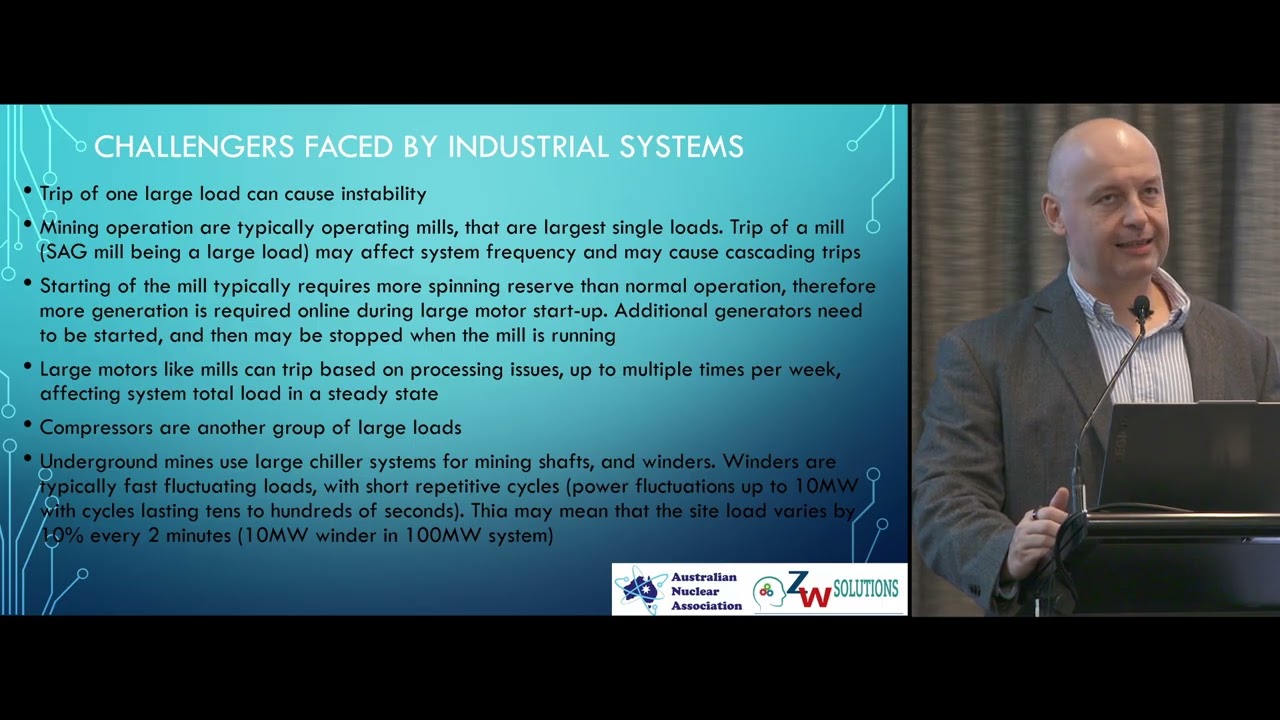
- Comparison of industrial grids vs large grids: load stability and inertia challenges.
- Case study: Cost of renewables and battery storage for a 1 MW system.
- Discussion on fuel supply logistics and LNG storage issues.
- Introduction of nuclear as a solution: examples of floating nuclear power stations.
- Addressing concerns: construction time, safety, and integration with storage.
- Conclusion: Summary of benefits and contact details.
Cited Sources
- Akademik Lomonosov (Wikipedia) — Mentioned as an example of a floating nuclear power station.
- RITM-200 reactor (Wikipedia) — Mentioned as a reactor type used in Russian icebreakers.
Concurring Sources
- International Atomic Energy Agency (IAEA) — General reference for nuclear energy information and safety.
Contribution & Novelties
The presentation offers a practical perspective on the benefits of nuclear energy for remote industrial applications, drawing on the speaker’s operational experience. It highlights the unique challenges of industrial grids, such as load stability and fuel logistics, and argues that nuclear can be a viable solution. The speaker provides a cost comparison and discusses integration with storage and co-generation.
Pour aller plus loin :
- Small modular reactors (Wikipedia) — Overview of SMRs, relevant to the discussion of small nuclear units.
- Floating nuclear power plant (Wikipedia) — Details on floating nuclear plants, including the Akademik Lomonosov.
- Energy storage (Wikipedia) — General concepts of energy storage, relevant to the integration with nuclear.
110 words
Radar Profile
The radar profile shows moderate scores across all dimensions, with slightly higher scores in information quantity and quality, reflecting the speaker's experience and the practical content. The technical level is moderate, and reliability is somewhat lower due to the lack of formal citations.
💬 No comments were provided for analysis.