Building a nuclear workforce: A whole-of-nation challenge
Keywords
Summary
145 words
Critical Evaluation
Value of the Information & Strength of the Argument
The talk provides valuable insights into the current state of nuclear education and workforce development in Australia, based on the speaker’s experience and collaborative input. The argumentation is coherent, emphasizing the urgent need for a sovereign nuclear workforce and the challenges in building it. The speaker supports her points with examples, such as the diversity of graduate destinations and the importance of scholarships and internships. However, the talk lacks quantitative data and formal citations, relying on anecdotal evidence and general observations. The argument is persuasive but could be strengthened with more concrete statistics or case studies.
Scientific Rigor, Source Quality, Title Accuracy
The talk is an expert opinion piece, not a scientific study. It does not cite specific sources, but references the collaborative work of ANREN and mentions the AUKUS agreement. The title accurately reflects the content. The speaker’s credentials and involvement in nuclear education lend credibility, but the lack of formal references limits the scientific rigor. The talk is more of a policy-oriented presentation than a technical analysis.
178 words
Title / Content Match
The title accurately reflects the content, which focuses on the challenges and opportunities in building a nuclear workforce in Australia.
Quality & Reliability
7/10
The talk is based on the speaker's expertise and collaborative input from ANREN members, but it is an opinion piece without formal citations or peer-reviewed references. The information is plausible and aligns with known challenges in nuclear workforce development, but lacks verifiable data.
Key Moments
Markers derived by PSI from the transcript: the creator did not define chapters.
- Introduction by Joe, presenting Elizabeth Williams and her background.
- Williams begins her talk, outlining the topics: situation report, need for sovereign nuclear literacy, building a workforce pipeline, and ANREN.
- Discussion of the demand for nuclear expertise outstripping supply, and challenges of importing expertise.
- Public perception challenges and the need to counter misinformation.
- Explanation of the workforce pipeline from high school to academia, and the need for awareness, competence, and expertise.
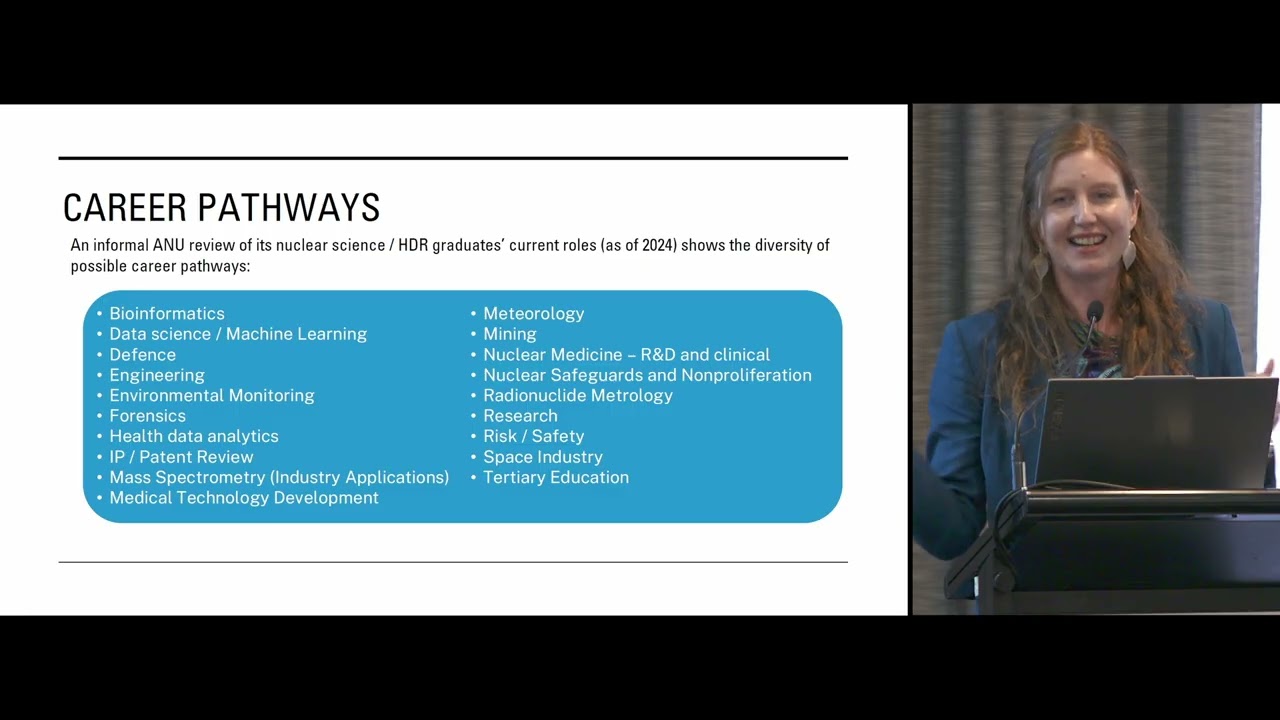
- Examples of graduate destinations and factors attracting students to nuclear.
- Introduction of ANREN, its goals, and activities.
- Conclusion: ANREN is unfunded but committed, and invitation to collaborate.
Cited Sources
- AUKUS agreement — Mentioned as a driver for increased nuclear workforce demand.
Concurring Sources
- Nuclear Workforce Assessment — IAEA resources on nuclear workforce development, aligning with the talk's themes.
Contribution & Novelties
The talk provides a current overview of the nuclear workforce challenges in Australia, specifically in the tertiary education sector. It introduces ANREN as a new collaborative initiative, which is a novel contribution to the discourse. The emphasis on a ‘whole-of-nation’ approach and the need for nuclear literacy across various sectors is valuable.
Pour aller plus loin :
- Nuclear power in Australia — Provides context on Australia’s nuclear history and current debates.
- AUKUS — Overview of the trilateral security pact and its implications.
- Australian Nuclear Science and Technology Organisation (ANSTO) — Key institution for nuclear research and education in Australia.
99 words
Radar Profile
The radar profile shows moderate scores across all dimensions, indicating a balanced but not highly technical presentation. The talk is more qualitative and policy-oriented, with lower technical depth but reasonable information quality and reliability.
💬 No comments were provided for analysis.