Indonesia's Plans for Nuclear Energy
Keywords
Summary
180 words
Critical Evaluation
Value of the Information & Strength of the Argument
The presentation offers valuable insights into Indonesia’s nuclear policy evolution and practical steps for advocacy. Effendi’s argumentation is persuasive, using comparative energy consumption data and specific policy references. He effectively argues for nuclear as a solution to Indonesia’s energy needs, but the argument is one-sided, lacking discussion of challenges like waste management or public opposition beyond a brief mention. The advocacy tone may reduce perceived objectivity.
Scientific Rigor, Source Quality, Title Accuracy
The speaker cites specific regulations (PP 79/2014, RUPTL 2025-2034) and institutions (BAPETEN, BRIN, DEN), lending credibility. However, many claims are unverified, and no external sources are provided in the description. The title accurately reflects the content. The presentation is an expert opinion rather than a peer-reviewed study, so scientific rigor is moderate.
133 words
Title / Content Match
The title accurately reflects the content, which focuses on Indonesia's nuclear energy plans, policies, and challenges.
Quality & Reliability
7/10
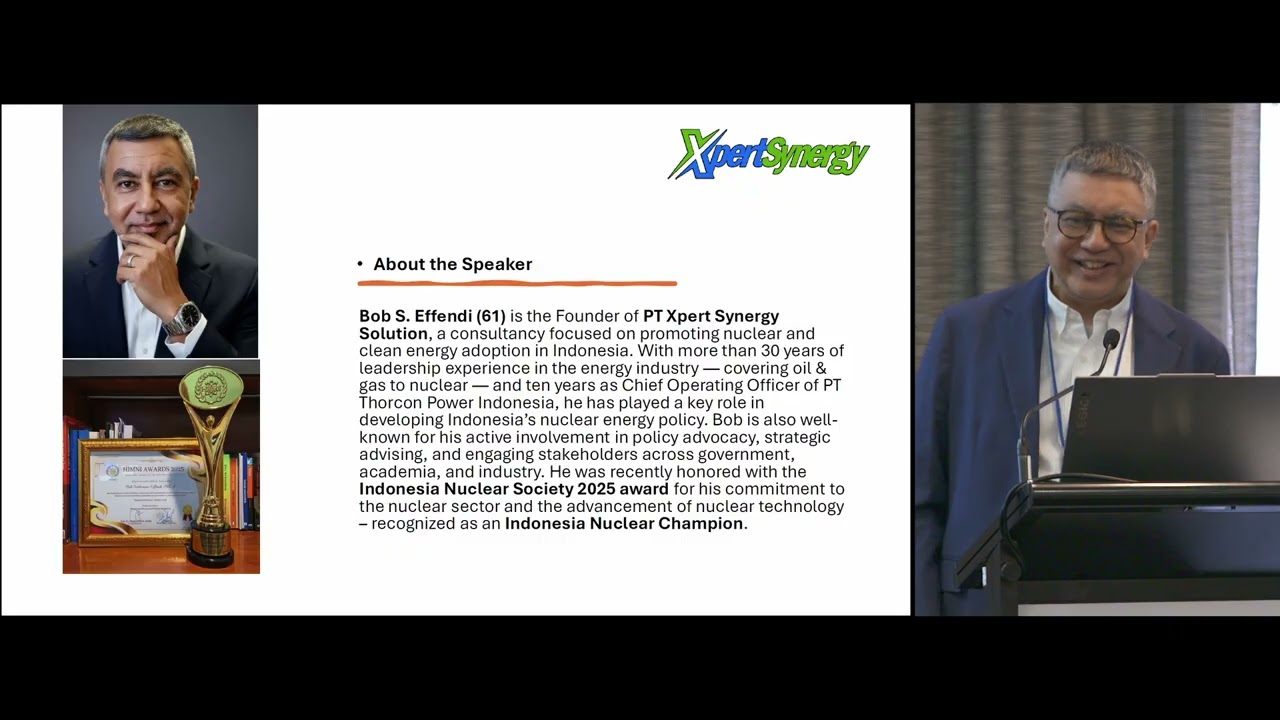
The speaker is a nuclear industry professional with 30 years of experience, including as COO of PT Thorcon Power Indonesia. He provides specific policy references and regulatory details, but the presentation is largely an advocacy piece with personal opinions and some unverified claims.
Key Moments
Markers derived by PSI from the transcript: the creator did not define chapters.
- Introduction of Bob S. Effendi and his background.
- Discussion on the 'why' for nuclear in Indonesia: prosperity, affordability, reliability, fuel security.
- History of nuclear in Indonesia: BATAN, BAPETEN, and past failed projects.
- Current policy shifts: PP 79/2014 to RUPTL 2025-2034, allocation of 250 MW each in Bangka Belitung and West Kalimantan.
- Role of BAPETEN and IAEA's SMR Regulatory Harmonization Initiative.
- Future targets: 10 GW by 2040, 54 GW by 2060, and repowering coal plants.
- Lessons learned for nuclear advocacy: persistence, narrative, champions, and not dancing to anti-nuclear tunes.
Cited Sources
- Australian Nuclear Association — Host of the ANA2025 Conference where this presentation was given.
Concurring Sources
- World Nuclear Association - Indonesia — Provides background on Indonesia's nuclear program and policy, consistent with the presentation.
Dissenting Sources
- No direct discordant sources found — The presentation is an advocacy piece; no specific discordant sources were cited.
Contribution & Novelties
The presentation provides an insider’s perspective on Indonesia’s nuclear policy evolution and advocacy strategies. It highlights the shift from ’last resort’ to a viable option, the role of the NEPIO, and the importance of regulatory harmonization for SMRs. The speaker’s personal experience adds unique insights.
Pour aller plus loin :
- IAEA SMR Regulatory Harmonization — Official IAEA page on SMRs and regulatory harmonization.
- BAPETEN — Indonesia’s nuclear energy regulatory agency.
- RUPTL (Electricity Supply Business Plan) — PLN’s electricity plan, though the 2025-2034 version may not be publicly available; this is a related document.
- Nuclear Energy in Indonesia - World Nuclear Association — Overview of Indonesia’s nuclear program.
107 words
Radar Profile
The radar profile shows high scores in quantity and quality of information, reflecting the speaker's expertise and detailed policy knowledge. The technical level is moderate, suitable for a general audience. Overall reliability is good but limited by the lack of external citations.
💬 No comments were provided for analysis.