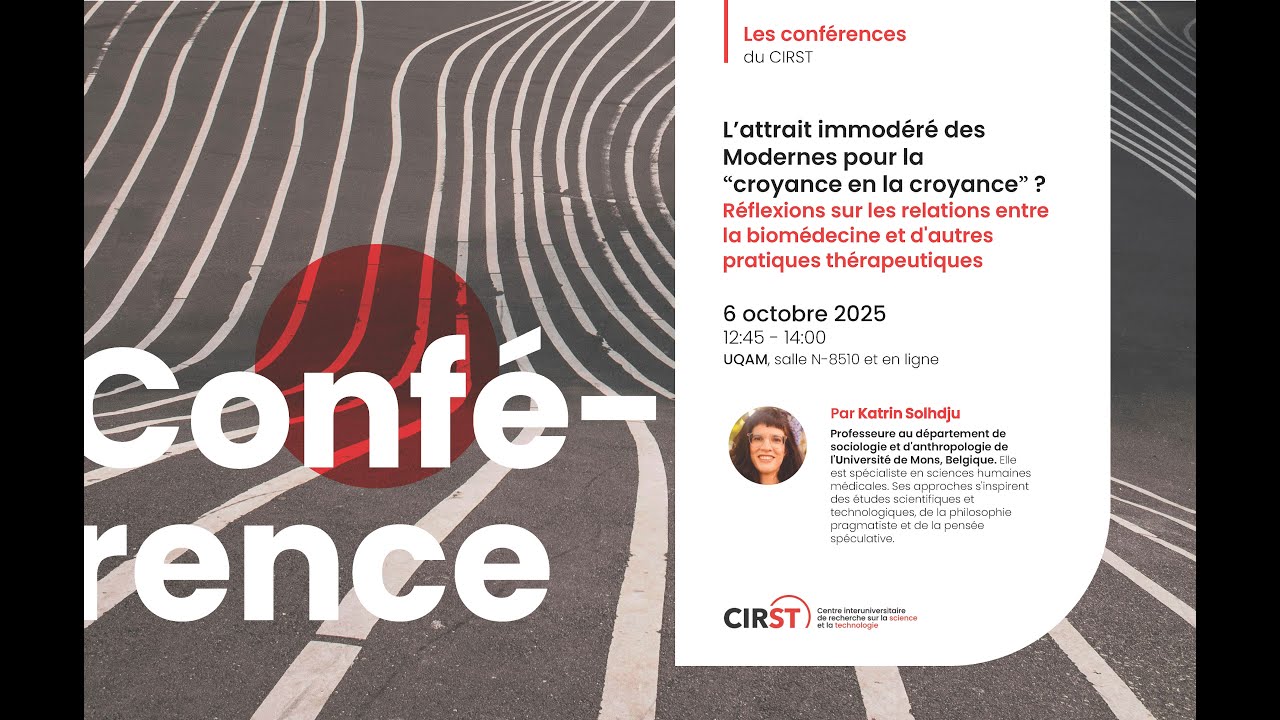
L'attrait immodéré des modernes pour la "croyance en la croyance"? // Katrin Solhdju
Keywords
Summary
174 words
Critical Evaluation
Value of the Information & Strength of the Argument
The lecture provides a valuable critical perspective on the integration of traditional medicine into modern healthcare, highlighting the epistemic injustices and ontological assumptions that underlie current policies. The argument is well-structured, drawing on theoretical frameworks from Latour and Descola, and is supported by concrete examples from postcolonial contexts. The speaker effectively demonstrates how the ‘belief in belief’ leads to a circular disqualification of practices that do not conform to modern scientific criteria. However, the argumentation could be strengthened by more empirical evidence and a deeper engagement with counterarguments. The proposal for a medicine based on ‘épreuve’ is thought-provoking but remains somewhat abstract and would benefit from more concrete elaboration.
Scientific Rigor, Source Quality, Title Accuracy
The lecture demonstrates scientific rigor by grounding its analysis in the works of established scholars like Bruno Latour and Philippe Descola, and by referencing specific historical and contemporary cases. The sources cited are relevant and credible, though the lecture does not provide a comprehensive literature review. The title accurately reflects the content, which focuses on the modern tendency to believe in others’ beliefs, particularly in the medical field. The lecture is well-organized and the argument is coherent, though it could be more concise. The speaker’s academic background and the institutional setting (CIRST) lend credibility to the presentation.
221 words
Title / Content Match
The title accurately reflects the content, which explores the modern tendency to believe in others' beliefs, particularly in the medical field.
Quality & Reliability
8/10
The lecture is based on a well-established theoretical framework (Bruno Latour, Philippe Descola) and presents a coherent argument supported by historical and contemporary examples. The speaker is a professor in sociology and anthropology, and the talk is given at a university research center. However, the lecture is not peer-reviewed and represents the author's interpretation, so a score of 8 reflects high quality but not absolute certainty.
Key Moments
Markers derived by PSI from the transcript: the creator did not define chapters.
- Introduction and context of the lecture, mentioning the WHO strategy on traditional medicine.
- Discussion of the problematic assumptions in integrating TCAM, focusing on evidence-based medicine and the extraction of biochemical resources.
- Examples from Mozambique and Madagascar illustrating the disqualification of traditional medicine and the 'belief in belief'.
- Exploration of the role of belief in modern medicine, particularly in clinical trials and the placebo effect.
- Proposal for a medicine based on 'épreuve' and the need to address the contamination of belief in belief.
Cited Sources
- Enquête sur les modes d'existence — Referenced as the main theoretical framework for the concept of 'belief in belief' and the analysis of modern epistemology.
- Sur le culte moderne des dieux faitiches — Referenced as an earlier work by Latour that introduces the concept of 'faitiche' and the critique of modern belief.
- Philippe Descola's work on nature and culture — Referenced for the idea that the nature/culture distinction is not universal but a modern construct.
- Maria Paula Menéndez's research on traditional medicine in Mozambique — Referenced for the case study on the disqualification and extraction of traditional medical knowledge in Mozambique.
Concurring Sources
- WHO Traditional Medicine Strategy 2014-2023 — The lecture critiques the WHO's approach to integrating traditional medicine, which aligns with the speaker's argument.
Dissenting Sources
- Evidence-based medicine: a movement in crisis? — Some scholars argue that evidence-based medicine is not inherently dismissive of traditional practices but rather provides a framework for evaluating all interventions, which may conflict with the lecture's critique.
Contribution & Novelties
The lecture offers a novel application of Latour’s concept of ‘belief in belief’ to the medical field, particularly in postcolonial contexts. It highlights the epistemic injustice inherent in the integration of traditional medicine and proposes a shift from ‘proof’ to ’trial’ (épreuve) as a way to acknowledge the ontological openness of healing practices. This perspective challenges the dominance of evidence-based medicine and opens up new avenues for thinking about medical pluralism.
Pour aller plus loin :
- Bruno Latour’s ‘Enquête sur les modes d’existence’ — Essential reading for understanding the theoretical framework.
- Philippe Descola’s ‘Beyond Nature and Culture’ — Provides the anthropological background on the nature/culture distinction.
- Maria Paula Menéndez’s work on traditional medicine — Offers empirical case studies on the topic.
- The concept of ’epistemic injustice’ — Relevant for understanding the systematic devaluation of traditional knowledge.
136 words
Radar Profile
The radar profile shows high scores in information quality and reliability, reflecting the lecture's strong theoretical grounding and academic rigor. The technical level is moderate, indicating that the content is accessible to a general academic audience but requires some familiarity with the concepts. The quantity of information is substantial, covering multiple examples and theoretical points.
💬 No comments were provided for analysis.