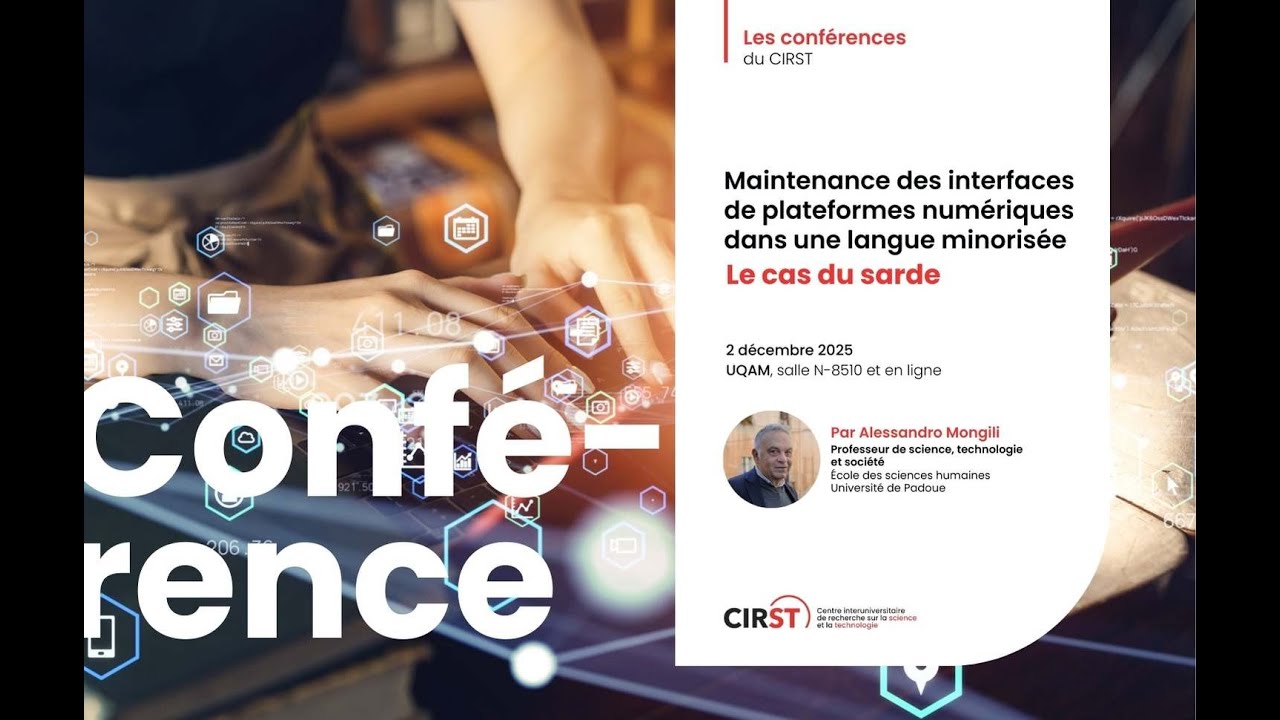
Maintenance des interfaces de plateformes numériques dans une langue minorisée
Keywords
Summary
182 words
Critical Evaluation
Value of the Information & Strength of the Argument
The value of the information lies in its detailed ethnographic account of a specific case of digital language activism, providing insights into the sociotechnical processes of localization and maintenance. The argumentation is solid, grounded in the speaker’s long-term engagement and fieldwork, and he effectively uses examples to illustrate the challenges and strategies of the Sardinian localization community. The talk contributes to discussions on language endangerment, digital inclusion, and the politics of platforms.
Scientific Rigor, Source Quality, Title Accuracy
The speaker is a credible academic with relevant expertise, and he references his own research and the activities of the Sardware collective. However, the presentation does not provide formal citations or a bibliography, and some claims are based on personal observation. The title accurately reflects the content, and the talk is well-structured, though it is a conference presentation rather than a peer-reviewed study.
150 words
Title / Content Match
The title accurately reflects the content, which focuses on the maintenance of digital platform interfaces in a minority language (Sardinian).
Quality & Reliability
7/10
The speaker is a recognized sociologist and STS researcher, and the presentation is based on his ongoing fieldwork. However, the talk is a conference presentation, not a peer-reviewed publication, and some claims are anecdotal or based on personal experience.
Key Moments
Markers derived by PSI from the transcript: the creator did not define chapters.
- Introduction and presentation of the speaker by the host.
- Mongili introduces the concept of localization and its importance for minority languages.
- Discussion of the Sardinian language and its sociolinguistic context.
- History of Sardinian localization starting with Facebook in 2014.
- Challenges of maintaining translations due to frequent platform updates.
- Preference for open-source platforms and the role of activists.
- The impact of Google Translate's omission of Sardinian in 2024.
- Discussion of the lack of standardized written form and its implications.
- The shift from design to maintenance and the invisible work of care.
- Conclusion and opening for questions.
Cited Sources
- Sardware collective — The group of activists and technicians working on Sardinian localization.
- Facebook translator app — Facebook's initiative that allowed volunteer translators to work on minority languages.
- Telegram — Messaging platform that became the most important localization project for Sardinian.
- Firefox — Web browser whose localization is a central part of the research.
- Wikipedia — Online encyclopedia with a Sardinian version and localization tools.
- Google Translate — Mentioned in the context of the omission of Sardinian in 2024.
Concurring Sources
- Sardinian language on Wikipedia — Provides background on the Sardinian language and its status.
- Digital language activism — Relates to the broader phenomenon of using digital tools for language preservation.
Contribution & Novelties
The talk provides a unique ethnographic perspective on the maintenance of digital platforms in a minority language, highlighting the often invisible work of localizers and the challenges they face. It contributes to the fields of STS, language activism, and digital studies.
Pour aller plus loin :
- Language revitalization — Relevant for understanding broader efforts to preserve minority languages.
- Software localization — Provides background on the technical process of localization.
- Maintenance and repair in STS — Connects to the concept of maintenance as a form of care.
86 words
Radar Profile
The radar profile shows a balanced performance with moderate to high scores across all dimensions, indicating a well-rounded presentation. The highest scores are in information quantity and quality, reflecting the depth of the ethnographic data, while the technical level is slightly lower, as the talk is accessible to a general audience.