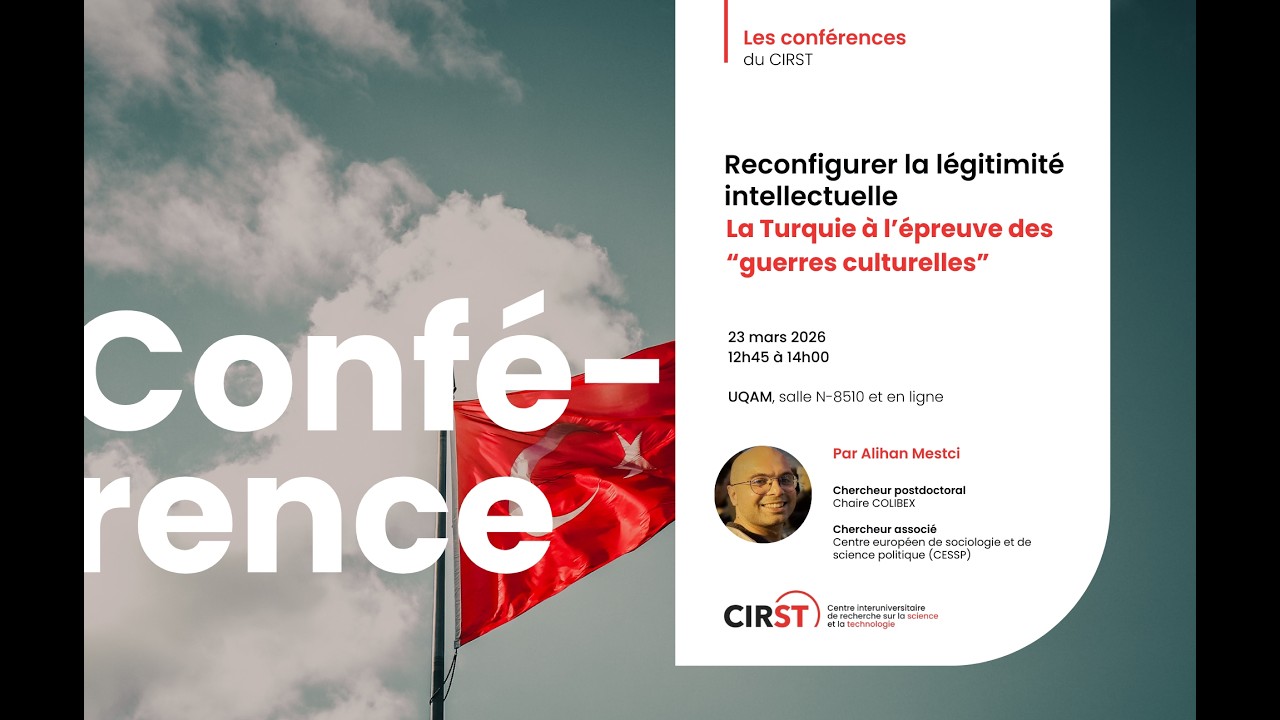
Reconfigurer la légitimité intellectuelle. La Turquie à l'épreuve des "guerres culturelles"
Keywords
Summary
140 words
Critical Evaluation
Value of the Information & Strength of the Argument
The presentation offers a valuable contribution by deconstructing the notion of ‘cultural wars’ and analyzing it as a social construct. The argument is well-structured, moving from a general discussion of the concept to a specific case study. The use of empirical data (corpus, prosopography) strengthens the argumentation. The speaker clearly explains his methodology and the theoretical framework (Bourdieu’s concepts of officialization and symbolic power). The analysis of the four positions within the conservative intellectual field adds nuance and avoids a simplistic binary view. The argument is persuasive and well-supported by evidence.
Scientific Rigor, Source Quality, Title Accuracy
The presentation demonstrates scientific rigor through a clear methodology and the use of diverse sources (archives, corpus, biographical data). The speaker cites relevant literature (e.g., James Davison Hunter) and situates his work within the sociology of public problems. The title accurately reflects the content. The sources are not explicitly listed in the video, but the description mentions the speaker’s affiliation and thesis. The presentation is a conference talk, so it is not peer-reviewed, but the underlying research is likely rigorous.
186 words
Title / Content Match
The title accurately reflects the content, which focuses on the reconfiguration of intellectual legitimacy in Turkey through the lens of cultural wars.
Quality & Reliability
8/10
The presentation is based on a doctoral thesis in sociology, combining prosopography, corpus analysis, and archival materials. The speaker is a postdoctoral researcher affiliated with reputable institutions. The methodology is clearly described, and the argument is supported by empirical data. However, the presentation is a single lecture and not peer-reviewed, and some claims rely on the speaker's interpretation.
Key Moments
Markers derived by PSI from the transcript: the creator did not define chapters.
- Introduction and acknowledgments
- Definition of cultural wars and global context
- Theoretical framework: from conflicts to actors
- Why Turkey? Historical background of AKP and conservative intellectuals
- The 'cultural problem' and its officialization
- Methodology: corpus and prosopography
- Key figures: Iskender Pala and Mustafa Isen
- The 2012 debate on conservative art and its four positions
- Impact of Gezi protests and diversification of actors
- Conclusion: cultural wars as institutional processes
Cited Sources
- Culture Wars: The Struggle to Define America — Referenced as the origin of the term 'culture wars' in the 1990s.
Concurring Sources
- Culture Wars: The Struggle to Define America — The concept of culture wars as a polarizing force is consistent with Hunter's work.
Contribution & Novelties
The presentation offers a novel perspective on cultural wars by analyzing them as a product of institutional processes rather than as pre-existing conflicts. It provides a detailed case study of Turkey, showing how the discourse on cultural wars was constructed and institutionalized by conservative intellectuals and state actors. The use of prosopography and corpus analysis is methodologically innovative.
Pour aller plus loin :
- Pierre Bourdieu’s concept of symbolic power — Relevant for understanding the mechanisms of legitimacy and officialization.
- Sociology of public problems — Provides a framework for analyzing how issues are constructed and recognized.
- James Davison Hunter’s Culture Wars — The foundational text on culture wars in the US context.
111 words
Radar Profile
The radar profile shows high scores in quantity and quality of information, indicating a well-researched and informative presentation. The technical level is moderate, suitable for an academic audience. The overall reliability is high, reflecting the speaker's expertise and methodological rigor.