4.2 Balistique avec frottement
Keywords
Summary
161 words
Critical Evaluation
Value of the Information & Strength of the Argument
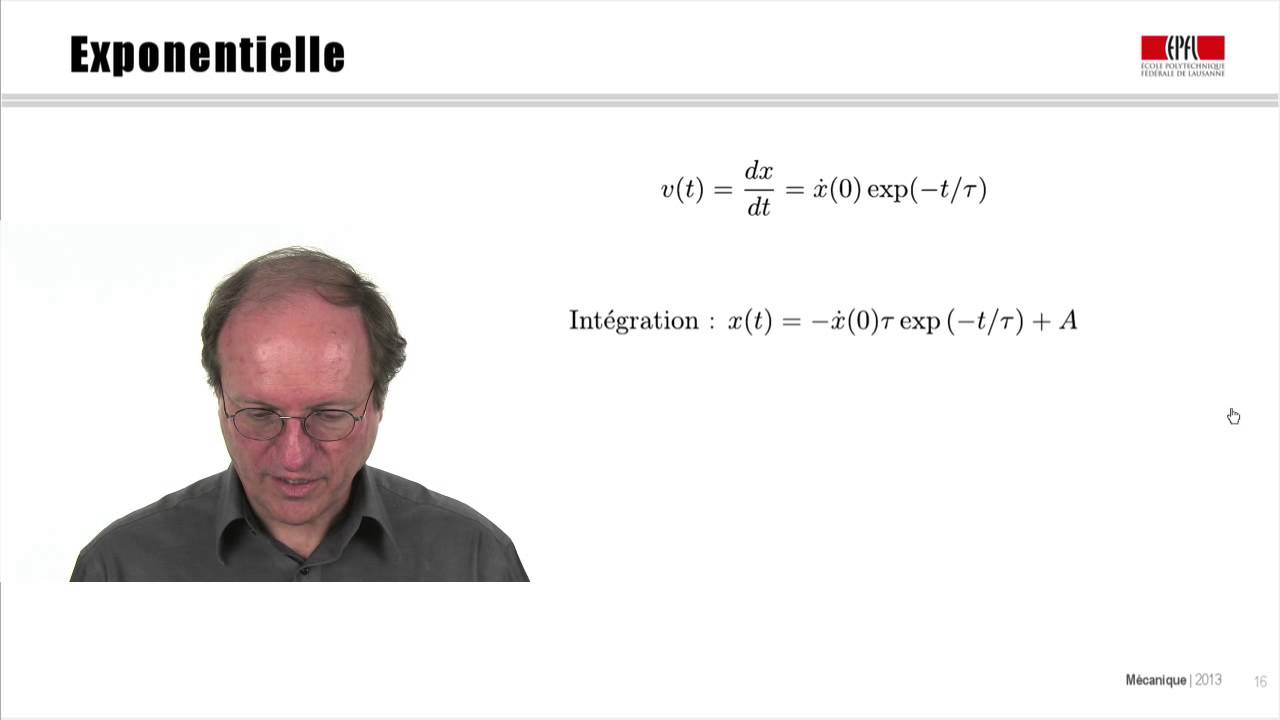
The video provides a solid, step-by-step derivation of projectile motion with linear drag, which is valuable for students learning classical mechanics. The argumentation is clear and logical, building from Newton’s second law to the solution of differential equations. The instructor emphasizes the physical meaning of the time constant tau and the terminal velocity, which enhances understanding. The use of qualitative analysis (asymptotes, limits) before full integration is pedagogically effective. However, the video does not discuss the limitations of the linear drag model or compare with experimental data, which would strengthen the argumentation.
Scientific Rigor, Source Quality, Title Accuracy
The scientific rigor is high: the derivation follows standard methods and the physics is correct. The sources are not explicitly cited in the video, but the description links to the Coursera course, which is a reputable educational platform. The title accurately reflects the content. No comments were provided for analysis.
157 words
Title / Content Match
The title accurately reflects the content, which focuses on projectile motion with friction (drag).
Quality & Reliability
8/10
The video is a clear, step-by-step derivation of projectile motion with linear drag, based on Newton's laws. The physics is standard and correctly presented, with appropriate mathematical rigor. The instructor is from EPFL, a reputable institution, and the content aligns with established mechanics. Minor limitations: no experimental validation or discussion of model limitations beyond the linear drag assumption.
Key Moments
Markers derived by PSI from the transcript: the creator did not define chapters.
- Introduction: goal to add friction to ballistic model.
- Setting up the drag force model and equations of motion.
- Solving the horizontal differential equation, introducing tau.
- Qualitative analysis of horizontal solution: asymptote and initial linear behavior.
- Vertical motion: terminal velocity and change of variables.
- Integrating vertical motion with initial conditions.
- Discussion of trajectory for low and high drag.
- Conclusion: effect of friction on projectile motion.
Cited Sources
- MOOC Mécanique EPFL — The video is part of this MOOC, and the description links to the full course.
Concurring Sources
- Classical Mechanics (Wikipedia) — General principles of mechanics, including Newton's laws and projectile motion.
Contribution & Novelties
The video provides a clear pedagogical derivation of projectile motion with linear drag, emphasizing qualitative analysis and the physical meaning of the time constant. It is a standard topic, but the presentation is effective for learners.
Pour aller plus loin :
- Drag (physics) — Overview of drag forces and models.
- Terminal velocity — Concept of terminal velocity in fluid dynamics.
- Ordinary differential equation — Background on solving differential equations.
69 words
Radar Profile
The radar profile shows high scores in quality and reliability, with moderate scores in quantity and technical level. This indicates a focused, accurate tutorial that may not cover a wide range of topics but provides solid depth in the specific area.