17.1 Systèmes de points matériels
Keywords
Summary
194 words
Critical Evaluation
Value of the Information & Strength of the Argument
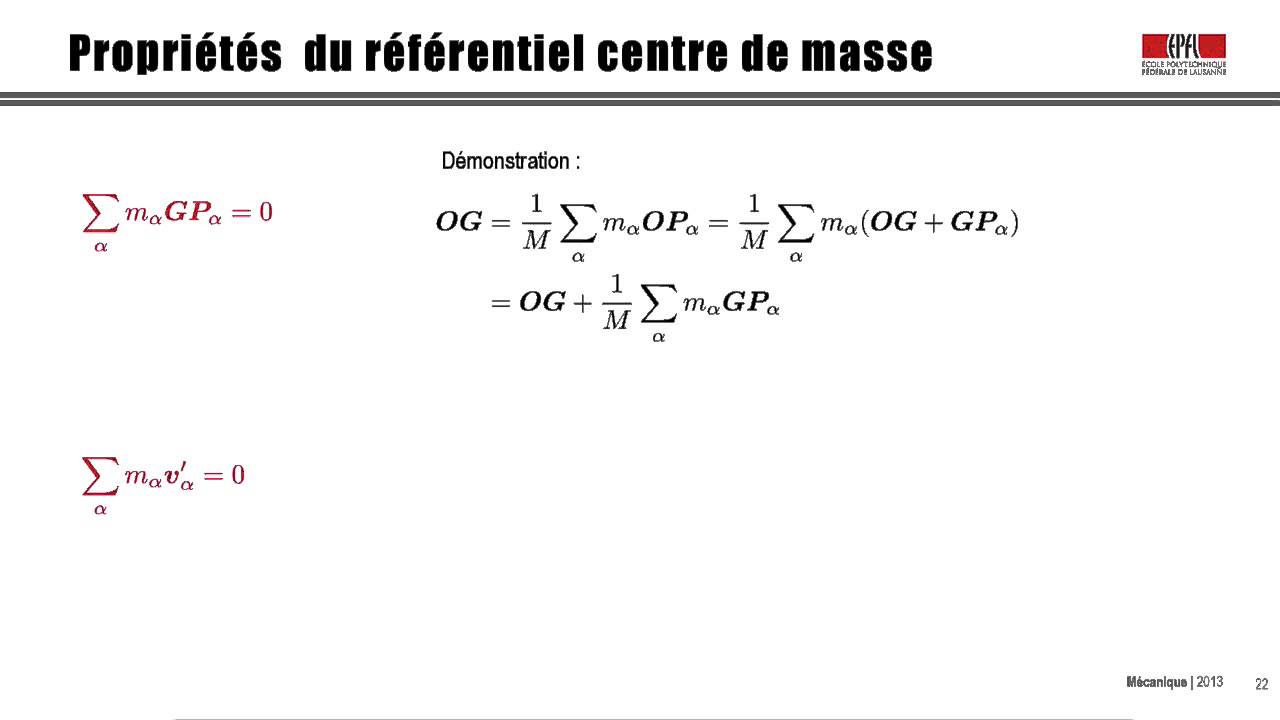
The lecture provides a clear and rigorous derivation of the fundamental principles governing systems of point masses. It builds logically from the definition of center of mass to the theorems of momentum and angular momentum, and then to conservation laws. The argumentation is solid, with explicit proofs for the independence of the center of mass from the origin and the properties of the center-of-mass frame. The extension of Newton’s third law to central forces is well-motivated and crucial for the subsequent derivations. The value lies in its pedagogical clarity and the emphasis on the correct interpretation of the equation for the center of mass, avoiding common misconceptions.
Scientific Rigor, Source Quality, Title Accuracy
The lecture is scientifically rigorous, with all derivations based on Newton’s laws and standard definitions. The sources are not explicitly cited within the video, but the content aligns with established mechanics textbooks. The title accurately reflects the content, which is a focused treatment of systems of point masses. The lecture is part of a reputable MOOC from EPFL, enhancing its credibility.
183 words
Title / Content Match
The title accurately reflects the content, which focuses on systems of point masses.
Quality & Reliability
9/10
The lecture is part of an EPFL MOOC, presented by a professor, and covers fundamental mechanics with rigorous derivations. The content is mathematically sound and aligns with standard physics textbooks.
Key Moments
Markers derived by PSI from the transcript: the creator did not define chapters.
- Introduction to the lecture on systems of point masses.
- Definition of the center of mass and proof of its independence from origin.
- Definition of the center-of-mass frame and its properties.
- Generalization of Newton's third law to central forces.
- Derivation of the theorems of momentum and angular momentum for the system.
- Conservation principles for momentum and angular momentum.
- Discussion of conservation of components along fixed directions.
Cited Sources
- MOOC Mécanique - Coursera — The full MOOC is available on Coursera.
Concurring Sources
- Classical Mechanics (Goldstein) — Standard textbook covering similar topics.
Contribution & Novelties
The lecture provides a clear and rigorous introduction to the dynamics of systems of point masses, emphasizing the correct interpretation of the center-of-mass equation. It is particularly valuable for its pedagogical approach, deriving conservation laws from fundamental principles.
Pour aller plus loin :
- Center of mass — For a broader overview of the concept.
- Newton’s laws of motion — To review the foundational laws.
- Conservation of momentum — To explore applications and implications.
73 words
Radar Profile
The radar profile shows high scores in information quality and reliability, with slightly lower scores in quantity and technical level, indicating a focused and rigorous lecture that may not cover all aspects of the topic but is excellent in its depth.