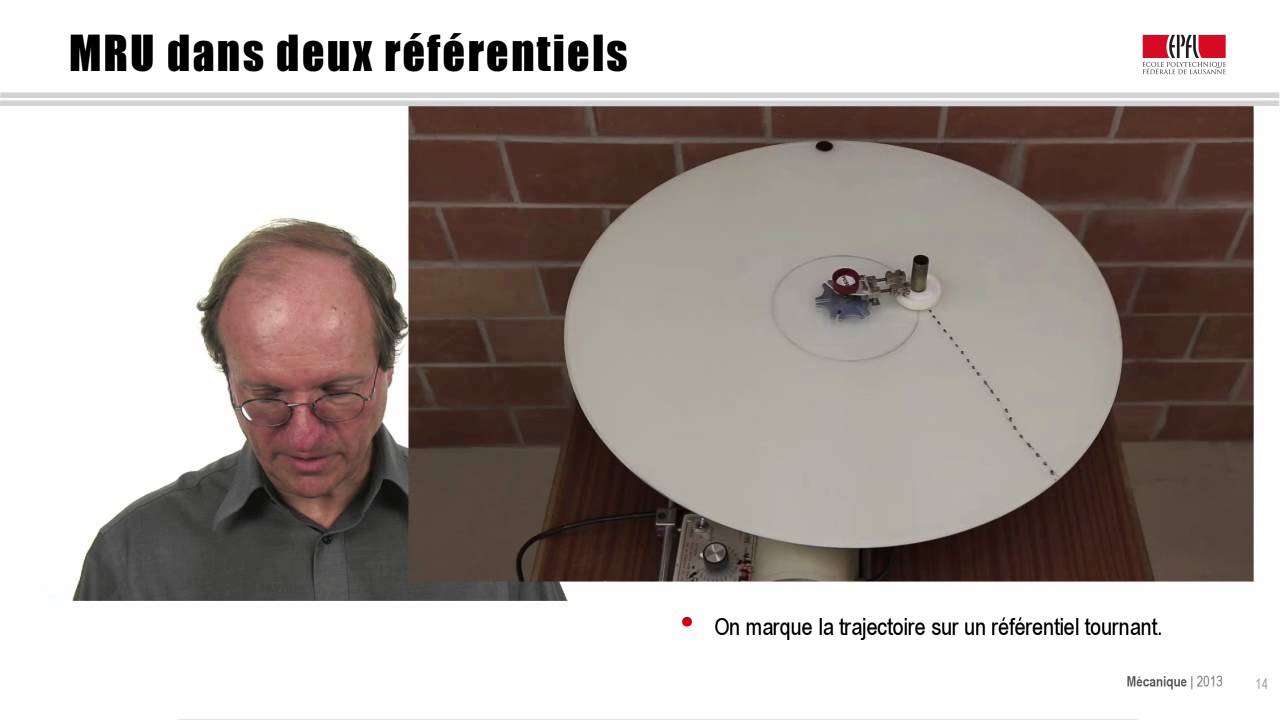
15.3 Mouvement vu d'un référentiel en rotation, débitmètre de Coriolis
Keywords
Summary
127 words
Critical Evaluation
Value of the Information & Strength of the Argument
The video provides clear experimental demonstrations that effectively illustrate the theoretical concepts of rotating frames and the Coriolis force. The argumentation is solid: the instructor derives the Coriolis acceleration and applies it to explain the observed phenomena, including a quantitative estimate of the radius of curvature. The reasoning is logical and well-supported by the experiments, making the content convincing and pedagogically effective.
Scientific Rigor, Source Quality, Title Accuracy
The scientific rigor is high, as the content is based on established mechanics principles and presented by a professor from a reputable institution. However, no explicit sources are cited within the video, and the only external link is to the Coursera course. The title accurately reflects the content, and the video is well-structured. No comments were provided for analysis.
136 words
Title / Content Match
The title accurately describes the content: it covers motion in rotating frames and the Coriolis flowmeter.
Quality & Reliability
8/10
The video is part of a formal MOOC from EPFL, presented by a professor, and demonstrates physical principles with experiments and mathematical derivations. The content is accurate and well-structured, though it lacks explicit citations to external sources.
Key Moments
Markers derived by PSI from the transcript: the creator did not define chapters.
- Introduction to the lesson on non-inertial frames and preview of experiments.
- Water jet experiment shown in the lab frame and rotating frame.
- Explanation of the curved jet using the Coriolis force formula.
- Quantitative analysis of the radius of curvature of the water jet.
- Experiment with a pen released from a rotating tube, shown in both frames.
- Comparison of the pen trajectory to the water jet.
- Introduction to the Coriolis flowmeter and its oscillation.
- Explanation of the twisting motion using Coriolis force.
- Discussion of the forces on the tube and connection to the ball in a ring example.
Cited Sources
- MOOC Mécanique - Coursera — Link to the full MOOC course.
Concurring Sources
- Coriolis force (Wikipedia) — General reference on the Coriolis force.
Contribution & Novelties
The video offers a clear pedagogical demonstration of the Coriolis effect using simple experiments, making abstract concepts tangible. It bridges theory and practice by showing real-world applications like the Coriolis flowmeter.
Pour aller plus loin :
- Coriolis force (Wikipedia) — Overview of the Coriolis force and its applications.
- Rotating reference frame (Wikipedia) — Detailed explanation of non-inertial frames.
- Mass flow meter (Wikipedia) — Information on Coriolis flowmeters and their principle.
70 words
Radar Profile
The radar profile shows high scores in information quality, technical level, and reliability, with a slightly lower score in information quantity due to the short duration. This indicates a focused, technically sound educational video.