Keywords
Summary
150 words
Critical Evaluation
Value of the Information & Strength of the Argument
The video provides a clear and rigorous demonstration of applying Lagrange’s method to a physical system with constraints. The argumentation is solid, with step-by-step derivations and physical interpretations. The use of a real experiment enhances the value by connecting theory to observation. The concept of a soft mode is well-illustrated and linked to critical phenomena.
Scientific Rigor, Source Quality, Title Accuracy
The scientific rigor is high, as the lecture is part of an accredited MOOC from EPFL, and the instructor is a professor. However, no external sources are cited within the video, and the only reference is the Coursera course link. The title is somewhat generic but does not mislead; it accurately reflects the experimental nature of the content. The video’s content aligns with the title, as it presents experiments and theoretical analysis.
142 words
Title / Content Match
The title '25.3 Expériences' is somewhat vague but appropriate as it presents experimental demonstrations of the theoretical concepts discussed.
Quality & Reliability
8/10
The video is a lecture from an EPFL MOOC, presented by a professor, with rigorous mathematical derivations and physical demonstrations. The content is well-structured and accurate, though it lacks explicit citations to external sources.
Key Moments
Markers derived by PSI from the transcript: the creator did not define chapters.
- Introduction to the module on holonomic constraints and plan for the lecture.
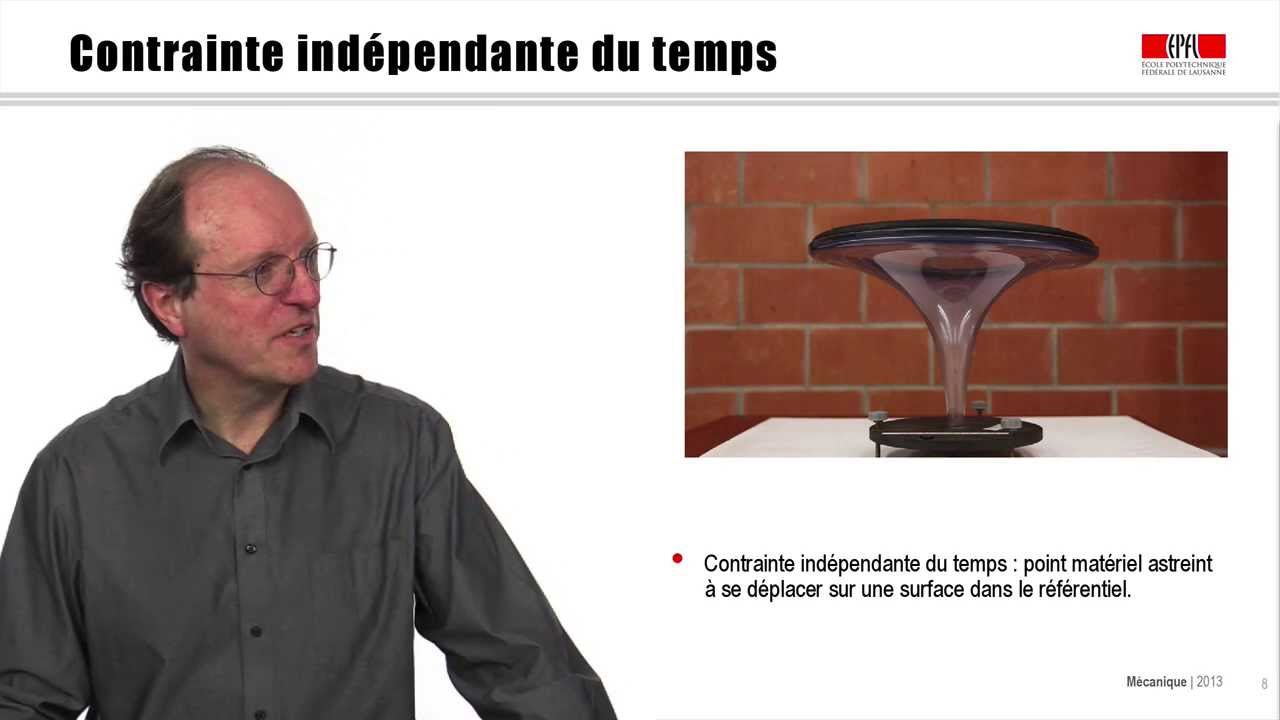
- Example of a time-independent constraint: bead on a surface.
- Introduction of the time-dependent constraint: bead in a rotating hemispherical track.
- Demonstration of the physical system: increasing angular velocity leads to instability and oscillations.
- Derivation of the Lagrangian and equations of motion using spherical coordinates.
- Finding equilibrium positions and the critical angular velocity.
- Stability analysis of the bottom equilibrium (θe=π) and the onset of instability.
- Stability analysis of the new equilibrium and derivation of the oscillation frequency.
- Summary graph showing the soft mode: frequency tends to zero at the critical point.
Cited Sources
- MOOC Mécanique - Coursera — The full MOOC course is available on Coursera.
Concurring Sources
- Classical Mechanics (Goldstein) — Standard textbook covering Lagrangian mechanics and small oscillations.
Contribution & Novelties
The video provides a clear pedagogical demonstration of the soft mode phenomenon in a mechanical system, linking theoretical analysis with experimental observation. It effectively illustrates the use of Lagrange’s equations for systems with time-dependent constraints and the stability analysis of equilibria.
Pour aller plus loin :
- Soft mode — Wikipedia article on soft modes in phase transitions.
- Lagrangian mechanics — Overview of Lagrangian mechanics.
- Holonomic constraints — Definition and examples.
70 words
Radar Profile
The radar profile shows high scores in information quantity, quality, technical level, and reliability, indicating a well-rounded and authoritative educational resource.