21.3 Effets gyroscopiques, y compris à rotation propre nulle
Keywords
Summary
151 words
Critical Evaluation
Value of the Information & Strength of the Argument
The video provides valuable educational content by combining physical demonstrations with mathematical explanations. The argumentation is solid, as each effect is derived from fundamental principles (e.g., dL/dt = torque, inertia tensor) and verified through experiments. The instructor carefully explains the direction of precession using the right-hand rule and vector cross products, making the reasoning accessible. The demonstrations are clear and well-integrated, reinforcing the theoretical concepts. The discussion of the inertia tensor’s symmetry is particularly insightful, showing how it affects dynamic behavior. The final example of the rotating pendulum illustrates a subtle gyroscopic effect even without proper rotation, which is a nuanced and valuable point.
Scientific Rigor, Source Quality, Title Accuracy
The scientific rigor is high, as the content is based on classical mechanics principles and presented by an academic expert. The demonstrations are reproducible and the mathematical derivations are correct. However, the video does not cite specific external sources; it only references the MOOC on Coursera. The title accurately describes the content, which covers gyroscopic effects including cases with zero proper rotation. The video is well-structured and the explanations are precise.
190 words
Title / Content Match
The title accurately reflects the content, which covers gyroscopic effects including cases with zero proper rotation.
Quality & Reliability
8/10
The video is an educational lecture from a reputable institution (EPFL) with clear demonstrations and mathematical derivations. The content is accurate and well-structured, but it lacks explicit citations to external sources and is based on established physics principles.
Key Moments
Markers derived by PSI from the transcript: the creator did not define chapters.
- Introduction and overview of the lesson topics.
- Demonstration of a bicycle wheel as a top, showing precession.
- Analysis of precession direction using right-hand rule and torque equation.
- Experiment with wheel center of mass aligned with pivot, showing constant angular momentum.
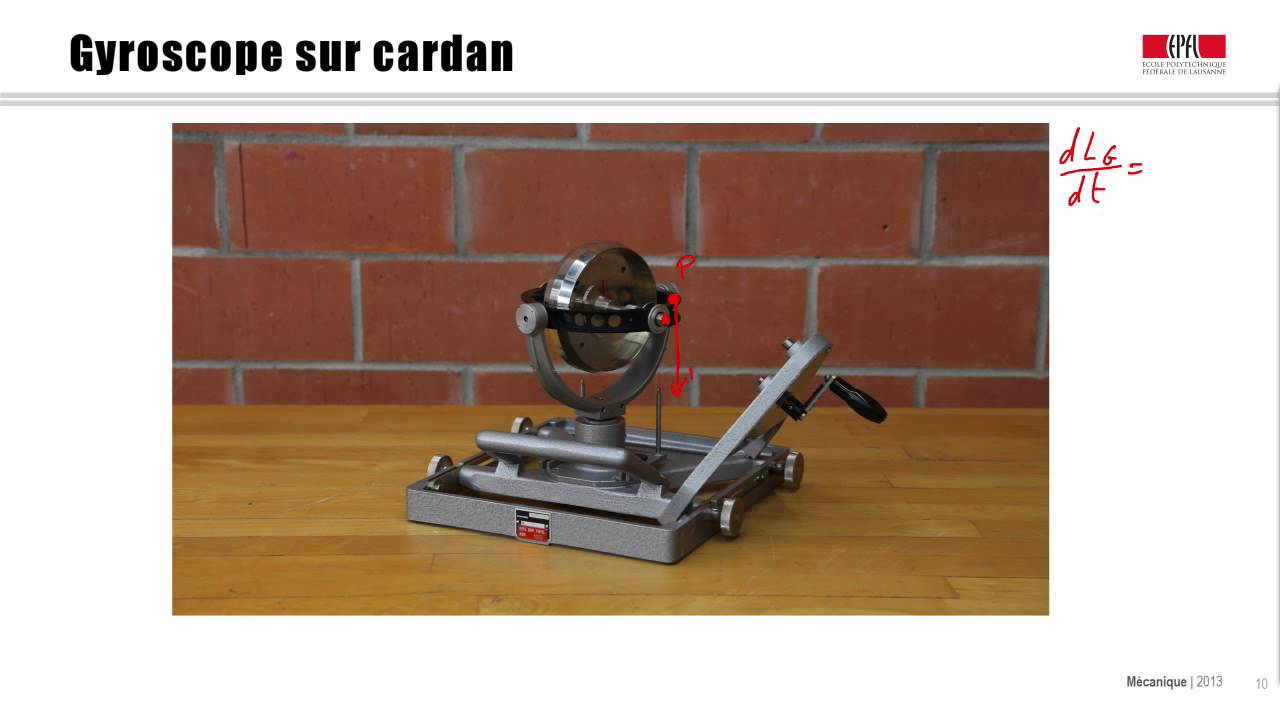
- High-precision gyroscope on gimbals, demonstration of precession under load.
- Analysis of gyroscope precession direction using torque and angular momentum.
- Discussion of inertia tensor symmetry with two-blade propeller, showing vibrations.
- Demonstration of three-blade propeller with symmetric inertia, smoother rotation.
- Rotating pendulum experiment with point mass and rod, showing different inclinations.
- Analysis of gyroscopic effect on rod without proper rotation, using inertia tensor.
Cited Sources
- MOOC Mécanique (Coursera) — The video is part of this MOOC, and the description links to it as the full course.
Concurring Sources
- Classical Mechanics (Goldstein) — Standard textbook covering gyroscopic motion and inertia tensor, consistent with the video's content.
Contribution & Novelties
The video offers a clear and practical demonstration of gyroscopic effects, emphasizing qualitative analysis and the role of the inertia tensor. It uniquely illustrates the effect of inertia tensor symmetry on dynamic behavior, and shows a gyroscopic effect even without proper rotation, which is often overlooked. The demonstrations are well-chosen and the explanations are rigorous.
Pour aller plus loin :
- Gyroscope — Overview of gyroscope principles and applications.
- Precession — Detailed explanation of precession phenomena.
- Moment of inertia — Fundamental concept used in the video.
- Rigid body dynamics — Theoretical background for the demonstrations.
94 words
Radar Profile
The radar profile shows high scores in quality, technical level, and reliability, with a slightly lower score in quantity of information due to the short duration. This indicates a focused, rigorous educational video with strong technical depth.