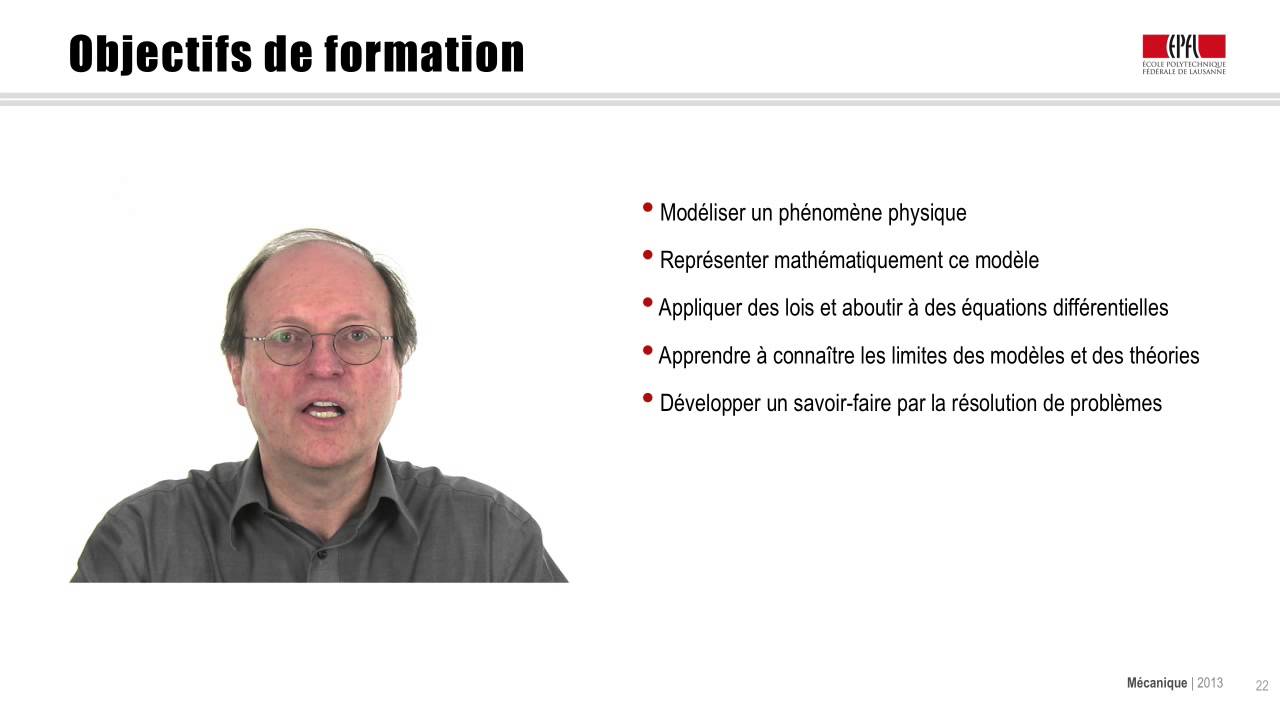
1.1 Etudier la mécanique
Keywords
Summary
160 words
Critical Evaluation
Value of the Information & Strength of the Argument
The video provides a valuable perspective on the role of mechanics in science and education. It argues that mechanics is fundamental for scientists and engineers, and it offers a clear historical narrative from Galileo to modern physics. The argumentation is coherent and well-structured, emphasizing the importance of mathematical modeling and the hypothetico-deductive method. However, it lacks concrete examples or demonstrations, and the discussion of scientific explanation is somewhat abstract. The value lies in its motivational and conceptual framing rather than in detailed technical content.
Scientific Rigor, Source Quality, Title Accuracy
The video is scientifically rigorous, as it is presented by a professor and aligns with established physics education. It does not cite specific sources, but it references historical figures like Galileo, Newton, Laplace, and Poincaré, which are well-known. The title ‘1.1 Etudier la mécanique’ accurately reflects the content, which is an introduction to studying mechanics. The video does not include any advertising or sponsored content.
164 words
Title / Content Match
The title accurately reflects the content, which is an introduction to the study of mechanics.
Quality & Reliability
8/10
The video is an introductory lecture by a university professor, presenting a historical and conceptual overview of mechanics. It is scientifically sound, but it is not a detailed technical exposition and does not provide citations for specific claims.
Key Moments
Markers derived by PSI from the transcript: the creator did not define chapters.
- Introduction to the course and its structure.
- Historical context: Galileo and the birth of modern science.
- Newton's contribution and the mathematical foundation of mechanics.
- Explanation of scientific explanation: 'how' vs 'why'.
- Learning objectives: modeling and mathematical representation.
- Importance of problem-solving skills and systematic approach.
- Use of mathematics in physics and its challenges.
- Role of experiments in physics and their historical significance.
- Laplace's determinism and Poincaré's chaos.
- Relativity and quantum mechanics as mechanical theories.
Cited Sources
- MOOC Mécanique de Newton (Coursera) — First part of the MOOC on Newtonian mechanics.
- MOOC Mécanique du point matériel (Coursera) — Second part of the MOOC on point particle mechanics.
Concurring Sources
- Newton's Principia — Newton's foundational work in mechanics.
Contribution & Novelties
The video provides a motivational and historical introduction to mechanics, emphasizing the scientific method and the role of mathematics. It is not original research but serves as an educational resource. For further exploration, one can look into the history of mechanics, the philosophy of scientific explanation, and the development of chaos theory.
Pour aller plus loin :
- Philosophy of science — Overview of scientific explanation and method.
- History of classical mechanics — Detailed historical account from Galileo to Newton.
- Chaos theory — Poincaré’s contributions and modern chaos theory.
88 words
Radar Profile
The radar profile shows high scores in quality and reliability, moderate in quantity and technical level, indicating a well-structured introductory lecture with solid content but limited depth.
💬 No comments were provided for analysis.