27.1 Systèmes vibratoires discrets, linéaires
Keywords
Summary
140 words
Critical Evaluation
Value of the Information & Strength of the Argument
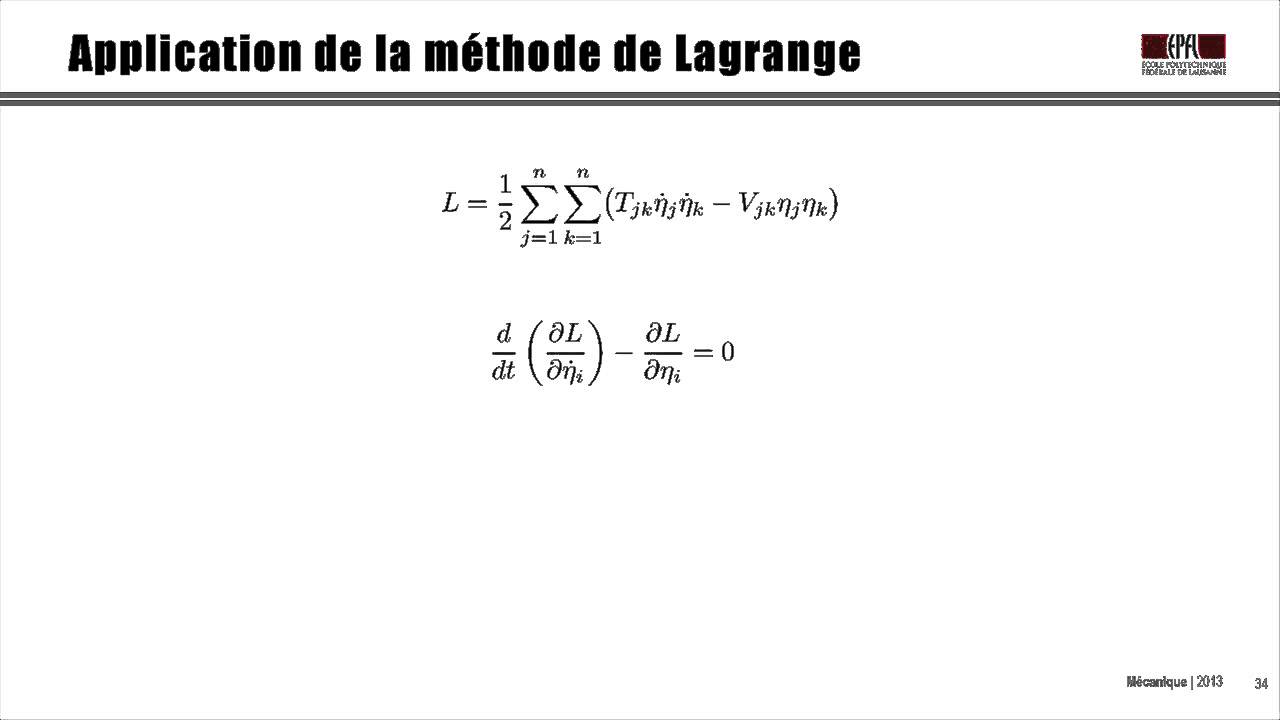
The video provides a clear and rigorous derivation of the equations of motion for coupled harmonic oscillators using Lagrangian mechanics. The argumentation is solid, building step by step from the definition of the system to the matrix formulation and the introduction of normal modes. The use of linear algebra to simplify the equations is well explained, making the content valuable for students of mechanics. The lecture is self-contained, assuming only basic knowledge of calculus and linear algebra.
Scientific Rigor, Source Quality, Title Accuracy
The scientific rigor is high, as the lecture is part of an EPFL MOOC and follows standard textbook derivations. However, no explicit sources are cited within the video; the only reference is the Coursera course link in the description. The title accurately reflects the content, which is focused on discrete linear vibrating systems. The lecture is well-structured and pedagogically effective.
152 words
Title / Content Match
The title accurately reflects the content, which focuses on discrete linear vibrating systems.
Quality & Reliability
8/10
The video is a lecture from a reputable institution (EPFL) and presents a rigorous mathematical derivation of coupled harmonic oscillators using Lagrangian mechanics. The content is accurate and well-structured, though it lacks explicit citations to external sources.
Key Moments
Markers derived by PSI from the transcript: the creator did not define chapters.
- Introduction and overview of the lecture
- Definition of the system and generalized coordinates
- Derivation of kinetic energy using Lagrangian
- Expansion of potential energy to second order
- Matrix formulation of equations of motion
- Introduction of square root of mass matrix and dynamical matrix
- Definition of normal modes and eigenfrequencies
- Introduction of normal coordinates and decoupling
Cited Sources
- MOOC Mécanique - Coursera — The full MOOC is available on Coursera, providing additional resources and exercises.
Concurring Sources
- Classical Mechanics (Goldstein) — Standard textbook covering Lagrangian mechanics and small oscillations, consistent with the lecture content.
Contribution & Novelties
The lecture provides a clear and systematic derivation of the matrix formulation for coupled harmonic oscillators, emphasizing the symmetry of the dynamical matrix and the use of normal coordinates. It bridges the gap between Lagrangian mechanics and linear algebra, making the topic accessible to students.
Pour aller plus loin :
- Normal mode — Wikipedia article on normal modes, directly related to the concept of normal modes discussed.
- Lagrangian mechanics — Wikipedia article on Lagrangian mechanics, the foundation of the derivation.
- Eigenvalue problem — Wikipedia article on eigenvalues and eigenvectors, essential for understanding the diagonalization process.
95 words
Radar Profile
The radar profile shows high scores across all dimensions, indicating a well-balanced and reliable educational resource. The lecture excels in technical depth and information quality, with a strong foundation in mathematical rigor.
💬 No comments were provided for analysis.