20.3 Trajectoire du centre de masse, pendule physique, chute d'une planche
Keywords
Summary
185 words
Critical Evaluation
Value of the Information & Strength of the Argument
The video provides valuable insights into the behavior of rigid bodies, emphasizing that the center of mass theorem applies to forces on the body, not on a point mass. The argumentation is solid, with clear derivations and experimental demonstrations. The physical pendulum experiment effectively shows that the period depends on the moment of inertia, not just the center of mass. The winch experiment is analyzed mathematically, leading to a prediction that matches observations. The falling plank experiment is particularly insightful, explaining the separation of the ball from the plank using acceleration analysis. The reasoning is logical and well-supported by equations.
Scientific Rigor, Source Quality, Title Accuracy
The scientific rigor is high, as the lecture is part of an EPFL MOOC and presented by a professor. The derivations are correct and the experiments are clearly described. However, no external sources are cited within the video, and the only link in the description is to the Coursera course. The title accurately reflects the content, covering the three main topics. The video is well-structured and educational, with no apparent biases or errors.
188 words
Title / Content Match
The title accurately describes the content: it covers the trajectory of the center of mass, physical pendulum, and the falling plank experiment.
Quality & Reliability
8/10
The video is an educational lecture from an EPFL MOOC, presented by a professor, with clear derivations and demonstrations. The content is accurate and well-structured, though it lacks explicit citations to external sources.
Key Moments
Markers derived by PSI from the transcript: the creator did not define chapters.
- Introduction to the lecture and overview of topics: center of mass trajectory, physical pendulum, winch, and falling plank.
- Demonstration of the center of mass trajectory using a foam square with a heavy object; parabolic path observed.
- Physical pendulum experiment: measuring frequency with masses at different positions while keeping center of mass fixed.
- Derivation of the equation of motion for a physical pendulum and explanation of why the period changes with moment of inertia.
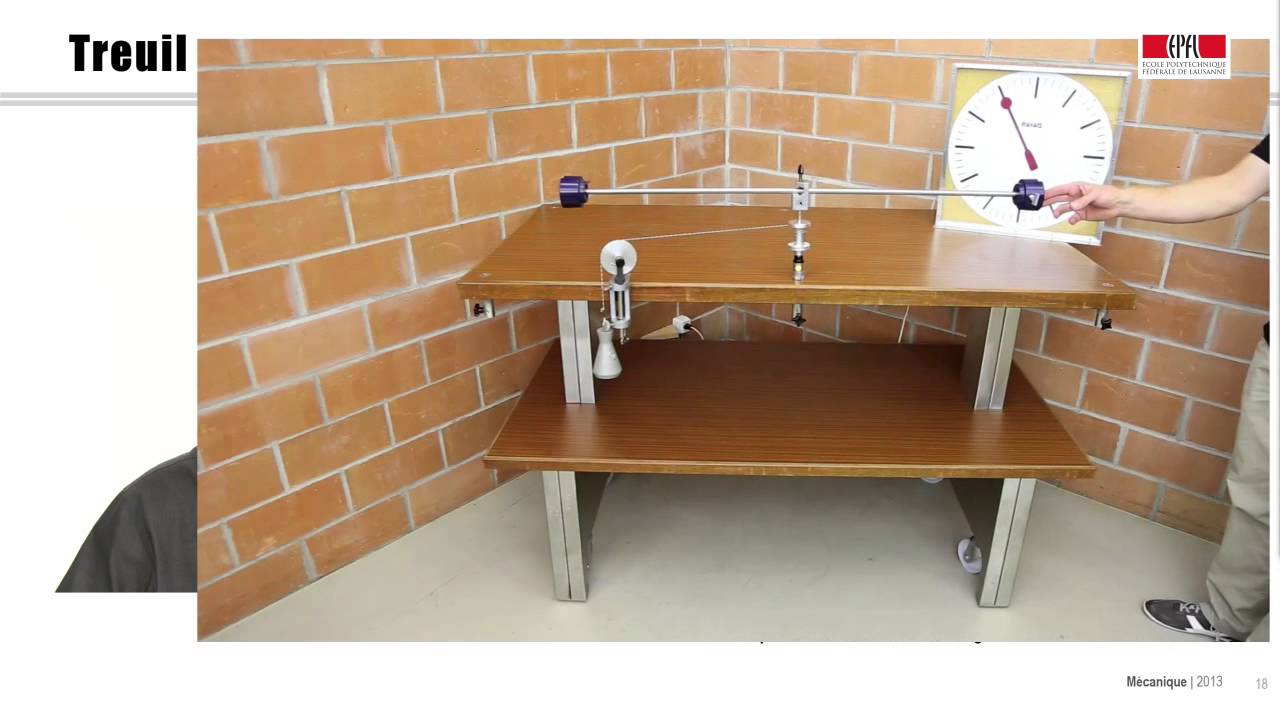
- Winch experiment: weight pulls a string on a cylinder, causing rotation; comparison of descent times for different mass positions.
- Analysis of the winch experiment using Newton's second law and angular momentum theorem, leading to the relation T2 = 2T1.
- Falling plank experiment: ball and plank released simultaneously; stroboscopic image shown.
- Analysis of the falling plank: calculation of moment of inertia using Steiner's theorem and derivation of the condition for separation.
- Conclusion: the plank's end accelerates faster than gravity, causing the ball to separate and follow a ballistic trajectory.
Cited Sources
- MOOC Mécanique EPFL on Coursera — The video is part of this MOOC, and the link is provided in the description for further learning.
Concurring Sources
- MOOC Mécanique EPFL on Coursera — The video is part of this MOOC, and the link is provided in the description for further learning.
Contribution & Novelties
The lecture provides a clear and rigorous explanation of the center of mass theorem for rigid bodies, emphasizing that the theorem applies to forces on the body, not on a point mass. It demonstrates through experiments that the moment of inertia plays a crucial role in the dynamics of rigid bodies, even when the center of mass is fixed. The falling plank experiment offers a novel insight into the separation of a point mass from a rotating body, with a mathematical condition derived from angular momentum and kinematics.
Pour aller plus loin :
- Steiner’s theorem (parallel axis theorem) — Relevant for understanding the calculation of moment of inertia about an axis not through the center of mass.
- Physical pendulum — Provides background on the equation of motion and period of a physical pendulum.
- Rigid body dynamics — General concepts of rotation and moment of inertia.
145 words
Radar Profile
The radar profile shows high scores in quantity, quality, and reliability, with a slightly lower technical level, indicating a well-balanced educational video that is both informative and accessible.