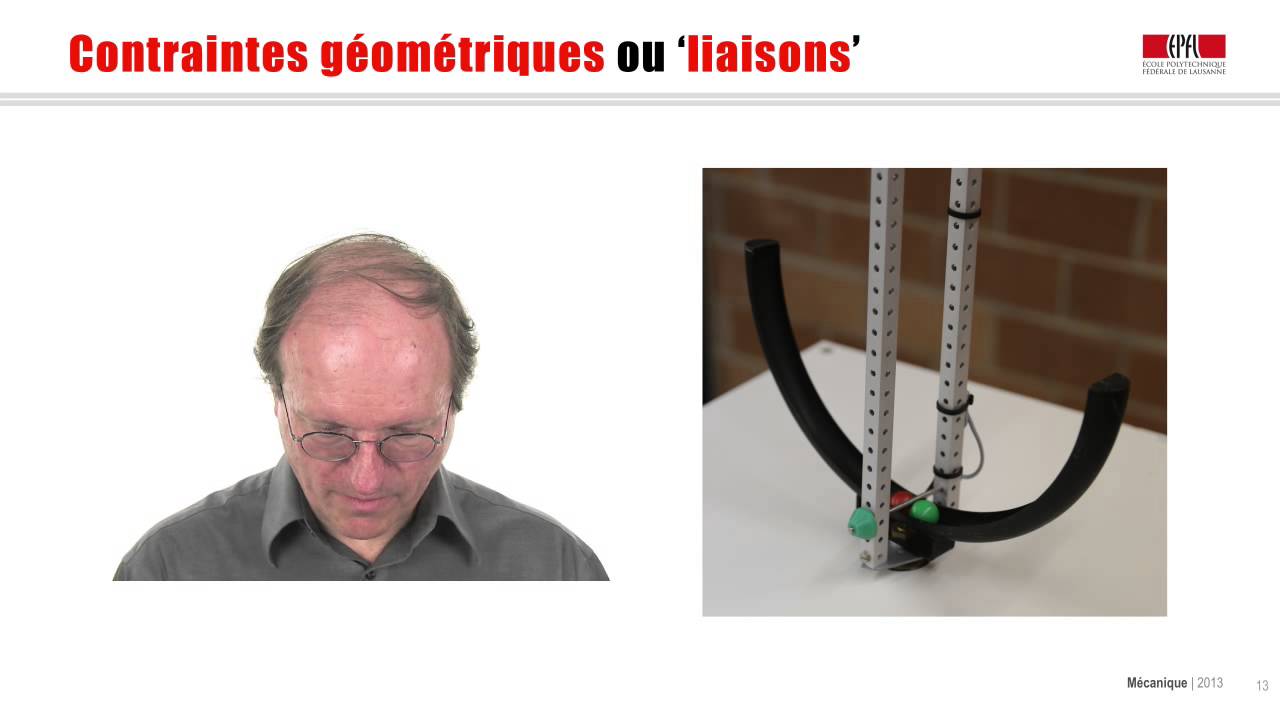
9.1 Contraintes géométriques
Keywords
Summary
168 words
Critical Evaluation
Value of the Information & Strength of the Argument
The video provides a clear and systematic introduction to the concept of geometric constraints in mechanics. The value lies in its pedagogical approach: it starts with intuitive physical examples and then shows how to translate them into mathematical models using coordinate systems. The argumentation is solid, as each step is justified by the symmetry of the problem and the need to simplify the description. The professor emphasizes the importance of choosing coordinates that reflect the constraints, and he carefully explains the transition from experimental reality to idealized models. The examples are well-chosen and progressively increase in complexity, helping the viewer understand the underlying principles. The discussion of forces of constraint is particularly valuable, as it clarifies a common point of confusion for students.
Scientific Rigor, Source Quality, Title Accuracy
The scientific rigor is high: the content is based on established principles of classical mechanics, and the mathematical derivations are correct. The quality of sources is limited, as the video does not cite external references, but it is part of a reputable MOOC from EPFL. The title accurately reflects the content, which is specifically about geometric constraints. The video is well-structured and the explanations are precise. No comments were provided for analysis.
210 words
Title / Content Match
The title accurately reflects the content, which focuses on geometric constraints in mechanics.
Quality & Reliability
8/10
The video is an educational tutorial by a professor at EPFL, presenting classical mechanics concepts with clear explanations and mathematical modeling. The content is accurate and well-structured, but it lacks citations to external sources and is based on established physics principles.
Key Moments
Markers derived by PSI from the transcript: the creator did not define chapters.
- Introduction to the lesson on geometric constraints.
- First example: ball rolling in a bowl, modeled as a point mass on a sphere.
- Second example: ball in a funnel, using cylindrical coordinates.
- Third example: ball on a looping track, constrained to a circle.
- Fourth example: rotating track with constant angular velocity, modeled with spherical coordinates.
- Discussion of the pendulum as a constraint to a circle or sphere.
- Introduction to forces of constraint using a pendulum with a dynamometer.
- Modeling the pendulum as a point mass on a circle and identifying the reaction force.
Cited Sources
- MOOC Mécanique EPFL — The full MOOC is available on Coursera.
Concurring Sources
- Classical Mechanics (Goldstein) — Standard textbook covering constraints and generalized coordinates.
Contribution & Novelties
The video provides a clear pedagogical introduction to geometric constraints in mechanics, emphasizing the importance of coordinate choice and the role of constraint forces. It bridges the gap between physical intuition and mathematical modeling.
Pour aller plus loin :
- Lagrangian mechanics — A more advanced framework that handles constraints systematically.
- Constraint forces — Further reading on the nature of constraint forces.
- Spherical coordinate system — Mathematical background for the coordinates used in the examples.
74 words
Radar Profile
The radar profile shows high scores in quality, technical level, and reliability, with a slightly lower score in quantity of information. This indicates a focused, well-explained tutorial that could benefit from more examples or depth.