15.2 Exemples de référentiels accélérés
Keywords
Summary
147 words
Critical Evaluation
Value of the Information & Strength of the Argument
The video provides valuable pedagogical content by demonstrating the application of theoretical concepts to concrete problems. The argumentation is solid: each step is carefully derived, and the equivalence of results in different frames is explicitly shown. The discussion of the constant of motion and the work done by the reaction force adds depth and encourages critical thinking. The examples are well-chosen to illustrate both translational and rotational accelerated frames.
Scientific Rigor, Source Quality, Title Accuracy
The scientific rigor is high: the derivations are correct and the physical reasoning is sound. The video is part of a structured MOOC, but it does not cite specific sources or references beyond the course itself. The title accurately describes the content. No comments were provided for analysis.
132 words
Title / Content Match
The title accurately reflects the content, which focuses on examples of accelerated reference frames.
Quality & Reliability
8/10
The video is an educational lecture from an EPFL MOOC, presented by a professor. The content is mathematically rigorous, with clear derivations and physical reasoning. The presentation is well-structured, but it lacks citations to external sources and does not address potential limitations or alternative interpretations.
Key Moments
Markers derived by PSI from the transcript: the creator did not define chapters.
- Introduction to the lesson on accelerated reference frames.
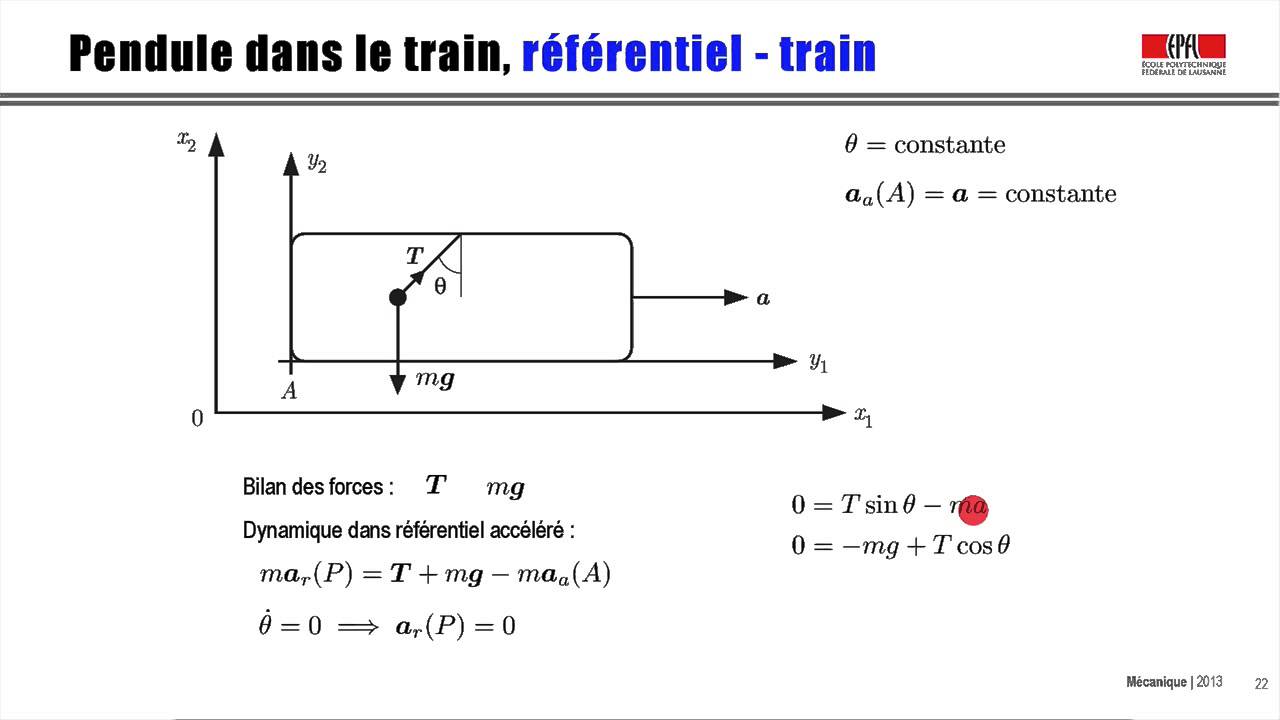
- First example: pendulum in an accelerating train, solved in the inertial frame.
- Derivation of tan(theta) = a/g in the inertial frame.
- Second solution of the pendulum problem using the accelerated frame of the train.
- Introduction of the centrifuge model with a rotating tube.
- Derivation of the equations of motion including centrifugal and Coriolis forces.
- Discussion of common mistake: omitting the reaction force component.
- Analysis of a constant of motion and why it is not the mechanical energy.
Cited Sources
- MOOC Mécanique - Coursera — The full MOOC is referenced in the video description.
Concurring Sources
- Fictitious force - Wikipedia — General concept of inertial forces, consistent with the video's treatment.
Contribution & Novelties
The video offers a clear and rigorous exposition of accelerated reference frames, with two classic examples that illustrate the use of inertial forces. The pedagogical value lies in the step-by-step derivations and the emphasis on common pitfalls. The analysis of the constant of motion provides an original insight into the role of non-conservative forces.
Pour aller plus loin :
- Fictitious force — Overview of inertial forces in non-inertial frames.
- Coriolis force — Detailed explanation of the Coriolis effect.
- Centrifugal force — Discussion of the centrifugal force in rotating frames.
89 words
Radar Profile
The radar profile shows high scores in quality, technical level, and reliability, with a slightly lower score in quantity of information, reflecting the focused scope of the lecture. The balance indicates a solid educational resource.