28.1 Résonance paramétrique
Keywords
Summary
203 words
Critical Evaluation
Value of the Information & Strength of the Argument
The lecture provides a solid mathematical foundation for understanding parametric resonance. It systematically derives the Hill equation, introduces the standard basis, and uses the Wronskian to prove linear independence. The argumentation is rigorous and well-structured, with each step clearly explained. The use of the monodromy matrix and its eigenvalues to analyze stability is elegant and insightful. The connection to Floquet theory and Bloch’s theorem adds depth and shows the broader applicability of the concepts. The lecture is valuable for students of mechanics and dynamical systems.
Scientific Rigor, Source Quality, Title Accuracy
The lecture is scientifically rigorous, with a clear derivation of the mathematical results. The source is an EPFL MOOC, which is a reputable academic institution. The title accurately reflects the content, focusing on parametric resonance. The lecture does not cite external sources, but it is based on well-established theory. The description provides a link to the full MOOC on Coursera, which is a reliable source.
165 words
Title / Content Match
The title accurately reflects the content, which focuses on parametric resonance.
Quality & Reliability
8/10
The lecture is mathematically rigorous, deriving the Hill equation and Floquet theory from first principles. The content is standard and well-established in classical mechanics. The presentation is clear and logical, with no apparent errors. The source is an EPFL MOOC, a reputable institution.
Key Moments
Markers derived by PSI from the transcript: the creator did not define chapters.
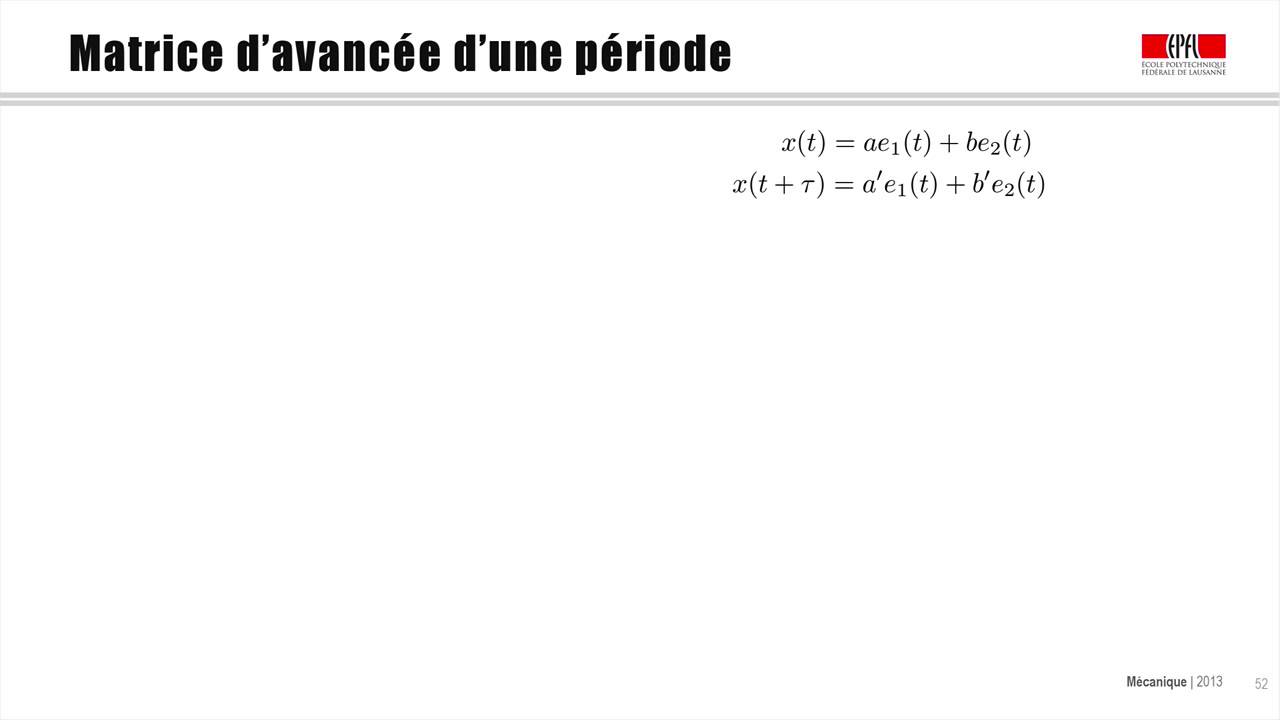
- Introduction to parametric resonance and the Hill equation.
- Definition of the standard basis and linear independence.
- Proof that the Wronskian is constant and the basis is independent.
- Time translation property of solutions.
- Definition of the monodromy matrix R and its determinant.
- Stability analysis using eigenvalues of R.
- Connection to Floquet theory and Bloch's theorem.
- Discussion of boundary cases and eigenfunctions of Mathieu equation.
Cited Sources
- MOOC Mécanique EPFL — Full course on Coursera, mentioned in the video description.
Concurring Sources
- Floquet theory — General theory for periodic differential equations, directly related to the lecture's content.
- Mathieu equation — The specific equation discussed in the lecture, with applications in physics and engineering.
Contribution & Novelties
The lecture provides a clear and rigorous introduction to parametric resonance, a topic often treated superficially. It emphasizes the mathematical framework of Hill’s equation and Floquet theory, which are fundamental to understanding stability in periodically driven systems. The connection to Bloch’s theorem is particularly insightful, linking classical mechanics to solid-state physics.
Pour aller plus loin :
- Floquet theory — Provides a general mathematical framework for differential equations with periodic coefficients.
- Mathieu function — Special functions that arise in the solution of the Mathieu equation, relevant to parametric resonance.
- Parametric oscillator — A physical system exhibiting parametric resonance, with applications in various fields.
102 words
Radar Profile
The radar profile shows high scores across all dimensions, indicating a well-balanced and reliable educational content. The lecture is mathematically rigorous, technically detailed, and provides a solid foundation for understanding parametric resonance.