14.3 Orbites dans champ électrique, champ magnétique, frottements secs
Keywords
Summary
190 words
Critical Evaluation
Value of the Information & Strength of the Argument
The video provides valuable educational content, demonstrating fundamental physics concepts through hands-on experiments. The argumentation is solid, as the instructor derives quantitative predictions from basic principles and then verifies them with measurements. The step-by-step calculations for the electron beam deflection and magnetic field estimation are clear and reinforce the theoretical framework. The experiments on friction are well-designed to illustrate the difference between static and kinetic coefficients, and the stick-slip phenomenon is effectively demonstrated. The inclusion of a quiz reference encourages active learning. Overall, the video successfully bridges theory and experiment, making it a valuable resource for students.
106 words
Title / Content Match
The title accurately reflects the content, which covers orbits in electric and magnetic fields and dry friction.
Quality & Reliability
8/10
The video is an educational demonstration by a university professor, presenting classic physics experiments with clear theoretical derivations. The content is accurate and well-structured, though it lacks explicit citations to external sources.
Key Moments
Markers derived by PSI from the transcript: the creator did not define chapters.
- Introduction to the lesson and overview of experiments.
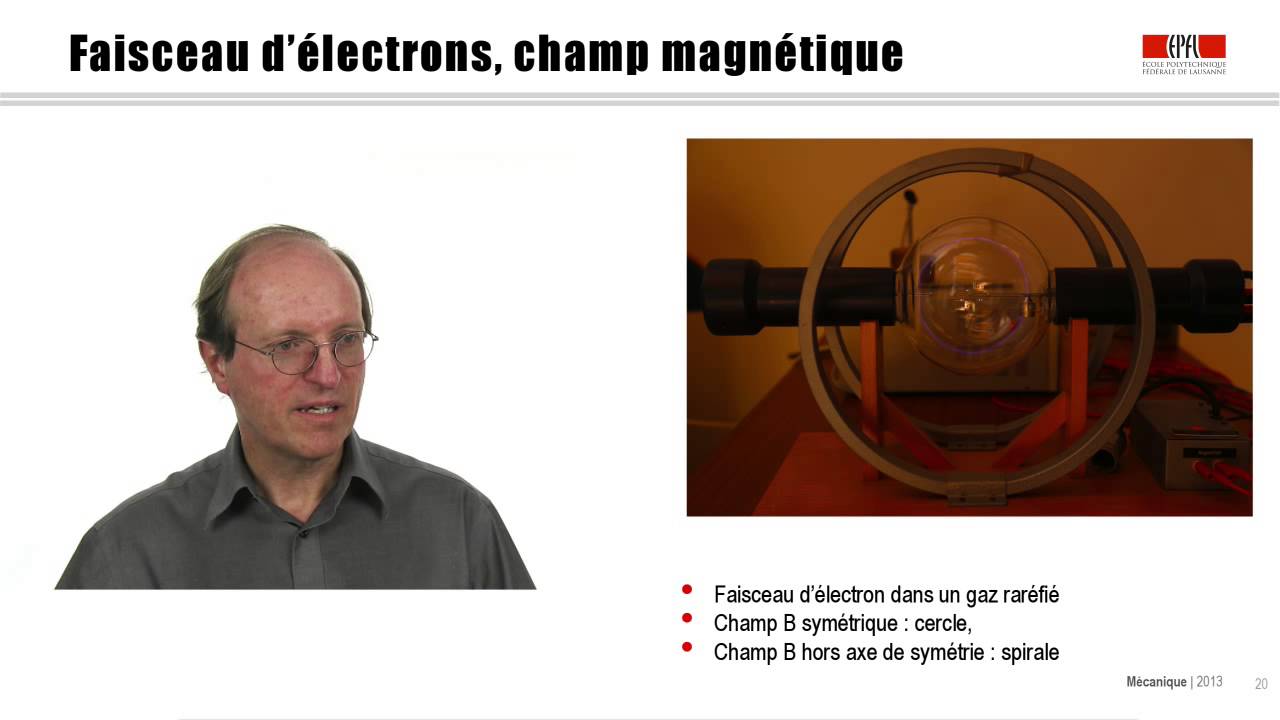
- Demonstration of electron beam deflection in an electric field.
- Quantitative analysis of the deflection, deriving the formula and estimating the deflection.
- Demonstration of electron beam deflection in a magnetic field.
- Calculation of the magnetic field strength and observation of spiral trajectory.
- Introduction to dry friction experiments with wooden blocks.
- Demonstration of stick-slip motion and the stick and fingers experiment.
- Experiment showing viscous friction with a falling cylinder in a tube.
Cited Sources
- Coursera MOOC: Mécanique — The video is part of this MOOC, and the description links to it for further learning.
Concurring Sources
- Coursera MOOC: Mécanique — The video is part of this MOOC, which provides a structured course on mechanics.
Contribution & Novelties
The video provides a clear and engaging demonstration of fundamental physics concepts, with a strong emphasis on connecting theory to experiment. It offers a practical approach to understanding electric and magnetic field effects on charged particles and friction phenomena. The quantitative analyses are instructive and encourage students to estimate parameters from observations.
Pour aller plus loin :
- Lorentz force — The force on a charged particle in electric and magnetic fields, central to the experiments.
- Coulomb friction — The model of dry friction used in the experiments, including static and kinetic coefficients.
- Stick-slip phenomenon — The jerky motion observed due to the difference between static and kinetic friction.
- Cathode ray tube — The device used to produce and observe electron beams.
- Viscosity — The property of fluids that causes viscous friction, demonstrated in the final experiment.
136 words
Radar Profile
The radar profile shows high scores in quality of information, technical level, and reliability, with a slightly lower score in quantity of information due to the limited number of topics covered. The video is well-balanced, providing both theoretical and experimental insights.